 Call833-268-8277

Medical malpractice may occur when a doctor, hospital, or other healthcare provider departs from accepted standards of medical care and that departure causes injury to a patient.
A poor outcome, unsuccessful treatment, or known complication does not, by itself, establish medical malpractice.
Evaluating a potential New York medical malpractice claim generally requires examining the medical care that was provided, determining the applicable standard of care, identifying whether a departure from that standard occurred, and assessing whether the departure caused an injury or made an existing condition worse. Medical records and qualified medical experts can play important roles in that evaluation.
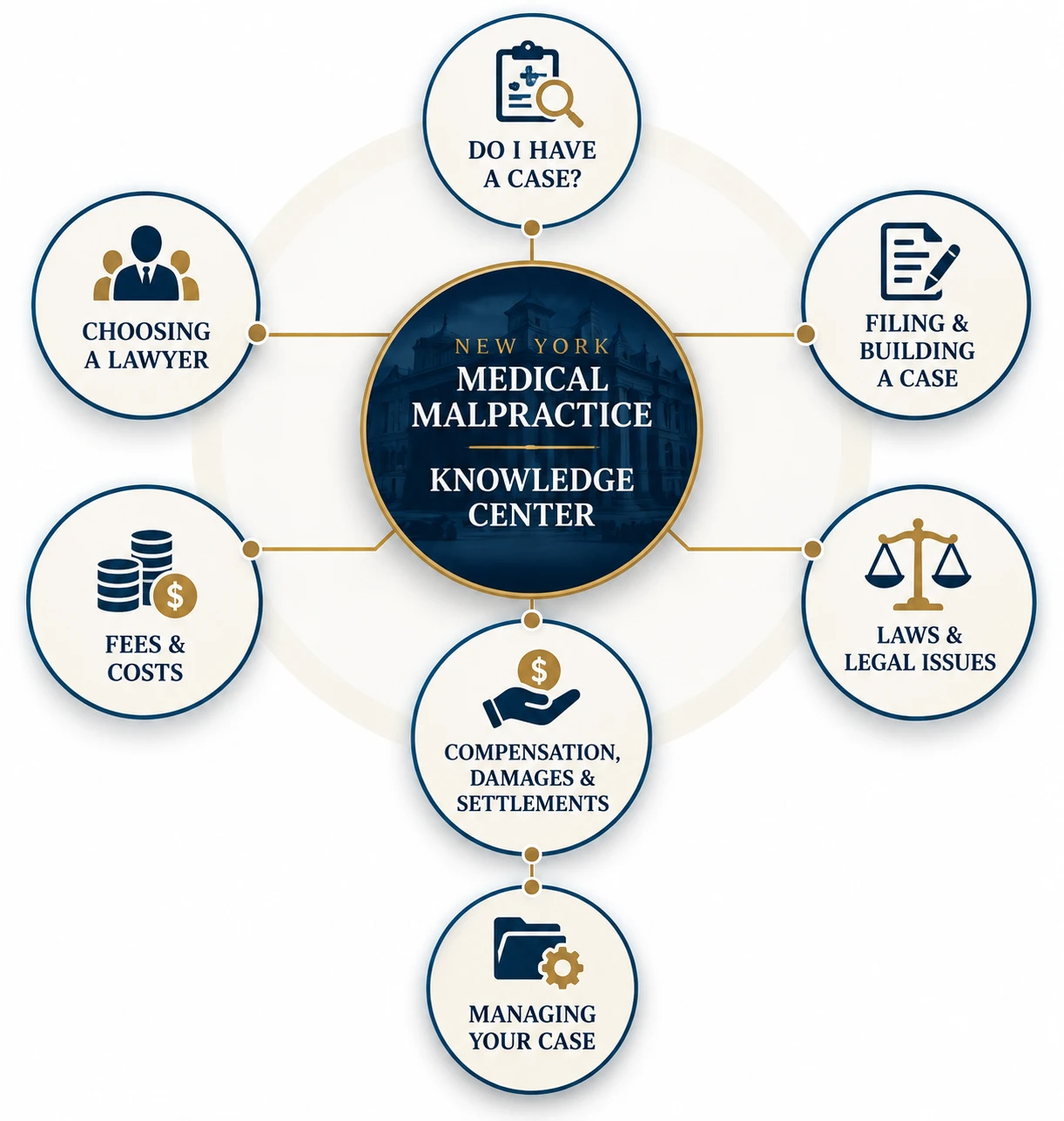
The Bottar Law New York Medical Malpractice Knowledge Center organizes these and related issues into seven core topics, allowing you to begin with the question you have now and explore connected subjects in greater depth.
Medicine involves uncertainty. Some medical conditions progress despite appropriate care. Treatments and procedures can have recognized risks. Complications can occur even when healthcare professionals act appropriately.
For that reason, the fact that a patient experienced a serious complication, or that a treatment did not produce the hoped-for result, does not automatically mean medical malpractice occurred.
The legal inquiry generally focuses on how the patient was treated, not simply on the outcome.
That requires examining the circumstances surrounding the care and determining whether the healthcare provider’s actions departed from the applicable standard of care.
The standard of care is central to the evaluation of a potential medical malpractice claim.
The question is not simply whether another doctor might have made a different decision. Instead, the circumstances must be evaluated to determine what care was medically appropriate and whether the defendant healthcare provider departed from the applicable standard.
The relevant standard can depend on factors such as the patient’s condition, the type of healthcare provider involved, the information available at the time, and the medical circumstances in which the care was provided.
Qualified medical experts can be important in determining what the applicable standard required and whether the care provided departed from it.
A departure from accepted medical care is only part of the analysis. There must also be a connection between that departure and the patient’s injury.
This issue, causation, can become one of the most important questions in a medical malpractice case.
For example, a patient may already have been seriously ill before the alleged negligence occurred. The question may therefore become whether the healthcare provider’s conduct caused a new injury, worsened the patient’s existing condition, reduced the patient’s opportunity for a better outcome, or otherwise caused compensable harm.
The facts and medical evidence must be evaluated together.
Medical malpractice cases often depend on reconstructing what happened during a patient’s care. That can involve examining:
Medical records can help establish what providers knew, what tests were ordered, what diagnoses were considered, what treatment was provided, and how the patient’s condition changed.
Expert medical review can then help evaluate those facts within the appropriate medical context.
That is one reason a medical malpractice claim cannot reliably be evaluated based solely on the outcome.
What care was medically appropriate under the circumstances? The first question is what the applicable standard of medical care required.
Did a healthcare provider depart from that standard? The treatment that was actually provided must be compared with the applicable standard of care.
Did that departure cause an injury? A departure alone is not enough. The medical evidence must support a connection between the alleged negligence and the harm being claimed.
What harm and losses resulted? The nature and extent of the patient’s injuries and resulting losses must also be evaluated.
STANDARD OF CARE → DEPARTURE → CAUSATION → DAMAGES

Bottar Law is a New York law firm representing individuals and families in medical malpractice and serious personal injury matters.
Our attorneys investigate claims involving complex questions of medical care, causation, liability, and damages and work with qualified professionals when expert review is appropriate.
The firm’s headquarters are located at the Historic Fairfield Estate in Syracuse, New York.
The Knowledge Center is the educational side of that work: a resource designed to help people understand medical malpractice and the legal questions that can follow a serious medical injury.
If you are looking for information about Bottar Law’s representation of individuals and families in medical malpractice cases, visit our practice-area page.
Educational resources can help you understand the issues involved. But determining whether a viable medical malpractice claim exists generally requires reviewing the specific facts, medical records, and other available evidence.
If you believe that medical negligence may have caused a serious injury to you or someone in your family, Bottar Law can listen to what happened and help you understand whether further investigation may be appropriate.
You do not need to determine for yourself whether malpractice occurred before contacting an attorney.
Tell us what happened.