 Call833-268-8277

Understand the first steps to take, what evidence to preserve, and why acting quickly protects your rights.
Attorney reviewed · New York focused · Updated resource
You don’t need to prove malpractice before consulting an attorney — that’s what the investigation is for.
If you suspect medical malpractice, the most important immediate step is to consult with an attorney to find out whether enough time remains to investigate and pursue a claim. New York medical malpractice claims may be subject to important filing deadlines and notice requirements, some of which can arise as early as 90 days in cases involving certain public entities or other special circumstances.
The clock typically starts when the negligence occurred, though exceptions exist for continuous treatment, retained objects, and cancer cases. Acting quickly protects your legal rights, preserves the evidence your case depends on, and removes the uncertainty of trying to figure out what to do next on your own.
Few moments feel more disorienting than the realization that a healthcare provider may have caused harm. You may not know what counts as malpractice, what evidence matters, or whether anyone will take your case seriously. Acting quickly does not require having all the answers. It requires the right next step.
After discovering medical malpractice, an injured patient should consult immediately with an attorney to determine if there is enough time for the attorney to investigate and pursue a medical malpractice lawsuit. How much time is allowed to pass between malpractice and when a lawsuit must be filed is called the statute of limitations. New York has many different statutes of limitations that apply to medical negligence claims, some of which are very short. Typically, the time is calculated from whenever the negligence occurred, but there are exceptions to this rule for continuous treatment, retained objects, and cancer cases.
Many patients are unsure whether what happened was truly medical malpractice. You do not need to answer that question before speaking with an attorney. One purpose of the investigation is to determine whether the care departed from the accepted standard of medical care and whether that departure caused injury.
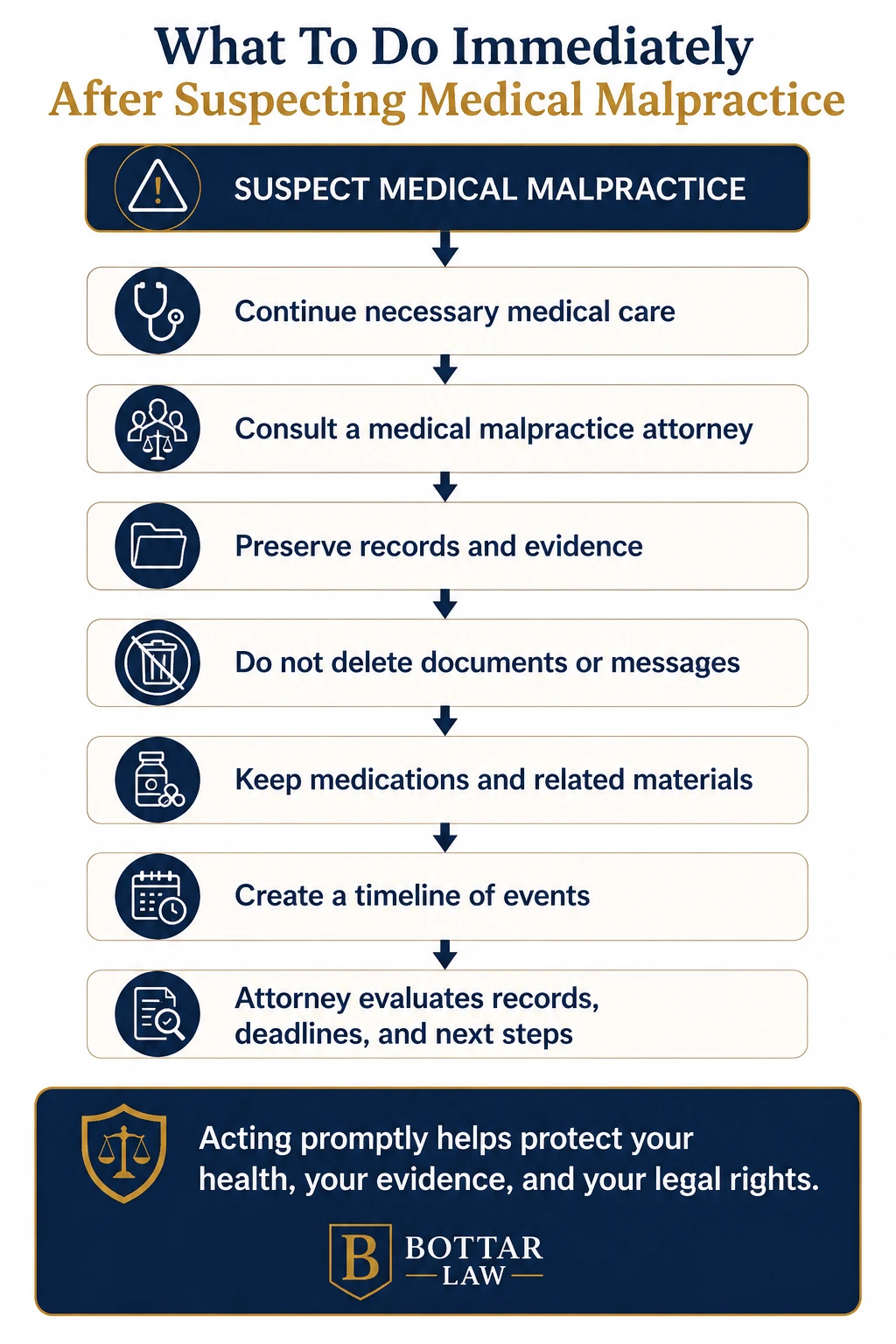
Acting promptly helps protect your health, your evidence, and your legal rights.
After discovering medical malpractice, a patient should collect all of the medical records in their possession for an attorney to review. The patient should also take steps to preserve other evidence that might be relevant to the case, including email or text messages with witnesses and the provider.
If the case involves a prescription medication error, keep the original medication container, pharmacy label, packaging, dosing instructions, package inserts, and, when practical, any remaining medication. To stay organized, some patients may also benefit from creating a chronology or narrative about the events at issue to discuss with a malpractice attorney.
Of course, any patient injured by malpractice should do whatever they can to obtain proper medical care to prevent further harm.
An injured patient who retains a medical malpractice lawyer to examine the facts does not need to collect any medical records, as the attorney will use medical record authorizations signed by the patient to collect his or her medical records for analysis.
As part of that analysis, the attorney may also want to review any other available evidence in the client’s possession, including notes made during an appointment, email, text messages, voicemail messages, photographs and video, and social media. An attorney should be consulted before anything that might relate to the case is intentionally deleted, as deletion could have a negative impact on a case.
Medical records in your possession
Gives the attorney material to begin reviewing the facts
Email and text messages with the provider
Preserves contemporaneous communication that may be central to the claim
Voicemail messages from providers or staff
Captures statements that may not appear in the medical record
Photographs and video
Documents injuries, conditions, or visible outcomes
Social media posts
May be reviewed by both sides during litigation
Prescription medication, original pill bottles, pharmacy labels, packaging, dosing instructions, package inserts, and any remaining medication (when practical)
May help identify the medication dispensed, dosage, prescribing information, pharmacy details, and other information that could become relevant during the investigation, particularly in medication error cases.
Notes made during appointments
Supports the timeline of events and what was said
A personal chronology or narrative of events
Helps organize the discussion with a malpractice attorney
Because it is important for a patient to trust his or her healthcare provider, it may be prudent, though not essential, for a patient to seek out a different provider if the patient believes that medical malpractice has occurred. Consulting with a new provider or seeking a second opinion may provide the patient with information needed to determine whether the healthcare provider departed from the accepted standard of medical care.
Consulting another qualified healthcare provider may help ensure appropriate ongoing treatment and may provide additional information about the patient’s medical condition. Whether malpractice occurred is ultimately a legal and medical question that generally requires review of the medical records and, when appropriate, qualified expert evaluation.
Most medical malpractice cases are proven by information contained within or missing from the medical record. While a patient’s precise memory of symptoms, conversations, or changes in condition may help prove the case, documentation outside of the medical record is not essential.
If a patient decides to document symptoms, conversations, or changes in condition, they should do so accurately. Inaccurate notes may introduce an element of uncertainty or inconsistency into the case that did not otherwise exist.
Avoid reconstructing conversations from memory weeks or months later. Notes made close in time to the events are generally more reliable than recollections created long afterward.
One of the most painful realities in medical malpractice law is that valid claims are sometimes lost not because the injury was not real, but because the deadline passed before anyone took action.
Some New York medical-negligence deadlines can be much shorter than the general statute of limitations, depending on the governing law and the facts of the case. While most deadlines are longer than 90 days, nothing bad happens if an injured patient contacts a lawyer early. In addition to preserving deadlines, early action helps ensure that evidence is not discarded by accident or design.
Many people delay calling a lawyer because they assume the cost will be out of reach. The truth about how medical malpractice cases are funded changes that calculation entirely. The biggest mistakes that people make after learning of malpractice are:
Many people mistakenly believe that they need to pay hourly to retain a medical malpractice lawyer, and this is not correct.
Experienced medical malpractice lawyers are retained on a contingency basis, which means they only earn a legal fee if the defendant pays the patient. Well-established malpractice law firms also do not ask their clients to pay litigation expenses out-of-pocket or through a loan.
It is generally wise to be cautious about discussing a potential legal claim publicly. Statements, photographs, comments, or updates posted online may later become relevant during litigation. Before posting about the incident, discuss any concerns with your attorney.
One reason to consult with a medical malpractice attorney is to reduce stress so the injured patient can focus on his or her health and recovery. Once an attorney is retained, the legal team can take steps to protect legal rights and also serve as a resource for peace of mind.
Use this checklist to organize your next moves while the facts are still fresh:
If you believe a healthcare provider caused harm to you or someone you love, the most important next step is to speak with a medical malpractice attorney without delay. Here is why time matters and what the process looks like:
You do not have to figure out the deadlines, the records, or the legal process on your own.
Not necessarily. If you retain a medical malpractice attorney, the firm can generally obtain the relevant records using properly executed authorizations. However, if you already possess records or discharge paperwork, keep them available because they may help begin the evaluation.
An attorney investigates whether sufficient evidence supports a claim.
Early legal review may protect important deadlines and preserve evidence.
Attorneys routinely obtain records with signed authorizations.
A second opinion may assist medical care, but legal evaluation usually requires additional investigation.
Social-media activity may become relevant, but it does not automatically determine the outcome of a claim.
Many medical-malpractice firms evaluate and pursue cases on a contingency-fee basis.
Acting promptly helps protect your health, your evidence, and your legal rights.

Michael Bottar is a nationally recognized New York medical malpractice and personal injury attorney and the founder of Bottar Law. Throughout his career, he has dedicated his practice to representing individuals and families affected by medical negligence, catastrophic injuries, wrongful death, and other serious acts of negligence. Michael is committed to helping clients understand their legal rights, navigate the complexities of the legal system, and pursue accountability with compassion, integrity, and unwavering advocacy.
For more than 40 years, Bottar Law has represented individuals and families throughout Syracuse, Central New York, and across New York in complex medical malpractice litigation involving catastrophic injuries and wrongful death. Through educational resources like these FAQs, Michael Bottar and the Bottar Law team strive to provide clear, reliable information to help injured individuals and their families make informed decisions during difficult times. Prior results do not guarantee a similar outcome.
Speak with Bottar Law now to find out how much time you have.