 Call833-268-8277

Understand how New York law distinguishes these terms, and what actually turns a bad outcome into a viable claim.
Attorney reviewed · New York focused · Updated resource
A viable claim requires departure from accepted care, causation, and injury, not just an unfavorable result.
Medical malpractice is a form of negligence involving medical treatment or professional judgment. People often use “medical negligence” and “medical malpractice” interchangeably, but New York law also distinguishes malpractice from ordinary negligence. A claim generally sounds in medical malpractice when deciding whether the provider acted properly requires specialized medical knowledge. It may sound in ordinary negligence when the conduct can be evaluated using common experience without medical expertise. To recover in a malpractice action, a patient ordinarily must establish that the provider departed from the accepted standard of medical care and that the departure caused or was a substantial factor in causing injury. The correct classification depends on the specific conduct alleged, not merely the label used.
The terms “medical negligence” and “medical malpractice” are often used informally to describe negligent medical care. Legally, medical malpractice is a type of negligence arising from medical treatment or professional judgment. However, New York courts also distinguish medical malpractice from ordinary negligence when deciding which legal and procedural rules apply.
The central question is not which label the patient initially uses. It is whether the alleged conduct involved medical science or professional judgment that requires expert evaluation, or whether it can be assessed using ordinary experience. The patient must also establish that the conduct caused a legally compensable injury.
Medical malpractice is a species of negligence involving medical treatment, diagnosis, or professional judgment. The terms "medical negligence" and "medical malpractice" are often used interchangeably in ordinary conversation, but New York law distinguishes malpractice from ordinary negligence.
A claim generally sounds in medical malpractice when evaluating the conduct requires specialized medical knowledge or an assessment of professional medical judgment. A claim may sound in ordinary negligence when the issue can be decided using common experience without expert medical analysis. For example, an allegation concerning diagnosis, surgery, medication selection, or clinical monitoring will commonly involve malpractice principles, while a nonmedical premises or administrative hazard may involve ordinary negligence. The classification depends on the substance of the allegations rather than the title placed on the claim.
Potentially. A compensatory medical malpractice claim generally requires more than a departure from accepted medical practice. The patient must also establish that the departure caused or was a substantial factor in causing an injury. If the same outcome would have occurred even without the alleged departure, or if no compensable harm resulted, the evidence may not support a damages claim.
That does not mean the care was necessarily appropriate. It means that departure and causation are separate elements, and both ordinarily must be supported. The significance of an error should be evaluated through the records, medical timeline, and qualified expert analysis.
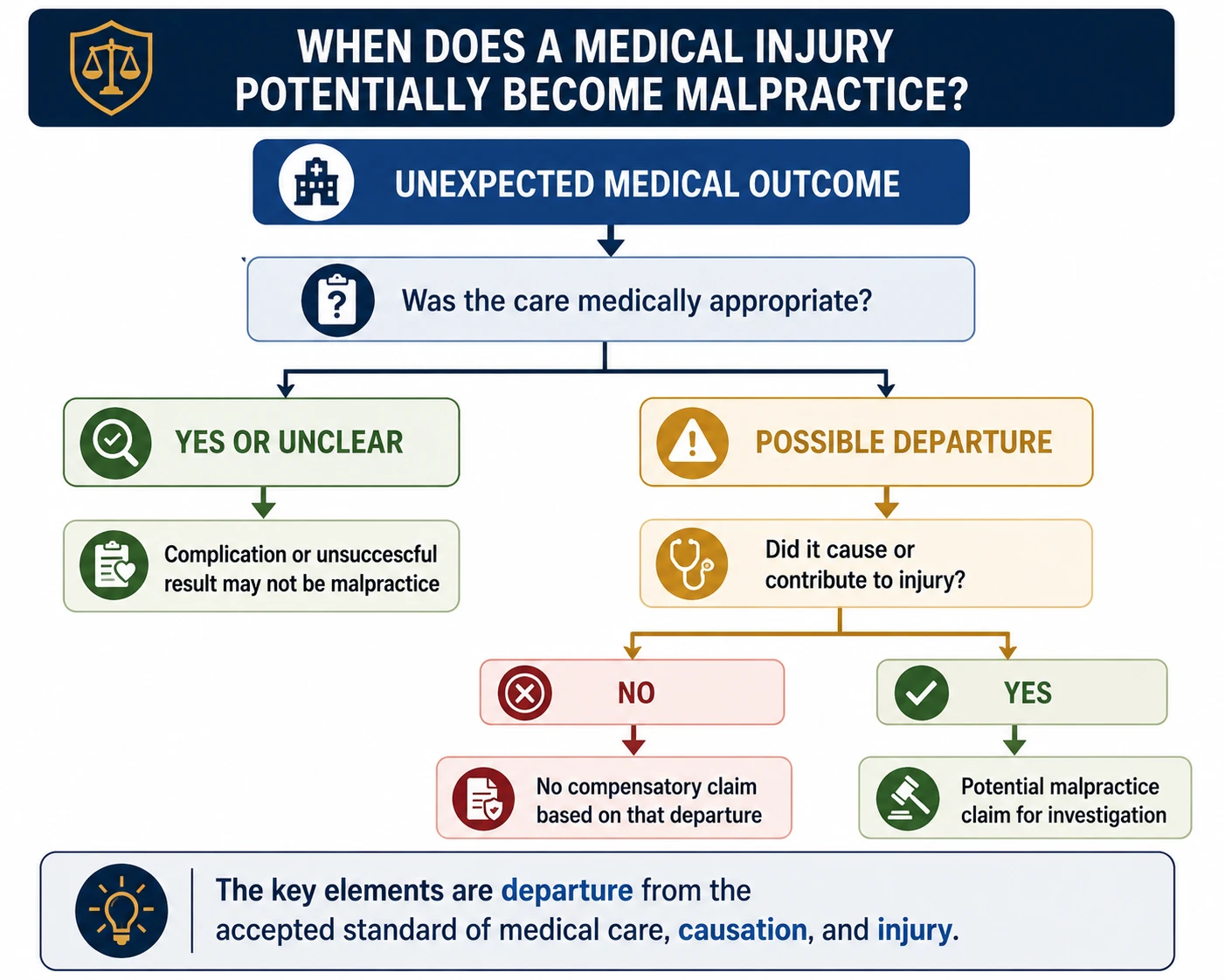
The key elements are departure from the accepted standard of medical care, causation, and injury.
The biggest fear for someone trying to make sense of these terms is assuming any mistake automatically means a case. Here is what actually separates the two.
Use this table to think through whether what happened may rise to the level of malpractice:
Medical negligence
Often used informally to describe negligent medical care
Did the provider depart from the accepted standard of medical care?
Medical malpractice
A negligence claim involving medical treatment or professional judgment
Did the provider depart from the accepted standard of medical care and cause injury?
Ordinary negligence in a healthcare setting
Conduct that does not require specialized medical knowledge to evaluate
Can the issue be decided using common experience?
Bad outcome or complication
An unfavorable result that may occur even when care was appropriate
Does the outcome itself prove a departure? Usually not
Departure without causation
Care may have fallen below the standard, but the departure did not cause the claimed injury
Would the harm have occurred anyway?
Departure plus causation and injury
The core basis of a potentially actionable malpractice claim
Did the departure cause or substantially contribute to compensable harm?
The legal classification depends on the nature of the conduct and the evidence, not merely the word used to describe it.
An unfavorable result, complication, or error in judgment does not automatically establish medical malpractice. The relevant question is whether the healthcare provider departed from the accepted standard of medical care under the circumstances.
That evaluation ordinarily compares the provider’s conduct with what a reasonably qualified provider would have done in a similar situation. A reasonable medical judgment may produce an unsuccessful outcome without constituting malpractice. Conversely, conduct may support a malpractice claim when it falls below the accepted standard and causes injury.
Qualified medical experts help attorneys interpret the records, identify the applicable standard of care, evaluate whether the provider departed from that standard, and analyze whether any departure caused the patient’s injury. They may also explain whether the result was a recognized complication or could have occurred despite appropriate care.
Before commencing most New York medical malpractice actions, the plaintiff’s attorney generally reviews the facts and consults an appropriately qualified physician who is knowledgeable about the relevant medical issues. If that physician concludes there is a reasonable basis for the action, the attorney ordinarily executes the certificate required by CPLR 3012-a, subject to the statute’s limited alternatives and exceptions. The physician provides the medical opinion; the attorney remains responsible for the legal evaluation and the decision whether to commence the action.
Expert review should be objective. The expert may support the potential claim, identify missing information, or conclude that the available evidence does not establish a departure or causation.
Yes. Not every negligent act occurring in a hospital or medical office is medical malpractice. A claim may involve ordinary negligence when the alleged conduct does not depend on medical treatment or professional judgment and can be evaluated using common experience.
For example, certain premises, maintenance, or nonmedical administrative failures may be analyzed as ordinary negligence. By contrast, decisions involving diagnosis, treatment, patient monitoring, medication, surgery, or clinical judgment generally require medical expertise and are more likely to sound in malpractice. The particular facts and duty involved determine the classification.
No. A complication, unsuccessful treatment, or worsening condition does not by itself establish malpractice. Medicine involves uncertainty, and an adverse result may occur even when the healthcare provider follows the accepted standard of medical care.
The investigation should determine what the provider knew or should have known, what options were reasonably available, whether the care departed from the accepted standard of medical care, and whether any departure caused the injury.
A departure from the accepted standard of medical care does not establish liability unless it caused or was a substantial factor in causing the patient’s injury. The defense may argue that the outcome resulted from the underlying illness, a preexisting condition, an unavoidable complication, or another provider’s conduct.
Qualified experts evaluate whether the alleged departure changed the patient’s outcome and whether the claimed injury would probably have occurred even with appropriate care.
You do not need to choose the correct legal term before speaking with an attorney. Preserve the available records and information, document the treatment timeline, and explain what happened in ordinary language.
A malpractice attorney can determine whether the allegations involve professional medical judgment or ordinary negligence, identify applicable deadlines, obtain additional records, and consult qualified experts when appropriate. The evaluation should focus on the nature of the conduct, whether there was a departure from the accepted standard of medical care, whether the departure caused injury, and what damages resulted.
The substance of the facts matters more than the label initially used.
Medical malpractice is a form of negligence involving medical treatment or professional judgment, while ordinary negligence may be evaluated without specialized medical knowledge.
The evidence must ordinarily establish a departure from the accepted standard of medical care and causally related injury.
Complications and unsuccessful outcomes may occur despite appropriate care.
The patient must also establish causation and compensable injury.
Counsel evaluates the facts and determines the appropriate legal theory.
Medical consultation informs the evaluation, while counsel remains responsible for the legal and procedural decision.
The key elements are departure from the accepted standard of medical care, causation, and injury.

Michael Bottar is a nationally recognized New York medical malpractice and personal injury attorney and the founder of Bottar Law. Throughout his career, he has dedicated his practice to representing individuals and families affected by medical negligence, catastrophic injuries, wrongful death, and other serious acts of negligence. Michael is committed to helping clients understand their legal rights, navigate the complexities of the legal system, and pursue accountability with compassion, integrity, and unwavering advocacy.
For more than 40 years, Bottar Law has represented individuals and families throughout Syracuse, Central New York, and across New York in complex medical malpractice litigation involving catastrophic injuries and wrongful death. Through educational resources like these FAQs, Michael Bottar and the Bottar Law team strive to provide clear, reliable information to help injured individuals and their families make informed decisions during difficult times. Prior results do not guarantee a similar outcome.
Speak with Bottar Law about whether the facts support a claim.