 Call833-268-8277

When medical malpractice causes an injury, compensation may depend on the nature and severity of the harm, medical expenses, lost income, future care needs, pain and suffering, permanency, available evidence, and other case-specific factors.
The value of a claim is not determined by the medical error alone. It depends on both the strength of the underlying case and the damages that can be proven.
This section of the New York Medical Malpractice Knowledge Center explains how damages are evaluated, what may affect the potential value of a case, how settlements work, and what can happen when a case proceeds to trial.
A person injured by medical malpractice in New York may potentially seek compensation for economic and non-economic losses caused by the malpractice.
Depending on the facts, damages may include past and future medical expenses, lost income, diminished earning capacity, pain and suffering, permanent disability or impairment, and other legally recoverable losses.
The amount that may ultimately be recovered depends on the nature of the injury, causation, supporting evidence, future needs, liability issues, and whether the case resolves through settlement or trial.
Understanding compensation begins with an important distinction.
Liability, damages, case value, and settlement are related, but they do not mean the same thing.
A useful way to understand the analysis is through five stages.
Can malpractice be established?
Before damages can result in a recovery, there must be a legally supportable claim.
The evidence must address whether a healthcare provider departed from the applicable standard of care.
What harm did the malpractice actually cause?
A medical error alone does not establish the damages attributable to malpractice.
The analysis must connect the alleged departure from accepted care to an injury or worsening condition.
This can be particularly important when a patient already had a serious illness or injury before the alleged malpractice occurred.
What losses resulted from that harm?
Those losses may include medical expenses, income loss, future care needs, physical pain, disability, and other legally compensable harm.
What does the evidence support?
Case valuation considers the damages together with liability, causation, available evidence, future losses, litigation risks, and other circumstances.
There is no universal formula.
Settlement or trial?
The parties may negotiate a settlement. If they do not reach an agreement, the case may continue toward trial, where disputed issues can ultimately be decided through the litigation process.
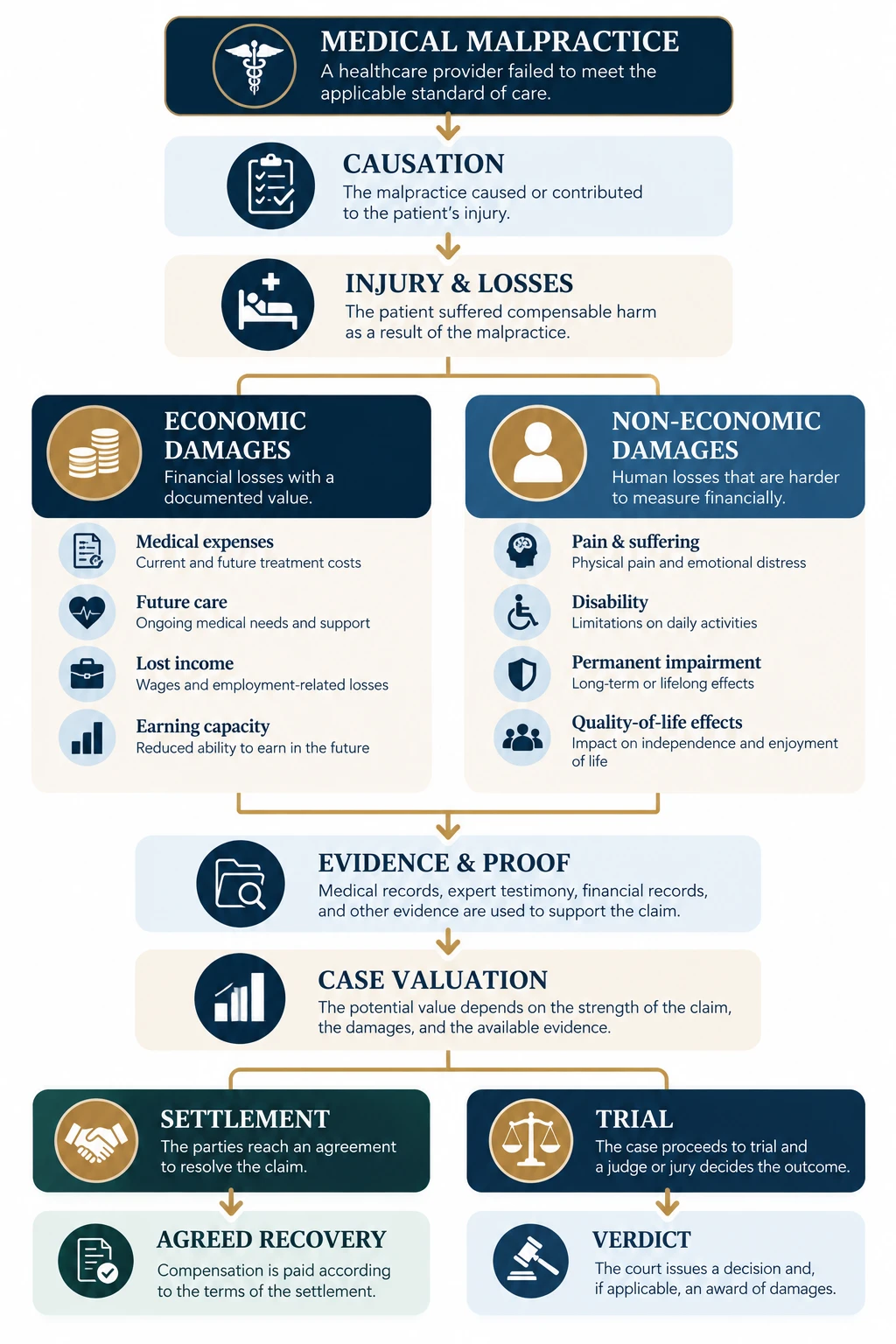
The potential value of a medical malpractice case depends on both the strength of the claim and the damages supported by the evidence.
Damages are intended to address legally compensable harm resulting from the malpractice. They can generally be understood through two broad categories.
Economic damages involve losses with a financial component. Depending on the facts, these may include:
Future economic damages may require analysis of medical needs and financial consequences that could continue for years.
Not every consequence of a serious medical injury appears on a bill. Non-economic damages concern the human effects of an injury and, depending on the circumstances, may include:
The existence and extent of these damages must still be supported by the evidence and connected to the malpractice-related injury.
One of the most understandable questions after a serious medical injury is: How much is the case worth?
There is no reliable answer based solely on the type of medical error.
Two cases involving similar medical mistakes can involve very different injuries, future needs, evidence, causation questions, and litigation risks.
Strength of liability evidence
Affects the ability to establish that malpractice occurred
Causation
Helps determine which injuries and losses resulted from the malpractice
Severity of injury
Can affect the nature and extent of damages
Permanency
May create losses extending far into the future
Future medical needs
May significantly affect economic damages
Lost earning capacity
May create substantial future financial losses
Pain and suffering
Addresses non-economic consequences of the injury
Quality of evidence
Affects how effectively liability and damages can be supported
Litigation risk
Can affect how a case is evaluated during settlement discussions
There is no reliable formula for determining the value of a medical malpractice case from the type of medical error alone.
Online settlement averages and calculators generally cannot account for the medical evidence, causation, future losses, disputed liability, or other facts that can materially affect an individual claim.
A permanent injury can change the damages analysis because its consequences may continue long after the initial medical event. The focus may shift from what the patient has already experienced to what the injury is expected to mean in the future.
A permanent injury may require ongoing physician care, additional surgery, medication, rehabilitation, therapy, medical equipment, or monitoring.
Some injuries can affect a person’s ability to live independently. Future needs might involve caregiving, home modifications, transportation, assistive equipment, or other forms of support.
An injury may prevent someone from returning to the same occupation, reduce the number of hours the person can work, or prevent future employment altogether. The analysis may therefore include lost earnings and diminished earning capacity.
Mobility, strength, cognition, communication, independence, and the ability to perform ordinary daily activities may all be relevant depending on the injury.
Permanent injuries can affect hobbies, relationships, independence, and other aspects of a person’s life that are not reflected in medical bills or wage statements.
How long an injury and its consequences are expected to continue may affect the evaluation of future damages.
The analysis is specific to the patient’s medical condition, prognosis, age, expected future needs, and available evidence.
Serious medical injuries can have consequences beyond additional medical expenses and lost income. Depending on the circumstances, emotional and psychological effects may form part of the damages analysis when they are legally recoverable and connected to the malpractice-related injury. For example:
The analysis remains case-specific.
Experiencing understandable fear, anger, or distress after a difficult medical event does not automatically establish a separate compensable claim. The nature of the underlying injury, the connection between the malpractice and the claimed harm, and the available evidence all matter.
Punitive damages should not be confused with the compensatory damages ordinarily sought for malpractice-related injuries. They serve different legal purposes.
Address legally recoverable losses resulting from injury
Serve a different legal purpose
Central to an ordinary damages analysis
Exceptional rather than routine
May include economic and non-economic losses
Require a substantially different legal showing
Focus on compensating for proven harm
Concern particularly serious misconduct under applicable law
Punitive damages should not be treated as a standard component of a medical malpractice claim.
Whether punitive damages can even be pursued depends on the particular facts and applicable New York law.
A settlement is an agreement to resolve a claim without obtaining a final trial verdict. Settlement discussions may occur at different stages of litigation rather than at one fixed point. A case might generally progress through:
A settlement offer is more than a number.
Evaluating an offer may involve considering the strength of the liability and causation evidence, documented damages, future needs, disputed issues, litigation risks, and what may happen if an agreement is not reached.
A settlement also involves terms that should be understood before an agreement is finalized.
There is no general rule that settlement is always preferable to trial, or that taking a case to trial is always preferable to settlement. The decision depends on the individual case.
Factors that may be considered include:
A settlement provides an agreed resolution.
Factors that may be considered include:
A trial asks the factfinder to decide disputed issues, which introduces uncertainty for everyone involved.
Whether to settle or proceed to trial should be evaluated using the evidence, settlement terms, litigation risks, and the client’s objectives, not a general assumption that one path is always better.
Damages are not simply alleged. They must be supported by evidence and connected to the injury caused by the malpractice. Different evidence may help establish different aspects of the loss.
Medical records
Document injuries, treatment, complications, and medical history
Bills and expenses
Help establish financial losses associated with medical care
Employment and income records
May support past lost earnings
Medical expert testimony
May address medical consequences, prognosis, and future needs
Economic analysis
May help evaluate future financial losses where appropriate
Treatment plans and prognosis
May help establish expected future care
Testimony
Can help explain pain, disability, functional limitations, and quality-of-life effects
Evidence can also reveal important limitations in a damages claim.
For example, records may show that a medical condition existed before the alleged malpractice, requiring careful analysis of which consequences are actually attributable to the alleged negligence.
Damages are not simply alleged. They must be supported by evidence and connected to the malpractice-related injury.
These seven resources examine the major questions surrounding compensation and resolution of a New York medical malpractice claim.
Learn why case value depends on liability, causation, injury severity, future needs, evidence, and litigation risk rather than a universal settlement formula.
Understand economic and non-economic damages and the types of losses that may be evaluated after malpractice causes an injury.
Learn how permanent injuries, future medical care, long-term assistance, lost earning capacity, and quality-of-life effects may influence the damages analysis.
Understand why punitive damages serve a different purpose from compensatory damages and are not a routine component of a malpractice case.
Learn how emotional and psychological consequences may relate to the damages analysis after a malpractice-related injury.
Understand how cases move into settlement discussions, how offers and counteroffers work, and what may be considered when evaluating a proposed resolution.
Learn about the evidence, risks, terms, timing, and client objectives that may be considered when evaluating settlement and trial.
The terms are sometimes used as though they mean the same thing. They do not.
Damages are the legally recoverable losses and harm attributed to the malpractice-related injury.
They may include financial losses and non-economic harm, depending on the facts and applicable law.
Case value is a broader evaluation of the potential claim.
It can take damages into account while also considering liability, causation, evidence, available sources of recovery, litigation risks, and other case-specific circumstances.
A useful conceptual framework is:
This is a conceptual framework, not a mathematical formula.
A case involving extensive damages may still present significant liability or causation disputes.
Conversely, strong evidence of malpractice does not by itself establish the amount of compensable harm.
Both sides of the analysis matter.
Under current New York law, there is not a general statutory dollar cap that automatically limits compensatory damages in medical malpractice cases to a fixed amount.
That does not mean damages are unlimited in practice or that any amount claimed will be awarded.
Damages still must be supported by evidence and applicable law.
Juries may determine damages when a case is tried, and New York law provides for judicial review of awards. Among other rules, CPLR 5501(c) provides a standard for appellate review based on whether an award deviates materially from what would be reasonable compensation.
New York also has statutory provisions governing how certain medical-malpractice judgments involving future damages are structured and paid.
These concepts are different from a statute establishing a universal dollar ceiling on every medical-malpractice recovery.
New York law can change, and proposed legislation should not be confused with enacted law. Any damages analysis should therefore be based on the law in effect when the particular matter is evaluated.
A medical malpractice claim requires more than showing that an injury is serious. And it requires more than identifying a medical mistake. The two sides of the analysis must connect.
Together, these help inform the broader evaluation of the case.
Understand how negligence, the standard of care, causation, injury, and medical evidence are evaluated.
Learn how medical records, timelines, qualified expert review, discovery, and other evidence can be used to develop a claim.
Understand filing deadlines, multiple-provider issues, patient conduct, consent, and other New York legal rules that may affect a claim.
Questions about compensation require careful context.
A settlement amount, verdict, or result from another case cannot determine the value of a different medical malpractice claim.
The analysis may depend on the medical facts, applicable law, liability evidence, causation, injuries, future needs, available recovery sources, litigation risks, and how the matter is ultimately resolved.
Bottar Law’s Knowledge Center is designed to explain these concepts without presenting generalized figures as predictions of an individual outcome.
Last reviewed: October 2026

Michael A. Bottar is an attorney with Bottar Law who has spent more than 20 years prosecuting medical malpractice, wrongful death, and serious personal injury cases throughout New York. He is the immediate past president of the New York State Academy of Trial Lawyers and has been recognized by The Best Lawyers in America® for his work in plaintiffs’ medical malpractice, product liability, and personal injury law.
Evaluating potential compensation requires more than identifying a medical error.
The analysis may involve the strength of the liability evidence, causation, severity and permanence of the injury, medical needs, past and future financial losses, available evidence, and other case-specific factors.
If you or someone in your family suffered a serious injury and you have questions about a potential medical malpractice claim, Bottar Law can review what happened and explain the legal options that may be available.
Tell us what happened.