 Call833-268-8277

Understand the exceptionally high standard for punitive damages, how they differ from compensatory damages, and the evidence required under New York law.
Attorney reviewed · New York focused · Updated resource
They require conduct substantially more culpable than ordinary medical negligence.
Punitive damages are legally available in some New York medical-malpractice cases, but they are exceptionally rare. Most malpractice claims involve negligence and seek compensatory damages for the patient’s injuries and financial losses. Punitive damages require evidence of conduct far more culpable than an ordinary medical mistake, such as willful or wanton wrongdoing, malicious conduct, or reckless indifference equivalent to intentional misconduct. Whether the evidence supports such a claim depends on the specific facts and is ultimately determined through the litigation process.
When a medical outcome feels like more than a mistake, it is natural to wonder whether the law allows for real accountability, not just compensation. Understanding what punitive damages actually require can help separate what feels true from what the law recognizes.
Punitive damages are not intended to reimburse a patient for medical bills, lost earnings, pain, or disability. They are intended to punish particularly egregious conduct and deter similar wrongdoing. Because the threshold is substantially higher than ordinary medical negligence, punitive damages are pursued only in unusual cases supported by specific evidence.
Punitive damages are a separate category of damages intended to punish especially egregious conduct and deter similar conduct. Unlike compensatory damages, they are not intended to reimburse an injured patient for medical expenses, lost income, physical pain, disability, or other personal losses.
In a New York medical malpractice case, punitive damages require evidence of conduct that is substantially more culpable than ordinary negligence. Depending on the facts, this may include willful or wanton misconduct, malicious conduct, or reckless indifference to the rights and safety of others. Because this standard is exceptionally high, punitive damages are sought only in unusual cases supported by specific evidence.
Compensatory damages and punitive damages serve different purposes under New York law.
Compensatory damages
Address the losses caused by the alleged medical malpractice.
Medical expenses, lost income, impairment of earning ability, pain and suffering, and other damages supported by the evidence.
Punitive damages
Punish exceptionally culpable conduct and discourage similar behavior.
A separate category of damages that may be considered only when the heightened legal standard for punitive damages is satisfied.
Most successful medical malpractice claims involve compensatory damages rather than punitive damages. Whether punitive damages are available depends on the specific facts of the case and whether the evidence supports conduct that goes well beyond ordinary medical negligence.
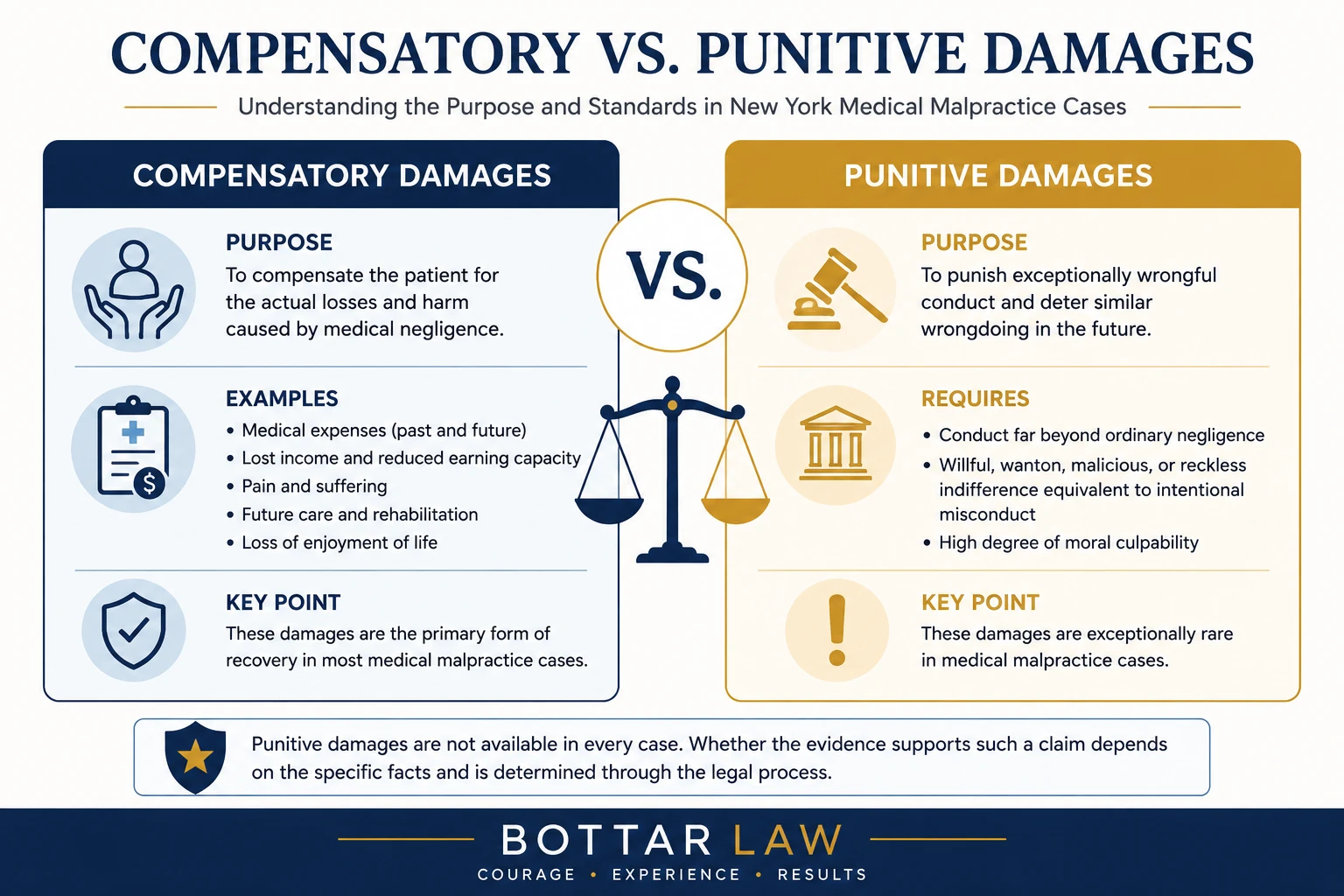
Compensatory damages address supported losses, while punitive damages are reserved for exceptionally culpable conduct.
Punitive damages may be considered when the evidence suggests that a healthcare provider engaged in conduct meeting New York's heightened standard for punitive damages. Depending on the facts of the case, this may include allegations of malicious conduct, deliberate concealment of wrongdoing, or a conscious disregard of a serious and known risk to a patient's rights or safety.
The conduct generally must go well beyond a mistaken diagnosis, delayed treatment, surgical complication, medication error, or other act of ordinary negligence. Even serious medical errors or catastrophic injuries do not, by themselves, establish a basis for punitive damages.
In limited circumstances, New York courts have allowed the issue of punitive damages to be considered where the evidence supported allegations that a medical professional intentionally destroyed or concealed medical records in an effort to evade potential malpractice liability. In those cases, the relevant issue was not simply that records were missing or incomplete, but that the evidence suggested deliberate conduct designed to interfere with the patient's legal rights.
Whether punitive damages may be available depends on the specific facts, the applicable law, and the evidence developed during the litigation. Because the legal standard is exceptionally high, punitive damages remain rare in New York medical malpractice cases.
Punitive damages are exceptionally rare in New York medical malpractice cases because even serious medical errors typically involve allegations of negligence rather than malicious, willful, wanton, or consciously reckless misconduct. The legal standard for punitive damages is substantially higher than the standard required to establish ordinary medical malpractice.
A catastrophic injury, permanent disability, or wrongful death may increase the amount of compensatory damages that a patient or family seeks to recover. However, the seriousness of the injury or the obviousness of a medical error does not, by itself, establish the heightened level of culpability required for punitive damages.
Whether punitive damages may be available depends on the specific facts of the case and whether the evidence supports conduct that goes well beyond ordinary negligence. As a result, punitive damages remain the exception rather than the rule in New York medical malpractice litigation.
Understanding the difference between ordinary medical negligence and the type of conduct that may support punitive damages helps explain why punitive damages are so uncommon in New York medical malpractice cases.
Ordinary negligence
A departure from the accepted standard of care that may support compensatory damages if it caused the patient's injury. Compensatory damages are the principal form of damages in a successful medical malpractice claim.
Serious medical error
May result in catastrophic injury or death but does not, by itself, establish a basis for punitive damages.
Grossly negligent or reckless conduct
May be relevant to the punitive damages analysis, but the evidence must demonstrate conduct substantially more culpable than ordinary medical malpractice.
Willful or wanton wrongdoing
May support punitive damages when the evidence shows a conscious disregard of the patient's rights or safety.
Malicious concealment or intentional destruction of medical records
In limited circumstances, may support punitive damages where the evidence demonstrates deliberate interference intended to evade potential liability or impair the patient's legal rights.
Whether punitive damages are available depends on the specific facts of the case and the evidence developed during litigation. Even where a patient suffers a devastating injury, punitive damages are considered only if the conduct satisfies New York's heightened legal standard.
Determining whether punitive damages may be available requires a careful review of the facts and evidence. The central question is not simply whether a medical error occurred, but whether the evidence may support conduct substantially more culpable than ordinary negligence.
Depending on the circumstances of the case, relevant evidence may include:
Not every case will involve each of these categories of evidence, and the availability of particular records or information depends on the facts of the case and the litigation process. An experienced medical malpractice attorney can evaluate the available evidence to determine whether there is a factual basis to pursue punitive damages in addition to compensatory damages.
At Bottar Law, every medical malpractice case is evaluated on its own facts and the available evidence. Our team carefully assesses liability, causation, compensatory damages, and whether the evidence provides a legal basis for any additional claims or remedies, including punitive damages where appropriate under New York law.
That evaluation may include reviewing the patient's medical records, relevant healthcare policies and procedures, treatment timelines, available communications, applicable medical literature, and opinions from qualified medical experts and other professionals when appropriate. The goal is to develop a thorough understanding of what occurred, whether the accepted standard of care was met, and what legal claims the evidence may support.
Just as importantly, if the available evidence does not support a claim for punitive damages or another extraordinary remedy, Bottar Law explains that clearly. Providing clients with an honest, evidence-based assessment helps them understand their legal options and make informed decisions based on the facts of their case rather than unrealistic expectations.
Use this checklist as a starting point for the conversation with an attorney:
If you believe a healthcare provider's conduct went beyond an ordinary medical mistake, it is understandable to have questions about what happened and whether the law provides additional remedies. You do not need to determine on your own whether the conduct meets the legal standard for punitive damages. An experienced medical malpractice attorney can review the facts, explain the applicable law, and provide an honest assessment of the available legal options.
If you are considering a legal claim, it may be helpful to:
A careful review of the medical records, the available evidence, and the opinions of qualified medical experts is often necessary to determine whether the conduct involved ordinary negligence or whether it may support additional legal remedies under New York law.
The severity of a patient's injury may affect the compensatory damages that are sought, but punitive damages focus on the defendant's conduct rather than the extent of the patient's losses. Even a catastrophic injury does not, by itself, establish the heightened legal standard required for punitive damages.
Punitive damages are reserved for exceptional cases involving conduct substantially more culpable than ordinary medical malpractice. Simply describing conduct as "gross negligence" does not, by itself, establish a basis for punitive damages. The availability of punitive damages depends on the specific facts and whether the evidence satisfies New York's heightened legal standard.
A wrong-patient or wrong-site procedure may warrant careful investigation, but it does not automatically support punitive damages. Whether punitive damages may be available depends on what the evidence shows about the healthcare provider's knowledge, conduct, intent, and level of culpability.
Medical records may be incomplete or unavailable for many reasons. A claim involving punitive damages may require evidence that records were intentionally altered, concealed, or destroyed to interfere with a patient's legal rights or evade potential liability. Missing records alone do not establish that conclusion.
Most successful medical malpractice claims involve compensatory damages, which are intended to address the patient's actual injuries and losses, such as medical expenses, impairment of earning ability, pain and suffering, and other damages supported by the evidence. Punitive damages are considered only in the rare case where the evidence satisfies New York's heightened legal standard.
Punitive damages focus on the defendant's level of culpability, not only the seriousness of the injury.

Michael Bottar is a nationally recognized New York medical malpractice and personal injury attorney and the founder of Bottar Law. Throughout his career, he has dedicated his practice to representing individuals and families affected by medical negligence, catastrophic injuries, wrongful death, and other serious acts of negligence. Michael is committed to helping clients understand their legal rights, navigate the complexities of the legal system, and pursue accountability with compassion, integrity, and unwavering advocacy.
For more than 40 years, Bottar Law has represented individuals and families throughout Syracuse, Central New York, and across New York in complex medical malpractice litigation involving catastrophic injuries and wrongful death. Through educational resources like these FAQs, Michael Bottar and the Bottar Law team strive to provide clear, reliable information to help injured individuals and their families make informed decisions during difficult times. Prior results do not guarantee a similar outcome.
Speak with Bottar Law about the medical evidence, records, legal standards, and remedies that may apply under New York law.