 Call833-268-8277

Understand how attorneys evaluate a settlement offer against trial risk, and who ultimately makes the final call.
Attorney reviewed · New York focused · Updated resource
Your attorney provides the analysis and recommendation, but you make the final call.
There is a saying in trial law that every legitimate case should settle. However, deciding whether to settle a medical malpractice case or proceed to trial is a complicated decision, and should be discussed with an attorney. The client and attorney should review the strengths and weaknesses of the case, including proof of liability, causation and damages, as well as the characteristics of the jury pool where the case is venued, prior jury verdicts, the experience of the trial judge, costs associated with trial, and prospects of an appeal.
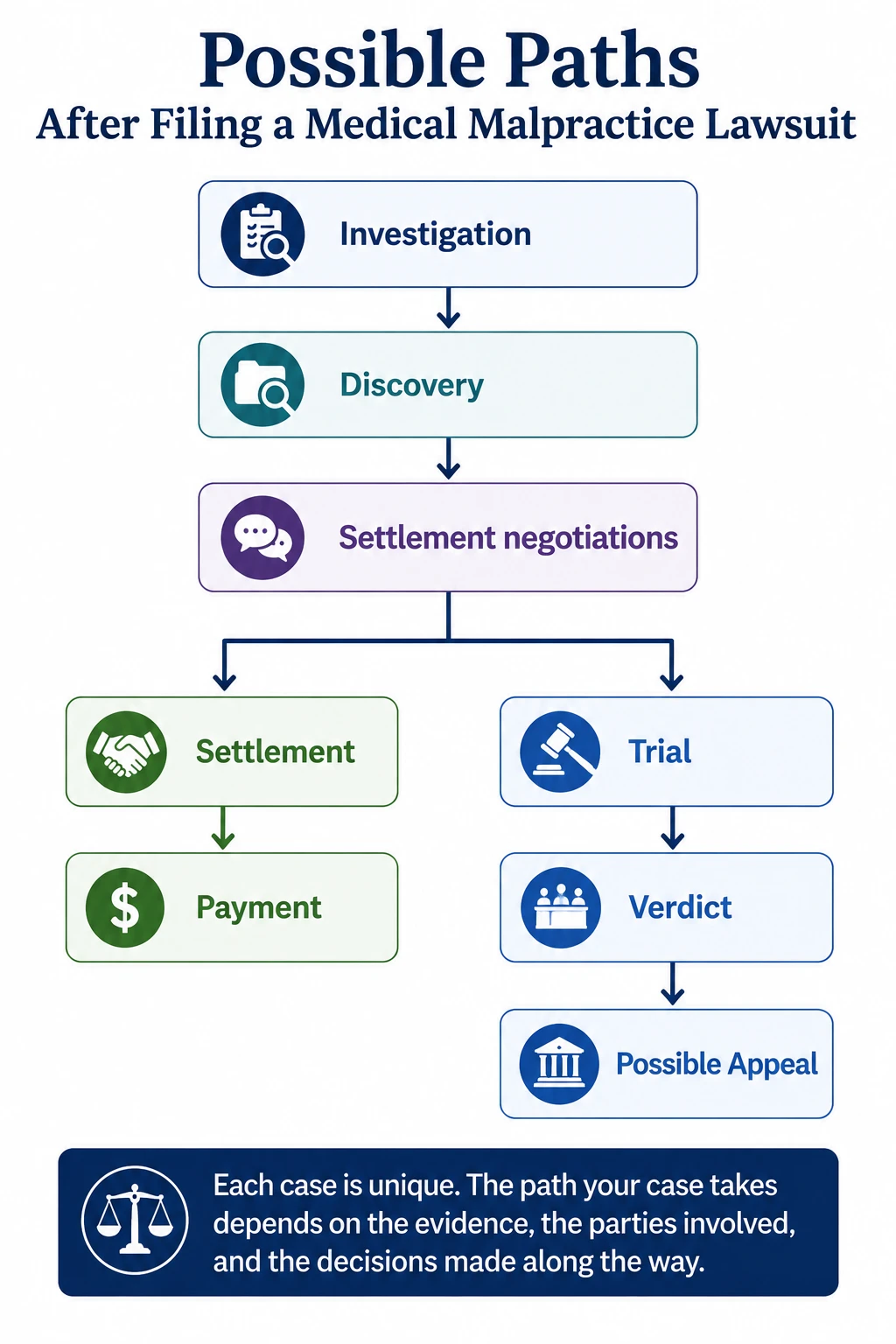
Each case is unique. The path your case takes depends on the evidence, the parties involved, and the decisions made along the way.
The amount of the proposed settlement and risk analysis are the primary considerations when deciding whether to settle a case or proceed to trial. The exact calculus is case-by-case. Settlement eliminates the risk of a jury concluding there was no negligence and, when a case is settled, there is no appeal so payment issues promptly after settlement documents are signed. Jury verdicts can be appealed. Appeals can take years to run their course.
First and foremost, we evaluate the settlement offer, if any. If there is no settlement offer, then the case cannot settle. In situations where a healthcare provider decides against making a settlement offer, we almost always recommend proceeding to trial. Obviously, trial is expensive and stressful for clients, but sometimes is the only option. When a settlement offer is made, we evaluate the amount of the offer against the total damages available at trial. We also review risk for loss, and prior settlements or jury verdicts for similar matters. If the offer seems fair, then we usually recommend settlement. While we represent injured patients, we do not decide whether to settle a case. The decision to settle a case is always the client’s decision.
Some cases are well suited for settlement because the evidence is strong, both sides have a realistic understanding of the damages, and an agreement can be reached that fairly compensates the injured patient. In other cases, settlement negotiations do not produce a reasonable offer, or the parties fundamentally disagree about liability or the extent of the injuries.
When that happens, taking the case to trial may be necessary to allow a judge or jury to decide the issues. Every decision should be guided by the facts of the individual case rather than by a predetermined strategy.
The quality of the medical evidence often has a significant impact on settlement negotiations. Cases supported by detailed medical records, credible expert opinions, and clear evidence of negligence are generally in a stronger position during discussions with the defense.
Strong evidence also helps both sides evaluate the risks of going to trial. Thorough preparation is essential regardless of whether the case ultimately settles or proceeds to court.
A settlement can provide certainty, resolve the case sooner, and avoid the time, expense, and uncertainty of a trial. For many clients, settlement allows them to move forward and focus on their recovery without continuing litigation.
On the other hand, accepting a settlement typically means the case is permanently resolved, and no additional compensation can be sought for the same claim. That is why every settlement offer should be carefully evaluated before a decision is made.
The following comparison highlights some of the practical differences between resolving a case through settlement and proceeding to trial.
Faster resolution
May take years
Guaranteed outcome
Outcome uncertain
No appeal
Appeals possible
Lower litigation costs
Greater expense
Less emotional stress
Trial preparation required
Privacy preserved
Public courtroom
Final resolution
Potential post-trial proceedings
Outcome controlled by agreement
Outcome determined by judge or jury
No. While there is a long-standing saying among trial lawyers that every legitimate case should settle, not every medical malpractice case actually resolves through settlement.
Many cases do settle after the parties evaluate the medical evidence, liability, causation, damages, and the risks of trial. Other cases never receive a settlement offer, or the parties may have fundamentally different views about responsibility or the value of the claim. In those situations, a trial may be necessary for a judge or jury to resolve the dispute.
Every case is different. Whether a case settles depends on the evidence, the positions of the parties, and whether a fair agreement can be reached.
The attorney’s role is to provide legal advice, explain the strengths and weaknesses of the evidence, discuss the risks and potential outcomes, and make a professional recommendation based on the facts of the case.
The final decision whether to accept or reject a settlement offer always belongs to the client. An attorney cannot accept a settlement on a client’s behalf without the client’s authorization. The goal is to ensure that every client has the information needed to make an informed decision that reflects their own circumstances and priorities.
Yes. Settlement discussions do not necessarily end when a trial starts.
In many medical malpractice cases, negotiations continue during jury selection, while witnesses are testifying, or even after much of the evidence has been presented. As the parties see how the evidence develops, they may reassess the risks of continuing to verdict and determine that settlement is in everyone’s best interests. Although some cases proceed all the way to a verdict, others resolve before the trial is completed.
If a jury returns a verdict that is greater than an earlier settlement offer, the case does not necessarily end immediately.
After a verdict, the court may consider post-trial motions, either party may have the right to appeal, and additional proceedings may be required before a final judgment is entered and collected. Depending on the circumstances, those steps can add months or even years to the process. When deciding whether to settle or proceed to trial, attorneys and clients often weigh both the possibility of a higher verdict and the additional time, expense, uncertainty, and appellate risks that may follow.
Yes. A jury may award more than a settlement offer, less than a settlement offer, or no damages at all if the plaintiff does not meet the required burden of proof.
That uncertainty is one of the reasons settlement decisions require careful analysis. Before making a recommendation, attorneys typically evaluate the available evidence, the potential damages, the risks of trial, and other factors that may affect the outcome. Every case involves different strengths, weaknesses, and uncertainties.
Sometimes a healthcare provider or insurance company decides not to make a settlement offer.
When that happens, there is generally no opportunity to resolve the case through settlement unless negotiations later begin. If the parties cannot reach an agreement, the case may need to proceed through trial so that a judge or jury can decide the disputed issues. The absence of a settlement offer does not necessarily reflect the strength or weakness of a case. It may instead reflect the defendant’s litigation strategy, disagreement about liability or damages, or other case-specific considerations.
It is common for the parties to have very different views about the value of the same case.
They may disagree about whether the healthcare provider departed from the accepted standard of medical care, whether that departure caused the patient’s injuries, the extent of the damages, the credibility of witnesses, the opinions of qualified medical experts, or how a jury is likely to evaluate the evidence. Because each side assesses these issues differently, settlement negotiations often involve significant differences in how the case is valued. Those differences may narrow as additional evidence is developed, but in some cases they remain unresolved until a trial or settlement is reached.
Medical malpractice trials are often complex and require extensive preparation. They involve expert testimony, detailed medical evidence, and legal arguments that may take days or weeks to present. Even after years of preparation, the outcome cannot be guaranteed because the final decision rests with the judge or jury.
While trials can be demanding, they are sometimes necessary when a fair settlement cannot be reached. A law firm should always be prepared to present the strongest possible case if trial becomes the best path forward.
At Bottar Law, we prepare every medical malpractice case as though it may ultimately be presented at trial. We conduct a thorough investigation, obtain and analyze the medical records, consult with qualified medical experts, and carefully document the full extent of our client’s damages.
This level of preparation not only strengthens a case for trial when necessary, but also helps position clients for meaningful settlement discussions because the evidence has been fully developed from the beginning.
Liability
Client goals
Medical evidence
Time
Expert opinions
Stress
Damages
Financial certainty
Jury history
Appeal risk
Venue
Trial costs
Many clients worry about making the wrong decision. They may wonder whether the settlement offer is fair, whether a trial could result in a better outcome, or whether continuing the case is worth the additional time and uncertainty.
These are important questions, and every client deserves thoughtful guidance. Our role is to explain the strengths and weaknesses of the case, discuss the possible outcomes, and provide honest recommendations so clients can make decisions with confidence.
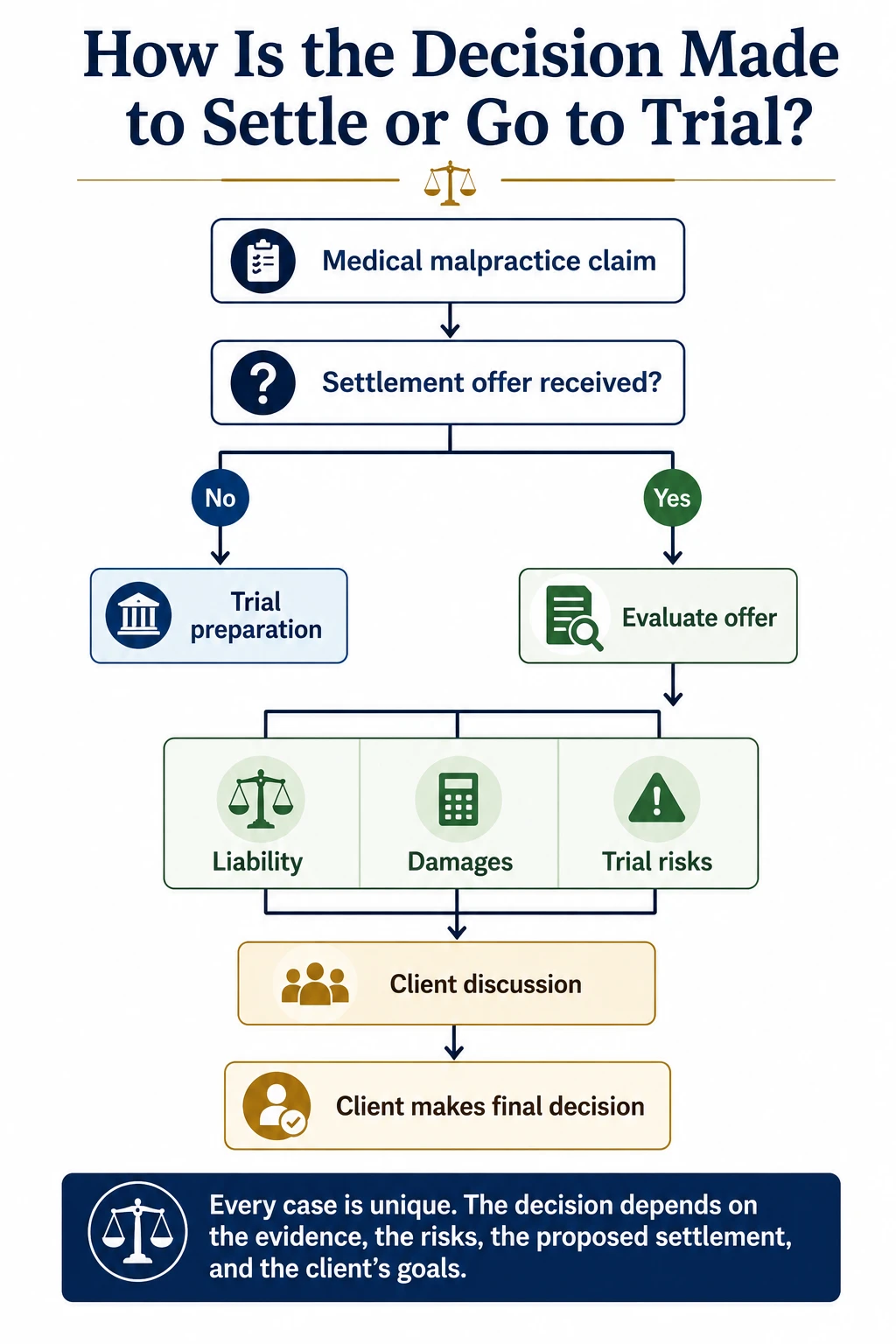
Every case is unique. The decision depends on the evidence, the risks, the proposed settlement, and the client’s goals.
We believe clients should have all the information they need before deciding whether to settle or proceed to trial. We explain the evidence, discuss the legal issues, answer every question honestly, and provide our professional opinion based on the facts of the case.
The final decision always belongs to the client. Our responsibility is to provide clear guidance, thoughtful advice, and the information necessary for clients to make informed decisions without feeling pressured.
If you receive a settlement offer and are uncertain whether it fairly reflects your injuries and losses, speak with your attorney before making any decision. A settlement is usually final, so it is important to understand both the immediate and long-term consequences of accepting an offer.
If you still have questions or would like additional reassurance, seeking a second opinion from an experienced New York medical malpractice attorney may also be appropriate. Taking the time to understand your options can help you make a decision that protects your interests and supports your future.
Many strong cases resolve through settlement.
Offers depend on many factors.
Trials carry significant uncertainty.
The client makes the final decision.
Appeals may continue for years.
Every case is unique. The decision depends on the evidence, the risks, the proposed settlement, and the client’s goals.

Michael Bottar is a nationally recognized New York medical malpractice and personal injury attorney and the founder of Bottar Law. Throughout his career, he has dedicated his practice to representing individuals and families affected by medical negligence, catastrophic injuries, wrongful death, and other serious acts of negligence. Michael is committed to helping clients understand their legal rights, navigate the complexities of the legal system, and pursue accountability with compassion, integrity, and unwavering advocacy.
For more than 40 years, Bottar Law has represented individuals and families throughout Syracuse, Central New York, and across New York in complex medical malpractice litigation involving catastrophic injuries and wrongful death. Through educational resources like these FAQs, Michael Bottar and the Bottar Law team strive to provide clear, reliable information to help injured individuals and their families make informed decisions during difficult times. Prior results do not guarantee a similar outcome.
Speak with Bottar Law about the risks, evidence, and options specific to your case.