 Call833-268-8277

If you were seriously injured after medical treatment, an unexpected outcome does not necessarily mean medical malpractice occurred. A potential New York medical malpractice case generally requires evidence that a doctor, hospital, or other healthcare provider departed from accepted standards of medical care and that the departure caused an injury or additional harm.
This section of the New York Medical Malpractice Knowledge Center can help you understand how potential malpractice is evaluated, what evidence may matter, and when certain types of medical errors may warrant further investigation.
You may have a medical malpractice case if a doctor, hospital, or other healthcare provider failed to provide care consistent with accepted medical standards and that failure caused you injury or made an existing condition worse.
However, a bad result, known complication, or unsuccessful treatment does not by itself establish malpractice.
Determining whether malpractice occurred typically requires reviewing the medical records, understanding what appropriate medical care required under the circumstances, identifying whether the healthcare provider departed from that standard, and determining whether the departure caused compensable harm.
Because those questions frequently involve specialized medical issues, qualified medical expert review may be necessary to evaluate a potential claim.
There is rarely a single fact that determines whether someone has a medical malpractice case. Instead, several issues generally must be evaluated together.
What care should reasonably have been provided? The answer can depend on the patient’s condition, the type of healthcare provider involved, the information available, and the circumstances surrounding the treatment.
Did the provider depart from the applicable standard? A potential case generally requires more than showing treatment was unsuccessful or that another provider might have decided differently.
Did that departure cause an injury? There must generally be a connection between the departure and the patient’s injury or additional harm.
Did the patient suffer compensable harm? Damages can involve additional treatment, physical injury, pain and suffering, lost earnings, permanent impairment, and other losses.
STANDARD OF CARE → DEPARTURE → CAUSATION → DAMAGES
These questions are highly fact-specific and may require review of the complete medical record by qualified medical professionals.
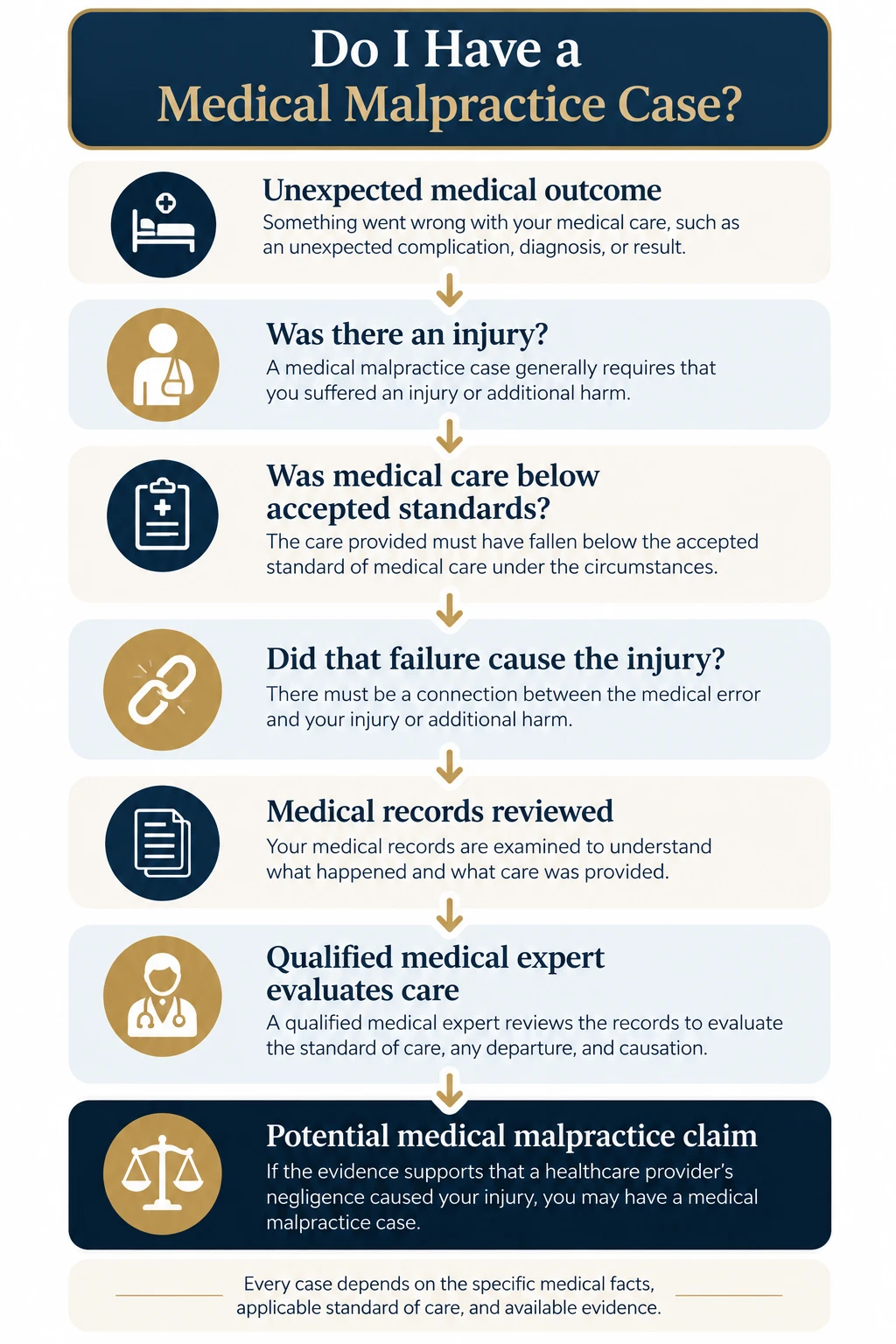
Every case depends on the specific medical facts, applicable standard of care, and available evidence.
No. A bad medical outcome does not, by itself, mean that medical malpractice occurred.
Medicine cannot guarantee a particular result. A patient may experience a known complication, a disease may progress despite appropriate treatment, or a procedure may fail even when the healthcare providers involved acted appropriately.
The central question is therefore not simply:
“Did something bad happen?”
It is:
“Did a healthcare provider depart from accepted medical care, and did that departure cause the patient’s injury or additional harm?”
Complication despite appropriate care
Departure from the applicable standard of care
Known risk of treatment or procedure
Preventable medical error
Injury not caused by negligent care
Injury caused or worsened by negligent care
Poor result by itself
Evidence supports both departure and causation
Medical evidence does not support a departure
Qualified expert identifies a departure from accepted care
Two patients can experience similar outcomes while the legal analysis of their cases is entirely different.
The medical circumstances and evidence matter.
You may suspect that something went wrong without knowing the legal or medical terminology to describe it. Start with the situation that most closely resembles your experience.
A missed or delayed diagnosis does not automatically mean that a doctor was negligent. However, a diagnostic error may warrant investigation when symptoms, test results, medical history, examination findings, or other available information should reasonably have led to further testing, referral, diagnosis, or treatment.
An investigation may examine what information was available to the healthcare provider, what steps should have been taken, when the condition reasonably could have been diagnosed, and whether the delay affected the patient’s outcome.
Complications can occur during or after surgery even when appropriate medical care is provided. But a serious surgical injury may raise questions about preoperative planning, surgical technique, injury to surrounding structures, anesthesia, monitoring, recognition of complications, or postoperative care.
Determining whether a surgical complication involved malpractice generally requires looking beyond the fact that the complication occurred and examining how the procedure and subsequent care were performed.
Hospital care frequently involves multiple people and systems. Depending on the circumstances, questions may involve physicians, nurses, technicians, hospital employees, communication among providers, monitoring, staffing, policies, medication administration, testing, or other aspects of a patient’s care.
Determining who may be responsible can require reconstructing the treatment and identifying who made the relevant decisions or failed to take appropriate action.
This is common. A patient or family member may know that a condition unexpectedly worsened, treatment did not work, or something about the medical care does not make sense, without knowing exactly why.
You do not necessarily need to identify the medical error yourself before asking questions. Reviewing the medical records, reconstructing the timeline of treatment, and obtaining appropriate medical evaluation may help clarify what occurred and whether further investigation is warranted.
Suspecting that something went wrong is different from being able to establish why it happened. Evaluating a potential medical malpractice case can require bringing together several kinds of information.
Medical records can document symptoms, examination findings, diagnoses, laboratory and imaging results, medications, procedures, treatment decisions, consultations, and follow-up care. They can help establish what healthcare providers knew, and what they did, at important points in the patient’s treatment.
Chronology can matter. A timeline helps establish when symptoms developed, when medical attention was sought, what tests were performed, when results became available, what treatment decisions were made, and when the patient’s condition changed.
The treatment actually provided must be considered in relation to the medical care that was appropriate under the circumstances. This is often a medical question rather than something that can be determined simply by reading a chart.
Qualified medical professionals may review the records and other evidence to evaluate the applicable standard of care, whether a departure occurred, and whether the alleged departure caused the patient’s injury.
Evidence must also help connect the alleged departure to the harm being claimed. That may require understanding the patient’s condition before the alleged malpractice, what occurred afterward, what additional treatment became necessary, and how the injury affected the patient’s life.
You do not need to determine on your own whether malpractice occurred before taking reasonable steps to protect your health and preserve information. Consider the following:
The resources below examine the most common questions people encounter when they are trying to determine whether medical malpractice may have occurred.
Learn how potential claims are initially evaluated and why the standard of care, causation, medical evidence, and damages matter.
Understand the relationship between negligence and malpractice and why an unexpected or poor medical outcome is not necessarily evidence of negligent care.
Learn about the evidence and legal elements that may be necessary to establish that a healthcare provider departed from accepted medical care and caused harm.
Explore when a missed or delayed diagnosis may raise malpractice concerns and how the effect of a diagnostic delay may be evaluated.
Learn how surgical errors and complications are evaluated, including questions about the standard of care and causation.
Understand how hospital-related errors may be investigated and why determining responsibility can involve both individual providers and institutional care.
Learn practical steps that may help protect your health, preserve information, and prepare for an evaluation of a potential claim.
Determining that a medical outcome warrants further investigation is only the beginning. A potential case may then move through a more detailed investigation:
Medical malpractice litigation can require significant medical and legal investigation before a lawsuit is filed.
If the available evidence supports moving forward, questions then turn to how the claim should be developed, which healthcare providers may be responsible, what additional evidence is needed, and whether New York’s legal filing requirements can be satisfied.
Understanding whether malpractice may have occurred often leads to additional questions.
What happens if there appears to be a potential claim?
Learn about medical records, expert review, evidence, filing a lawsuit, discovery, and the process of developing a medical malpractice case.
What New York-specific rules could affect the claim?
Explore legal deadlines, liability issues, consent questions, multiple healthcare providers, and other New York medical malpractice issues.
What happens if medical malpractice caused a serious injury?
Learn how damages may be evaluated, what types of losses may be compensable, and how settlements and trials work.
These resources are designed to explain how potential medical malpractice cases are evaluated under New York law. Because medical malpractice questions frequently involve both legal and medical issues, the materials address interconnected concepts including accepted standards of medical care, departures from those standards, causation, medical records, expert review, injuries, and damages.
Content is reviewed by Bottar Law attorneys for legal accuracy, relevance, and clarity.
Last reviewed: October 2026

Michael A. Bottar is an attorney with Bottar Law who has spent more than 20 years prosecuting medical malpractice, wrongful death, and serious personal injury cases throughout New York. He is the immediate past president of the New York State Academy of Trial Lawyers and has been recognized by The Best Lawyers in America® for his work in plaintiffs’ medical malpractice, product liability, and personal injury law.
It can be difficult to determine from the outcome alone whether medical negligence occurred. A complication may happen despite appropriate care. In other situations, understanding what went wrong may require reviewing medical records, reconstructing the treatment, and evaluating the care with qualified medical professionals.
If you or someone in your family suffered a serious injury and you have questions about the medical care that was provided, Bottar Law can review the circumstances and help you understand whether further investigation may be appropriate.
You do not need to diagnose the legal problem before asking for help.
Tell us what happened.