 Call833-268-8277

Understand when a surgical complication may be malpractice, what evidence matters, and how New York law evaluates departures from accepted surgical care.
Attorney reviewed · New York focused · Updated resource
The evidence must show a departure from accepted surgical care that caused the injury.
Yes. You may be able to sue after a surgical error if evidence shows that the surgeon or another healthcare provider departed from accepted medical practice and that the departure caused your injury. A poor result or recognized surgical complication does not automatically establish malpractice. Attorneys and qualified medical experts generally review the operative report, anesthesia record, imaging, consent documentation, nursing records, postoperative care, and other evidence to determine what happened and whether the harm was preventable.
Surgery always involves some degree of risk, and an unexpected outcome does not necessarily mean that anyone was negligent. The relevant question is whether the surgeon, anesthesiologist, hospital, nursing team, or another provider failed to use the accepted level of care and whether that failure caused additional harm.
Surgical malpractice may occur before, during, or after an operation. It can involve inappropriate surgical planning, an error during the procedure, failure to monitor the patient, delayed recognition of a complication, inadequate postoperative treatment, or lack of informed consent. A detailed review of the complete medical record is usually necessary.
A surgical error may constitute medical malpractice when a surgeon or another healthcare provider departs from the accepted standard of medical care and that departure is a proximate cause of the patient’s injury. A poor outcome, recognized surgical risk, or postoperative complication, by itself, does not establish medical malpractice.
Determining whether malpractice occurred requires a careful review of the medical records and the opinions of qualified medical experts. Depending on the circumstances, the analysis may include:
Because every surgical procedure presents inherent risks, the occurrence of a complication alone does not mean that medical malpractice occurred. The question is whether the available evidence demonstrates a departure from accepted medical practice that caused avoidable harm.
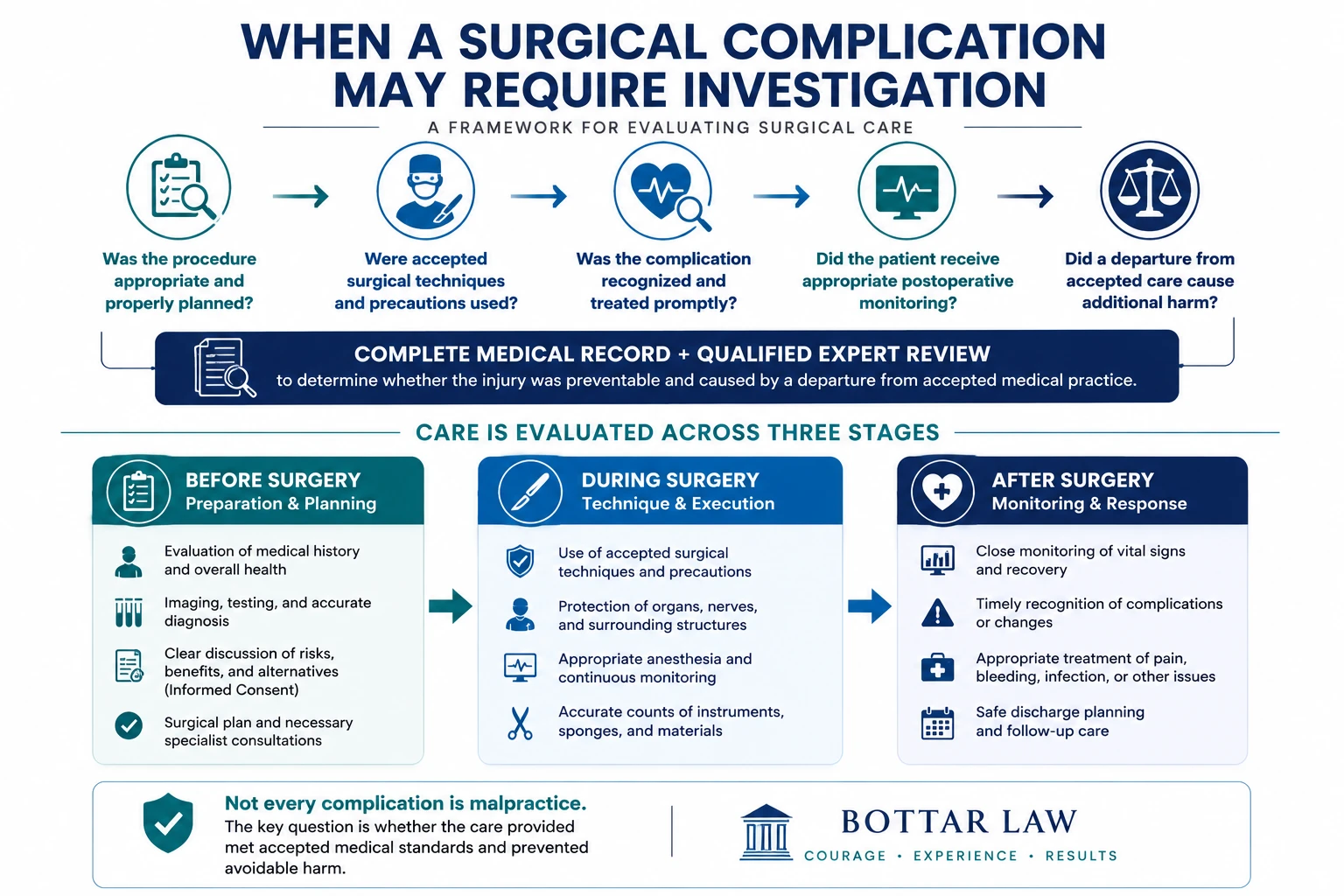
Care is evaluated across three stages: before, during, and after surgery, supported by the complete medical record and qualified expert review.
Depending on the facts of the case, a medical malpractice claim may arise from many different types of alleged surgical errors, including:
The occurrence of one of these events does not, by itself, establish medical malpractice. Many surgical complications are recognized risks of appropriately performed procedures. Whether malpractice occurred depends on whether a healthcare provider departed from the accepted standard of medical care and whether that departure was a proximate cause of the patient’s injury.
Determining whether a surgical complication resulted from medical malpractice requires a careful review of the patient’s medical records, the operative records, diagnostic imaging, and the opinions of qualified medical experts. The central question is not whether a complication occurred, but whether a healthcare provider departed from the accepted standard of medical care and whether that departure was a proximate cause of the patient’s injury.
The evaluation may include questions such as:
Was the surgery medically appropriate?
An unnecessary or contraindicated procedure may create liability before the operation begins.
Was the patient properly evaluated and prepared?
Clearance, testing, imaging, medications, and known risks may affect patient safety.
Was the accepted surgical technique and clinical judgment used?
Experts evaluate the operative records, surgical technique, anatomy, instruments, and clinical judgment.
Was the injury a recognized risk of the procedure?
A recognized risk is relevant but does not automatically make the injury unavoidable.
Could reasonable precautions have prevented the injury?
Preventability depends on the specific procedure, the available evidence, and accepted medical practice.
Was the complication recognized and treated promptly?
A non-negligent complication may still be mishandled if appropriate postoperative care is not provided.
Did any departure from accepted standard of care cause additional harm?
Medical malpractice requires a causal connection between the departure and the patient’s injury.
The frequency of a complication does not determine whether medical malpractice occurred. Instead, independent medical experts evaluate how the complication happened, whether accepted precautions were used, and whether appropriate medical care would likely have prevented the injury or reduced the resulting harm.
Not every complication points the same direction. The table below compares recognized surgical risks with circumstances that more often call for a closer legal review.
Recognized surgical complication
May occur without negligence, but the specific facts still require careful review.
Unexpected or rare complication
May justify closer investigation but does not, by itself, establish medical malpractice.
Retained surgical object
May support an inference of negligence in appropriate circumstances.
Injury remote from the operative site
May warrant closer analysis and, in limited circumstances, support application of the doctrine of res ipsa loquitur.
Wrong-patient, wrong-site, or wrong-procedure surgery
Strongly suggests a serious breakdown in patient safety and clinical care but still requires legal evaluation.
Delayed recognition of postoperative deterioration
May support a medical malpractice claim if postoperative monitoring, evaluation, or treatment departed from accepted medical practice.
Incomplete or inconsistent operative documentation
May raise important questions about what occurred but does not independently establish negligence.
Certain circumstances — such as a retained surgical object or some unexplained injuries occurring while a patient was under anesthesia — may, in appropriate cases, permit an inference of negligence under the legal doctrine of res ipsa loquitur. Whether that doctrine applies depends on the specific facts and applicable New York law. It does not create automatic liability or eliminate the need to establish the other elements of a medical malpractice claim.
Bottar Law has investigated surgical-error matters involving allegations such as:
These examples do not mean that medical malpractice occurred in every similar situation. Each matter requires a careful review of the medical records and the opinions of appropriately qualified surgical experts to determine whether there was a departure from the accepted standard of medical care and whether that departure was a proximate cause of the patient’s injury.
The most important evidence depends on the alleged surgical error. Although the operative report and anesthesia record are often central to the analysis, they should be evaluated together with the complete preoperative, intraoperative, and postoperative medical record.
Depending on the circumstances, important evidence may include:
No single record determines whether medical malpractice occurred. Instead, attorneys and qualified physicians in the same specialty evaluate the available evidence as a whole to determine what happened, whether there was a departure from the accepted standard of medical care, and whether that departure was a proximate cause of the patient’s injury.
A qualified medical expert evaluates whether the surgeon’s care was consistent with the accepted standard of medical care applicable at the time of the treatment. The review typically includes the patient’s medical records, diagnostic imaging, operative records, the patient’s clinical condition, available treatment alternatives, and the accepted surgical practices relevant to the procedure and circumstances.
The expert evaluates whether the surgeon’s clinical judgment, decision-making, and surgical technique were consistent with what a reasonably skilled practitioner would have done under similar circumstances based on the information available at the time — not with the benefit of hindsight.
The expert must also evaluate causation. In addition to identifying any departure from the accepted standard of medical care, the expert considers whether that departure caused or was a substantial factor in causing the patient’s injury.
In New York medical malpractice cases, competent expert testimony is generally required to establish both a departure from the accepted standard of medical care and causation, unless the alleged negligence falls within a narrow category that can be understood without specialized medical knowledge.
Patients sometimes receive explanations that feel incomplete, highly technical, or inconsistent with their later condition. When that happens, it may be appropriate to request copies of the complete medical records and obtain an independent review of the care that was provided.
A surgeon’s failure to provide a satisfactory explanation after surgery does not, by itself, establish medical malpractice. Instead, the investigation should focus on the medical care that was provided, the patient’s condition, the available medical documentation, and whether any departure from the accepted standard of medical care caused or was a substantial factor in causing the patient’s injury.
An independent review by an experienced medical malpractice attorney and qualified medical experts can help determine whether the available evidence supports a medical malpractice claim under New York law.
No. Surgical negligence and lack of informed consent are related but distinct legal theories under New York law.
A surgical-negligence claim focuses on whether the operation itself — or the care provided before, during, or after surgery — met the accepted standard of medical care and whether any departure caused or was a substantial factor in causing the patient’s injury.
A lack-of-informed-consent claim generally focuses on whether the healthcare provider disclosed the reasonably foreseeable risks, benefits, and alternatives that a reasonable practitioner would have disclosed under similar circumstances, whether a reasonably prudent patient would have declined the procedure if adequately informed, and whether the lack of informed consent caused the patient’s injury.
In New York, lack of informed consent is a distinct medical malpractice theory governed by Public Health Law § 2805-d. Although the same case may involve both surgical negligence and lack of informed consent, each claim has different legal elements and must be evaluated based on the specific facts and available evidence.
Yes. A surgical procedure may be performed appropriately, yet medical malpractice may still occur if the surgeon, hospital, or another healthcare provider departs from the accepted standard of medical care during the postoperative period.
Depending on the circumstances, postoperative malpractice allegations may involve failures to:
The occurrence of a postoperative complication does not, by itself, establish medical malpractice. The relevant question is whether the postoperative care departed from the accepted standard of medical care and whether that departure caused or was a substantial factor in causing additional harm.
Every surgical malpractice case is unique, but the investigation generally follows a structured process designed to determine what happened, whether the care departed from the accepted standard of medical practice, and whether that departure caused or was a substantial factor in causing the patient’s injury.
Many surgical malpractice claims can be meaningfully evaluated through a comprehensive review of the medical records and qualified expert analysis. In some cases, additional information obtained during litigation — including testimony from the healthcare providers involved — may also help clarify disputed issues or explain the clinical decisions that were made.
Use this checklist to organize what you need before speaking with a medical malpractice attorney:
Anyone who believes that a surgical error caused serious harm should consult with a medical malpractice attorney to determine if there is time remaining to file a lawsuit seeking compensation for damages caused by medical malpractice. That conversation generally includes:
You do not need to already know what went wrong in the operating room. The next step is having your records reviewed by someone who can find out.
Surgery involves recognized risks, and an unexpected outcome alone does not establish negligence. The evidence must demonstrate a departure from the accepted standard of medical care and that the departure caused or was a substantial factor in causing the patient’s injury.
Consent to a recognized surgical risk is not consent to negligent medical care. A signed consent form does not automatically defeat a claim alleging that the surgery or related care fell below the accepted standard of medical practice.
The rarity of a complication does not determine whether medical malpractice occurred. The analysis focuses on how the complication happened, whether accepted medical care was provided, and whether appropriate care would likely have prevented or reduced the injury.
Even a recognized complication may support a medical malpractice claim if it was caused or worsened by a departure from the accepted standard of medical care, including negligent surgical technique, postoperative monitoring, diagnosis, or treatment.
Depending on the facts, responsibility may extend to other healthcare providers or entities, including anesthesiologists, nurses, hospitals, surgical assistants, radiologists, consulting physicians, or others whose care contributed to the patient’s injury.
The operative report is often an important part of the investigation, but it should be evaluated together with the anesthesia record, nursing documentation, diagnostic imaging, pathology findings, postoperative records, and other available evidence. No single document determines whether medical malpractice occurred.
The evidence must show a departure from accepted surgical care that caused the injury.

Michael Bottar is a nationally recognized New York medical malpractice and personal injury attorney and the founder of Bottar Law. Throughout his career, he has dedicated his practice to representing individuals and families affected by medical negligence, catastrophic injuries, wrongful death, and other serious acts of negligence. Michael is committed to helping clients understand their legal rights, navigate the complexities of the legal system, and pursue accountability with compassion, integrity, and unwavering advocacy.
For more than 40 years, Bottar Law has represented individuals and families throughout Syracuse, Central New York, and across New York in complex medical malpractice litigation involving catastrophic injuries and wrongful death. Through educational resources like these FAQs, Michael Bottar and the Bottar Law team strive to provide clear, reliable information to help injured individuals and their families make informed decisions during difficult times. Prior results do not guarantee a similar outcome.
Speak with Bottar Law to find out whether your care departed from accepted medical standards.