 Call833-268-8277

Understand the four legal elements required to prove medical negligence, and how evidence, records, and expert review build a case.
Attorney reviewed · New York focused · Updated resource
New York law requires proof of duty, breach, causation, and damages.
Proving medical negligence requires more than showing that a patient experienced a poor medical outcome. Under New York law, it must be shown that a healthcare provider failed to provide care that met accepted standards of medical care and that this failure directly caused the patient’s injury.
Building a medical negligence case typically involves obtaining and reviewing medical records, consulting with qualified medical experts, and gathering evidence that explains what happened and why the injury could have been prevented. An experienced medical malpractice attorney can guide this process and determine whether the evidence supports a legal claim.
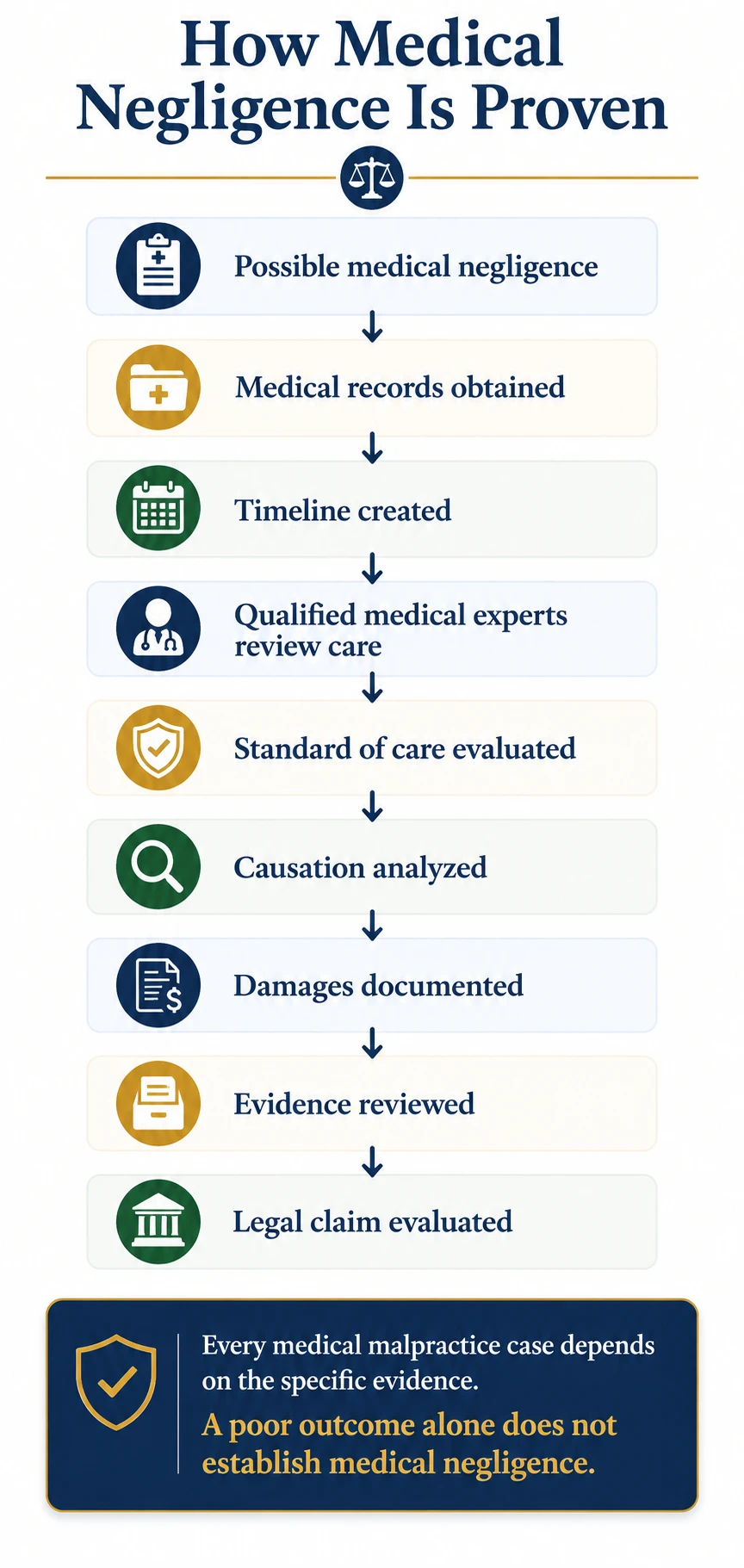
Every medical malpractice case depends on the specific evidence. A poor outcome alone does not establish medical negligence.
To pursue a medical negligence claim, a patient generally must prove four things.
Each of these elements must be supported by evidence. Simply experiencing an unexpected complication or poor outcome does not automatically mean medical negligence occurred.
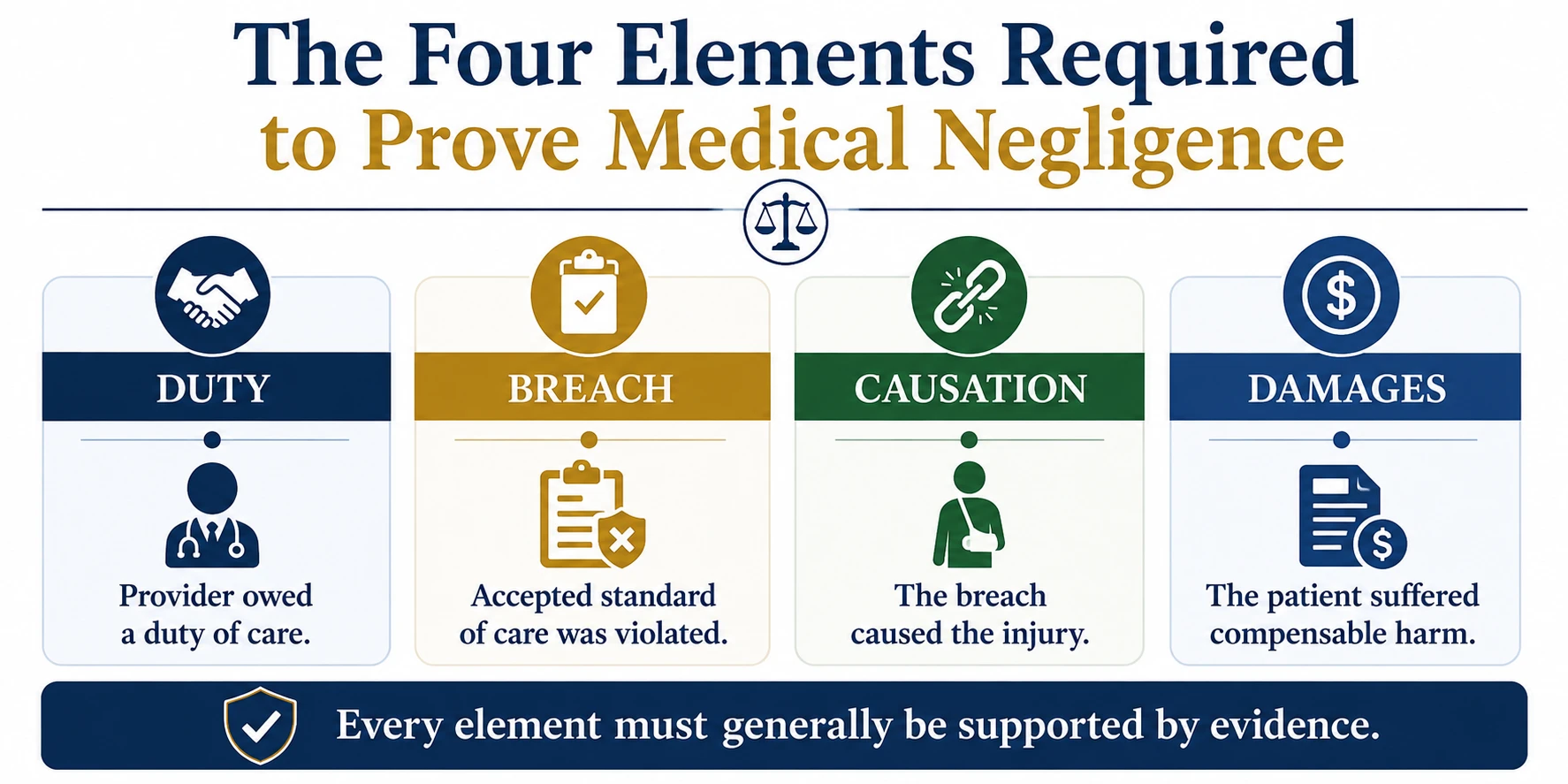
Every element must generally be supported by evidence.
While these four legal elements form the foundation of every medical negligence claim, proving each one requires careful investigation, detailed medical evidence, and qualified expert analysis.
Determining whether the standard of care was violated requires a careful review of the medical treatment that was provided. Qualified medical experts compare the care that was actually delivered with what a reasonably competent healthcare provider would have done under similar circumstances.
If the evidence shows that accepted standards of medical care were not followed and that the departure contributed to the patient’s injury, there may be grounds for a medical malpractice claim.
The medical record is often the most important piece of evidence in a medical malpractice case. Hospital records, physician notes, nursing documentation, laboratory results, imaging studies, operative reports, medication records, and follow-up treatment records all help explain what occurred.
Developing a detailed timeline of events is equally important. Understanding when symptoms developed, what decisions were made, and how treatment progressed often helps identify whether opportunities to prevent harm were missed.
Medical experts play a critical role in almost every medical malpractice case. After reviewing the medical records, they evaluate whether the healthcare providers acted in accordance with accepted medical standards and whether any departures from those standards contributed to the patient’s injuries.
Their opinions help determine whether a claim has legal merit and, if a lawsuit is filed, they often provide testimony to explain complex medical issues to the court or jury.
No. Not every medical error or unexpected outcome amounts to medical negligence.
Medicine is complex, and some complications occur even when healthcare providers deliver appropriate care that meets the accepted standard of medical care. Likewise, a patient’s condition may worsen despite timely and appropriate treatment.
A medical malpractice claim generally requires more than showing that an error occurred. It must be established that the healthcare provider departed from the accepted standard of medical care and that the departure caused or was a substantial factor in causing the patient’s injuries. Every case depends on the specific medical facts and the available evidence.
Unexpected complication
Departure from accepted standard
Does not automatically establish liability
Must be supported by evidence
May occur despite proper treatment
Requires proof of breach
No automatic claim
Requires causation and damages
Many clients contact us because they know something went wrong but do not know exactly why. In some cases, important facts are discovered only after obtaining the complete medical records and having them reviewed by qualified experts. A delayed diagnosis, a missed laboratory result, incomplete documentation, or a breakdown in communication between healthcare providers may not be apparent until the records are carefully analyzed.
This is one of the reasons why a thorough investigation is so important. The medical records often tell a more complete story than a patient is able to see on their own.
Proving negligence is only part of a medical malpractice case. It must also be shown that the negligence caused or substantially contributed to the patient’s injury. This is known as causation.
Medical experts review whether the patient’s outcome would likely have been different if appropriate care had been provided. If the evidence demonstrates that the injury could have been avoided or significantly reduced, there may be a basis for pursuing compensation.
Yes. There are times when a patient experiences a devastating outcome, but the available evidence does not establish that a healthcare provider acted negligently. Medicine is not perfect, and some complications occur even when appropriate care is provided.
These cases can be emotionally difficult because a patient may sincerely believe something went wrong. A careful review by qualified medical experts helps determine whether the evidence supports a legal claim under New York law.
Yes. In some medical malpractice cases, more than one healthcare provider or healthcare entity may share responsibility for a patient’s injuries.
Depending on the circumstances, the investigation may evaluate the actions of physicians, nurses, hospitals, medical practices, residents, physician assistants, or other healthcare professionals involved in the patient’s care. Each provider’s conduct must be evaluated individually to determine whether they departed from the accepted standard of medical care and whether that departure caused or was a substantial factor in causing the patient’s injuries.
Not every provider involved in a patient’s treatment is necessarily responsible. The evidence determines whether one provider, multiple providers, or no provider may be legally responsible.
Incomplete medical records do not automatically prevent a medical malpractice claim from being investigated.
Although medical records are often the foundation of a malpractice case, they are only one source of evidence. Depending on the circumstances, an investigation may also consider diagnostic studies, laboratory results, pharmacy records, emergency medical services records, photographs, correspondence, billing records, witness testimony, and other available information.
If records appear incomplete or raise additional questions, qualified medical experts and attorneys continue evaluating all available evidence to determine what occurred and whether the facts support a medical malpractice claim.
Medical malpractice cases are among the most complex types of civil litigation because they involve both legal and highly technical medical issues. Attorneys must understand complicated medical records, work with experts in multiple specialties, and explain complex concepts in a way that judges and juries can understand.
In addition, healthcare providers and hospitals are often represented by experienced defense attorneys and supported by their own medical experts. Building a strong case requires careful preparation, detailed investigation, and persuasive expert testimony.
The time required to investigate a potential medical malpractice claim varies depending on the complexity of the medical issues, the number of healthcare providers involved, and how quickly relevant records can be obtained.
A thorough investigation generally includes obtaining and reviewing the medical records, preparing a detailed timeline of the patient’s care, consulting with qualified medical experts, and evaluating whether the evidence supports each element of a medical malpractice claim under New York law.
Some investigations can be completed relatively quickly, while others require additional time because of the complexity of the medical issues or the need for expert review. Throughout the process, a careful investigation is more important than reaching a conclusion quickly.
Yes. Family members can sometimes provide important factual information during the investigation of a medical malpractice claim.
Although family members generally cannot offer expert medical opinions about whether the accepted standard of medical care was met, they may help establish the timeline of events, describe changes in the patient’s condition, recount conversations with healthcare providers, identify photographs or other documents, and explain what they personally observed before, during, and after the medical treatment.
When considered together with the medical records and qualified expert review, these observations may help attorneys develop a more complete understanding of what occurred and identify additional evidence that may be relevant to the investigation. Family members may also help identify healthcare providers involved in the patient’s care, preserve photographs, or locate records that become relevant during the investigation.
At Bottar Law, every potential medical malpractice case begins with a comprehensive investigation. We obtain and review the relevant medical records, prepare a detailed timeline of the patient’s care, and consult with qualified medical experts to determine whether accepted standards of medical care were followed.
If the evidence supports a claim, we carefully prepare every aspect of the case before filing suit. Throughout the process, we keep our clients informed, explain the legal issues in clear language, and work to present the strongest possible case based on the facts and the medical evidence.
If you believe that you or a loved one may have been harmed by medical negligence, you do not need to prove your case before contacting an attorney. The first step is to speak with an experienced medical malpractice lawyer who can evaluate your situation and begin the investigation.
An attorney can obtain the necessary medical records, consult with qualified medical experts, and determine whether the evidence supports a medical malpractice claim. Seeking legal guidance early can help preserve important evidence and provide the answers you need to make informed decisions about your future.
Poor outcomes can occur without negligence.
The investigation helps determine that.
Cases are evaluated using all available evidence.
Qualified experts independently evaluate whether accepted standards were followed.
The required legal elements must still be proven.
A poor outcome alone does not establish medical negligence.

Michael Bottar is a nationally recognized New York medical malpractice and personal injury attorney and the founder of Bottar Law. Throughout his career, he has dedicated his practice to representing individuals and families affected by medical negligence, catastrophic injuries, wrongful death, and other serious acts of negligence. Michael is committed to helping clients understand their legal rights, navigate the complexities of the legal system, and pursue accountability with compassion, integrity, and unwavering advocacy.
For more than 40 years, Bottar Law has represented individuals and families throughout Syracuse, Central New York, and across New York in complex medical malpractice litigation involving catastrophic injuries and wrongful death. Through educational resources like these FAQs, Michael Bottar and the Bottar Law team strive to provide clear, reliable information to help injured individuals and their families make informed decisions during difficult times. Prior results do not guarantee a similar outcome.
Speak with Bottar Law to find out whether the evidence supports a claim.