 Call833-268-8277

Understand when a missed or delayed diagnosis may support a claim, and what evidence matters most.
Attorney reviewed · New York focused · Updated resource
The evidence must show a departure from accepted care and that the delay caused harm.
A missed or delayed diagnosis may support a New York medical malpractice claim when the evidence shows that a healthcare provider departed from the accepted standard of medical care and that the departure caused or was a substantial factor in causing injury. The harm may include disease progression, more invasive treatment, loss of treatment options, additional pain, disability, a worsened prognosis, or, in appropriate cases under New York law, the loss of a substantial chance for a better outcome, supported by qualified medical evidence.
Qualified medical experts evaluate what should have been diagnosed, when appropriate testing or referral should have occurred, and whether earlier diagnosis probably would have changed the outcome. Counsel then evaluates the legal claim, responsible parties, damages, and filing deadlines.
A failure to diagnose is not automatically malpractice. The investigation must determine whether the provider responded appropriately to the symptoms, history, examination findings, test results, and clinical circumstances available at the time. A potential claim also requires evidence that an earlier diagnosis or different response probably would have avoided or reduced the patient’s injury.
If a doctor fails to diagnose a condition, and the failure to diagnose causes harm, then the patient may have a claim against the doctor for medical malpractice. While healthcare providers are trained to promptly diagnose symptoms, every failure to diagnose is not actionable. If you learn about a failure to diagnose, it is important to consult with an attorney who has experience investigating whether it was possible to diagnose the disease or condition sooner, what the treatment options would have been had the condition been timely diagnosed, and whether the delay changed the patient’s prognosis.
A missed or delayed diagnosis may support a malpractice claim when a healthcare provider departed from the accepted standard of medical care and the departure caused or was a substantial factor in causing injury. The alleged departure may involve failing to consider a reasonable diagnosis, order appropriate testing, interpret results correctly, communicate an abnormal finding, arrange a referral, or ensure necessary follow-up.
Qualified medical experts evaluate the medical issues, including what a reasonably qualified provider should have done and whether earlier diagnosis probably would have changed the outcome. Counsel then considers those opinions together with the records, responsible parties, damages, legal deadlines, and procedural requirements. A medical opinion supporting departure does not by itself guarantee that a viable lawsuit exists.
A delayed-diagnosis claim may involve any medical condition for which earlier recognition and treatment could have changed the patient’s outcome. Whether a delay constitutes medical malpractice depends on the facts of the case, including what information was available to the healthcare provider at the time and whether earlier diagnosis probably would have prevented additional harm.
Examples include:
Regardless of the underlying condition, the central questions remain the same: should the condition reasonably have been recognized sooner, and did the delay cause additional harm that probably could have been avoided with timely diagnosis and treatment?
Cancer of the breast, lung, and other organs
Disease progression, fewer treatment options, or worsened prognosis
Transient ischemic attack (TIA)
Stroke or loss of an opportunity for preventive treatment
Unstable angina
Heart attack, cardiac damage, or delayed intervention
Bowel obstruction
Perforation
Fetal distress
Neurologic injury to the baby
Blood clots
Pulmonary embolism
Appendicitis
Rupture
Sepsis
Organ damage, severe illness, or death
The investigation compares what actually happened with the probable course of events if the condition had been diagnosed at the appropriate time. Qualified experts may evaluate the disease stage, symptoms, imaging, laboratory findings, available treatments, expected prognosis, and the period during which additional harm remained preventable.
The relevant injury may include progression of the underlying condition, loss of treatment options, a more invasive procedure, additional hospitalization, permanent impairment, or deprivation of a substantial chance for a better outcome. In some cases, the evidence may show that the same result probably would have occurred even with timely diagnosis. Causation must therefore be evaluated separately from whether the diagnosis should have been made sooner.
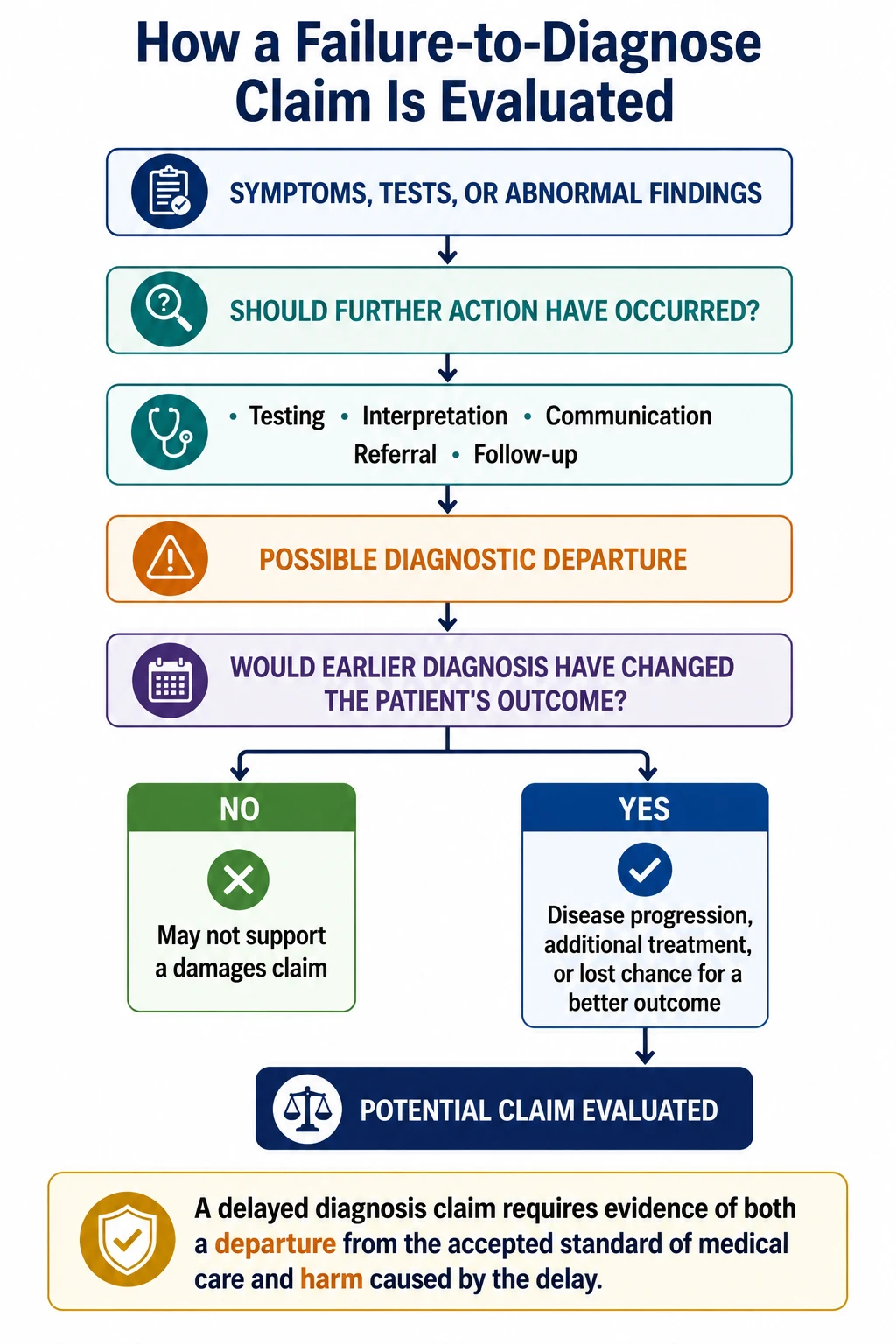
A delayed diagnosis claim requires evidence of both a departure from the accepted standard of medical care and harm caused by the delay.
Potentially. A patient does not necessarily need to prove that earlier diagnosis would have guaranteed a complete recovery. Depending on the evidence, a claim may involve the loss of a substantial chance for a better outcome, recovery, or cure.
Qualified experts must explain how the delay affected the patient’s prognosis and why the provider’s departure was a substantial factor in reducing that opportunity. General statements that earlier treatment might have helped are not enough; the opinion must be connected to the medical facts of the case.
Bottar Law has evaluated delayed-diagnosis matters involving conditions such as aneurysms, blood clots, bowel obstruction, cancer, fetal distress, fractures, heart attack, hemorrhage, hypoxia, infection, sepsis, and stroke. Each matter requires an individualized analysis of what information was available, what additional evaluation was indicated, and whether earlier diagnosis or treatment probably would have changed the outcome.
The seriousness of the underlying condition does not itself prove malpractice. The investigation must identify a supported departure from the accepted standard of medical care and causally related injury.
Relevant evidence may include office notes, emergency-department records, triage documentation, symptom histories, physical examinations, laboratory results, imaging and reports, pathology records, referral orders, consultation notes, telephone logs, portal messages, discharge instructions, and follow-up documentation.
The investigation should identify when symptoms were first reported, what differential diagnoses were considered, which tests were ordered, who received the results, whether abnormal findings were communicated, and what follow-up occurred. Medical records provide important contemporaneous evidence, but they may not document every conversation or event. Testimony, communications, imaging, pharmacy information, and records from later providers may also be relevant.
A chart entry or abnormal result does not establish malpractice by itself. Qualified experts must evaluate the evidence in its clinical context.
Reports of symptoms, worsening conditions, or repeated requests for evaluation may be important evidence. The investigation should determine what the patient communicated, what the provider documented, whether the information required additional testing or referral, and whether the response was medically appropriate.
Relevant evidence may include medical notes, triage records, portal messages, telephone logs, after-visit summaries, testimony from people present during the encounter, and subsequent treatment records. Patients should preserve existing communications and use the patient portal accurately for ongoing medical concerns. They should not alter records or attempt to recreate conversations retrospectively.
The absence of a symptom from the chart does not necessarily prove it was never reported, but a documentation dispute may require testimony and other corroborating evidence.
Qualified experts review the symptoms, history, examination findings, test results, imaging, differential diagnosis, clinical guidelines where relevant, and the provider’s role and specialty. They evaluate whether a reasonably qualified provider should have ordered additional testing, interpreted a result differently, communicated an abnormal finding, referred the patient, or arranged closer follow-up.
Experts also analyze causation. They may assess when the condition became diagnosable, how it progressed during the delay, which treatments were available at each stage, and whether timely intervention probably would have produced a better outcome. Different experts may be required to evaluate the diagnosing provider, radiology or pathology findings, treatment options, and prognosis.
Experts provide medical opinions. Counsel determines how those opinions, the evidence, and New York law affect the potential legal claim.
Was the condition reasonably diagnosable?
Symptoms, examination findings, differential diagnosis, laboratory results, imaging, pathology
Should additional testing or referral have occurred?
Clinical presentation, provider specialty, prior results, follow-up plan
Was an abnormal result missed or not communicated?
Reports, inbox data, portal messages, telephone logs, referral records
When should diagnosis have occurred?
Chronology, disease progression, expert review
Would earlier treatment have changed the outcome?
Stage, prognosis, treatment options, survival or functional evidence
What additional harm resulted?
More invasive care, disease progression, hospitalization, disability, pain, lost opportunity for a better outcome
Who may be responsible?
Individual providers, radiology or pathology groups, hospitals, medical practices, communication systems
A missed diagnosis is not enough by itself. The evidence must support both a departure from the accepted standard of medical care and causally related injury.
A delayed diagnosis may cause physical injury, additional treatment, fear, loss of independence, disruption of employment, and emotional distress associated with the medically caused harm. Family members may also face caregiving burdens and uncertainty.
The damages recoverable in a particular case depend on the injuries legally caused by the malpractice, the available evidence, and applicable New York law. Emotional harm should not be treated as automatic or evaluated separately from causation.
The investigation may begin with an intake review of the symptoms, treatment chronology, possible defendants, injuries, and filing deadlines. If further evaluation is appropriate, Bottar Law may request relevant medical records, imaging, laboratory data, pathology materials, communications, and records from subsequent treating providers.
Counsel then organizes the evidence into a chronology and identifies the medical specialties needed for review. Qualified experts may evaluate:
Investigation time varies with record volume, imaging availability, provider response, medical complexity, deadlines, and expert availability. Bottar Law does not charge prospective clients for an initial case review. Fee arrangements vary among law firms, so prospective clients should ask how the evaluation process works.
Use this checklist to organize important information before speaking with a medical malpractice attorney:
Potentially. New York generally requires a medical malpractice action to be commenced within two years and six months of the challenged act, omission, or qualifying continuous treatment. CPLR 214-a also contains a special discovery-based rule for certain claims involving the negligent failure to diagnose cancer or a malignant tumor, subject to statutory conditions and an outside time limit.
Other defendants, including public hospitals or government entities, may be governed by additional notice and filing requirements. Because the correct deadline depends on the diagnosis, treatment history, defendant, and other facts, it should be calculated by counsel rather than assumed.
If you believe a doctor failed to diagnose your condition or your loved one’s condition in time, you do not have to figure out the deadlines or the next steps on your own. Here is what the attorney’s role looks like at this stage:
The deadlines that apply to your case are already running. The next step is a conversation with an attorney who can tell you what time you have left.
The evidence must show a departure from the accepted standard of medical care and causally related injury.
The investigation must evaluate what information was reasonably available at the earlier time.
Some cases may involve loss of a substantial chance for a better outcome, depending on the medical evidence.
Records are important but may be incomplete or disputed.
Primary providers, specialists, radiologists, pathologists, hospitals, laboratories, and communication systems may require evaluation.
The deadline may depend on the condition, treatment history, defendant, and statutory rules.
A delayed diagnosis claim requires evidence of both a departure from the accepted standard of medical care and harm caused by the delay.

Michael Bottar is a nationally recognized New York medical malpractice and personal injury attorney and the founder of Bottar Law. Throughout his career, he has dedicated his practice to representing individuals and families affected by medical negligence, catastrophic injuries, wrongful death, and other serious acts of negligence. Michael is committed to helping clients understand their legal rights, navigate the complexities of the legal system, and pursue accountability with compassion, integrity, and unwavering advocacy.
For more than 40 years, Bottar Law has represented individuals and families throughout Syracuse, Central New York, and across New York in complex medical malpractice litigation involving catastrophic injuries and wrongful death. Through educational resources like these FAQs, Michael Bottar and the Bottar Law team strive to provide clear, reliable information to help injured individuals and their families make informed decisions during difficult times. Prior results do not guarantee a similar outcome.
Speak with Bottar Law about whether the delay caused harm and what deadlines may apply.