 Call833-268-8277

New York medical malpractice claims are governed by laws and procedural rules that can affect when a lawsuit must be filed, who may be legally responsible, how responsibility may be allocated, and whether particular facts affect a patient’s ability to pursue compensation.
Some of these issues can be easy to misunderstand.
When did the filing period begin? Does continuing treatment affect the deadline? What if several doctors were involved? Does signing a consent form prevent a lawsuit? What happens if the patient is blamed? Can a claim still be investigated if the doctor has retired or moved away?
This section of the New York Medical Malpractice Knowledge Center explains legal issues that may affect a potential claim and connects you with more detailed resources about each subject.
New York medical malpractice cases can involve rules governing filing deadlines, continuous treatment, responsibility among multiple healthcare providers, a patient’s own conduct, informed consent, procedural requirements, damages, and other issues.
Under current New York law, medical, dental, and podiatric malpractice actions generally must be commenced within two years and six months of the alleged act, omission, or failure, or from the last treatment where qualifying continuous treatment exists for the same illness, injury, or condition underlying the alleged malpractice. CPLR 214-a also contains specific provisions concerning foreign objects and certain negligent failures to diagnose cancer or malignant tumors.
The rule that applies to a particular case depends on the facts.
That means treatment dates, the patient’s medical history, the providers involved, the nature of the alleged error, and the chronology of care can all matter when determining which legal issues require closer analysis.
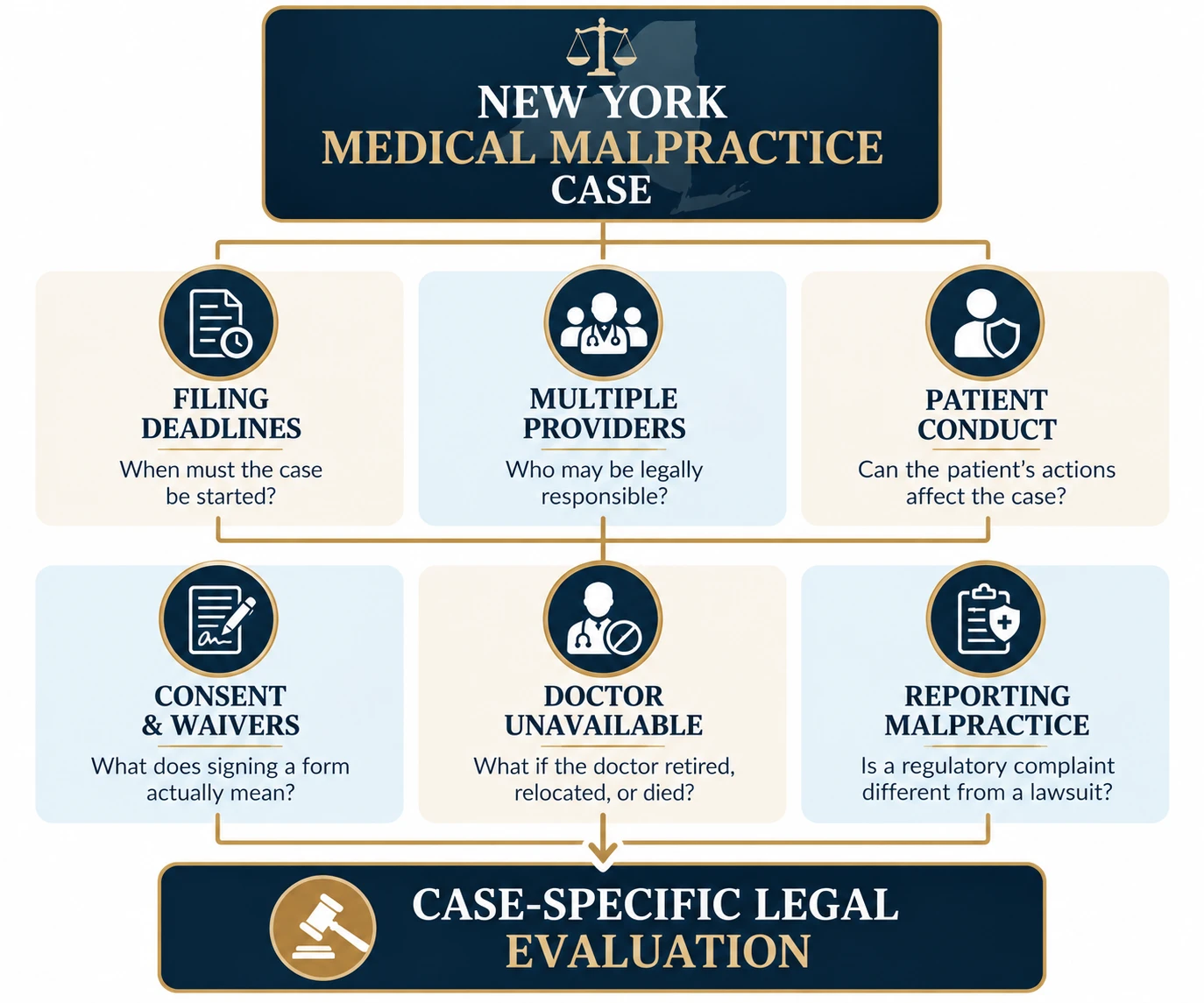
The legal issues that matter depend on the medical facts, treatment history, parties involved, injury, and timing of the potential claim.
The time available to commence a medical malpractice action is one of the most important legal issues to evaluate. Waiting too long can affect whether a claim can be pursued at all. But determining the correct deadline can involve more than simply counting forward from the date something went wrong.
Under current New York CPLR 214-a, an action for medical, dental, or podiatric malpractice generally must be commenced within two years and six months of the act, omission, or failure complained of.
However, that is not the end of the analysis.
CPLR 214-a also addresses continuous treatment.
Where qualifying continuous treatment exists for the same illness, injury, or condition that gave rise to the alleged malpractice, the limitations period may be measured from the last qualifying treatment rather than simply from the original act or omission.
Whether treatment qualifies as continuous treatment is a legal and factual question. Simply continuing to see a healthcare provider does not necessarily mean the doctrine applies.
New York law also contains a specific rule for certain claims based on the discovery of a foreign object in a patient’s body.
CPLR 214-a provides a one-year period measured from discovery of the foreign object or discovery of facts that would reasonably lead to its discovery, whichever occurs earlier. The statute also defines the term in a way that excludes certain items, including fixation devices and prosthetic aids or devices.
CPLR 214-a contains another specific provision concerning certain claims based on an alleged negligent failure to diagnose cancer or a malignant tumor.
That provision uses a discovery-based framework subject to statutory requirements and an outside time limit.
A statute-of-limitations analysis can depend on facts and legal rules that are not apparent from the date of a medical appointment alone.
Do not assume that the general two-year-and-six-month rule establishes the filing deadline in a particular case.
Questions involving continuous treatment, discovery, the identity of the defendant, the type of claim, and other circumstances can require individualized legal analysis.
Medical care is often delivered by teams rather than one person. A patient’s treatment may involve:
When an injury occurs, determining responsibility can therefore require looking separately at what each person or entity did.
The investigation may ask:
The answer may be different for each defendant.
One provider may have acted appropriately while another did not. Multiple departures may have combined to cause an injury. Or the evidence may show that an alleged mistake did not actually contribute to the patient’s harm.
New York also has rules addressing liability among multiple people or entities responsible for an injury. How those rules apply can depend on the circumstances, the relative responsibility assigned, and the type of damages involved.
Healthcare providers and their insurers may sometimes argue that a patient’s own actions contributed to the injury or outcome. Examples could include allegations that the patient:
These allegations can be significant, but they do not automatically answer the central malpractice question.
An allegation that a patient contributed to an injury does not, by itself, determine whether a healthcare provider was negligent.
The provider’s conduct still must be evaluated. So must causation. And so must the relationship, if any, between the patient’s conduct and the resulting harm.
The relevant questions may therefore include:
The answer depends on evidence, not simply an accusation that the patient should have done something differently.
No. Signing a consent form does not automatically mean that negligent medical care was acceptable or eliminate every potential medical malpractice claim.
Consent and negligent medical treatment are related concepts in some cases, but they are not interchangeable.
A patient may consent to a procedure and accept certain disclosed risks while still expecting the procedure and related care to be performed in accordance with applicable medical standards.
Concerns information about treatment, risks, benefits, and alternatives
Concerns whether the care provided met applicable medical standards
Patient agrees to undergo treatment
Consent does not authorize negligent treatment
A known complication may be a disclosed risk
The fact that a complication was possible does not necessarily answer how or why it occurred
Analysis may focus on what information was provided before treatment
Analysis focuses on the actual medical care and evidence
Signing a form may be relevant evidence
A signed form does not automatically resolve whether malpractice occurred
For example, a patient may accept that bleeding is a recognized risk of a procedure.
That does not necessarily answer whether an injury resulted from a recognized complication despite appropriate care, or from a preventable departure from accepted medical practice.
The medical facts still matter.
A doctor’s departure from active practice does not, by itself, determine whether a potential malpractice claim exists. The circumstances may instead create practical and legal questions that need to be investigated. For example:
Medical records may be held by a former practice, hospital, successor provider, records custodian, or another entity depending on the circumstances.
Questions may also arise about the identity and legal status of the provider, applicable insurance coverage, other potentially responsible parties, and filing deadlines.
The key point is that a doctor’s retirement, relocation, practice closure, or departure does not by itself answer whether the patient’s underlying medical care can be investigated.
No. Reporting concerns about a healthcare professional and pursuing a civil medical malpractice lawsuit are separate processes.
They serve different purposes.
Generally concerns professional conduct
Seeks civil legal relief
May involve a licensing or regulatory authority
Proceeds through the civil legal system
May result in professional investigation or discipline
May seek compensation for legally recoverable losses
Focuses on professional or regulatory standards
Focuses on the elements of the civil legal claim
Does not automatically establish civil liability
Requires the plaintiff to establish the required elements of the malpractice claim
Is not a substitute for evaluating civil filing deadlines
Is subject to applicable filing and procedural requirements
A person may therefore have questions about both processes, but one should not be assumed to substitute for the other.
Making a professional complaint does not itself establish that a patient will recover compensation in a malpractice action.
Likewise, pursuing a malpractice lawsuit is not the same thing as asking a professional licensing authority to investigate a provider.
These resources examine six legal questions that can materially affect a potential New York medical malpractice case.
Learn about New York’s medical malpractice filing deadline, continuous treatment, and other statutory provisions that may affect when an action must be commenced.
Learn how a case may be investigated when several doctors, healthcare providers, or institutions were involved in the patient’s care.
Understand why allegations about a patient’s conduct do not automatically resolve whether a healthcare provider was negligent and how questions of causation and responsibility may interact.
Learn why signing a consent form or acknowledging medical risks does not automatically authorize negligent treatment or eliminate every potential malpractice claim.
Understand how a potential claim may be investigated when a healthcare provider has retired, relocated, closed a practice, or is otherwise no longer available.
Learn the difference between making a professional or regulatory complaint and pursuing a civil medical malpractice claim.
Different legal questions can become important at different stages of a medical malpractice case.
Potential issues may include:
Before a lawsuit is commenced, attorneys may need to determine not only whether the medical evidence supports a potential claim, but also whether the claim can be brought within the applicable legal timeframe.
Potential issues may include:
New York CPLR 3012-a generally requires a certificate of merit in medical, dental, and podiatric malpractice actions represented by counsel. The statute addresses counsel’s review of the facts and consultation with an appropriately licensed professional believed to be knowledgeable about the relevant issues, while also containing provisions addressing circumstances in which consultation cannot be obtained before filing.
Potential issues may include:
As evidence develops, legal questions that initially appeared straightforward may become more complicated.
For example, discovery may reveal that another provider participated in an important treatment decision or that the chronology differs from what was initially understood.
Potential issues may include:
Establishing liability and determining compensation are related but distinct parts of a malpractice case.
Medical malpractice law is not static.
Statutes can be amended. Courts can interpret existing laws. Procedural requirements can change. And the application of an established rule can depend heavily on the particular facts of a case.
Proposed legislation is also different from enacted law.
A bill introduced in the New York Legislature may propose significant changes to medical malpractice law without changing the law that currently applies.
For that reason, Knowledge Center resources discussing New York law should be read as educational information based on the law at the time of review, not as a substitute for determining the law that applies to a particular matter.
Last legal review: October 2026
The medical and legal sides of a malpractice case are closely connected.
Consider the statute of limitations.
Determining whether a medical provider departed from accepted care may require obtaining records and consulting qualified medical experts. But the applicable filing deadline can affect how much time is available to complete that investigation.
The providers involved can also affect the case-development process.
If several doctors, a hospital, and other healthcare professionals participated in the patient’s care, the investigation may need to determine the role of each before deciding who should be included in a lawsuit.
The process can therefore involve two questions developing at the same time:
Establishing that a healthcare provider may be legally responsible for an injury does not automatically determine how much compensation may be recoverable. Liability and damages answer different questions.
Who, if anyone, is legally responsible for the injury?
What legally compensable harm resulted from that injury?
A case may therefore involve separate analysis of:
and
Issues involving multiple defendants or allegations about a patient’s own conduct may also affect the legal analysis of responsibility.
Understand the standard of care, medical negligence, causation, evidence, and the questions used to evaluate whether malpractice may have occurred.
Learn how medical records, expert review, filing requirements, discovery, and evidence can be used to investigate and develop a potential claim.
Understand the types of harm that may be compensable and how settlement and trial issues can arise after liability and damages are investigated.
Legal information is particularly sensitive to changes in statutes, procedural rules, and court decisions.
Bottar Law’s Knowledge Center resources addressing New York medical malpractice law are designed to identify the governing legal concepts in understandable language while recognizing that their application depends on the facts of an individual case.
Content is reviewed by Bottar Law attorneys for legal accuracy, relevance, and clarity.
Last reviewed: October 2026
Where appropriate, Knowledge Center resources should link directly to authoritative New York legal materials so readers can identify the underlying authority. Relevant sources for this cluster include:
Medical, dental, and podiatric malpractice limitations period and specified statutory provisions.
Certificate of merit in medical, dental, and podiatric malpractice actions.
Rules concerning limited liability of persons jointly liable, where applicable.
Court rules, procedures, and published decisions relevant to New York medical malpractice litigation.

Michael A. Bottar is an attorney with Bottar Law who has spent more than 20 years prosecuting medical malpractice, wrongful death, and serious personal injury cases throughout New York. He is the immediate past president of the New York State Academy of Trial Lawyers and has been recognized by The Best Lawyers in America® for his work in plaintiffs’ medical malpractice, product liability, and personal injury law.
General legal information cannot determine which rules apply to a particular case.
Treatment dates, continuous treatment, the healthcare providers involved, the nature of the alleged error, causation, the patient’s injury, and other facts may affect the legal analysis.
If you or someone in your family suffered a serious injury and you have questions about how New York law may affect a potential medical malpractice claim, Bottar Law can review the circumstances and explain the options that may be available.
You do not need to determine which statute or legal rule applies before contacting an attorney.
Tell us what happened.