 Call833-268-8277

Understand why retirement, relocation, or a closed practice doesn’t decide whether your claim can move forward.
Attorney reviewed
New York focused
Updated resource
What matters is the care provided at the time, not whether the doctor still practices today.
You may still be able to pursue a medical malpractice claim even if the doctor who treated you has retired, relocated, changed practices, or is no longer seeing patients. A physician’s current employment status does not automatically prevent a medical malpractice claim from being investigated or filed. A physician’s retirement, relocation, or closure of a practice does not extend or shorten the legal deadline for filing a medical malpractice claim.
The most important questions are whether the healthcare provider failed to meet the accepted standard of medical care and whether that failure caused your injury. An experienced medical malpractice attorney can obtain the necessary records, identify the appropriate parties, and determine whether a valid claim exists under New York law.
Patients should not assume that a physician’s retirement, relocation, or practice closure prevents an investigation. Determining whether a claim exists depends on the available medical evidence, applicable legal deadlines, and qualified expert review rather than the provider’s current employment status.
Yes. A doctor’s retirement, relocation, or decision to stop practicing medicine does not eliminate a patient’s legal rights. Medical malpractice claims are based on the care that was provided at the time of the alleged negligence, not on whether the physician is currently practicing.
In many cases, a claim can still proceed even if the provider has moved to another state, retired, or closed a private practice.
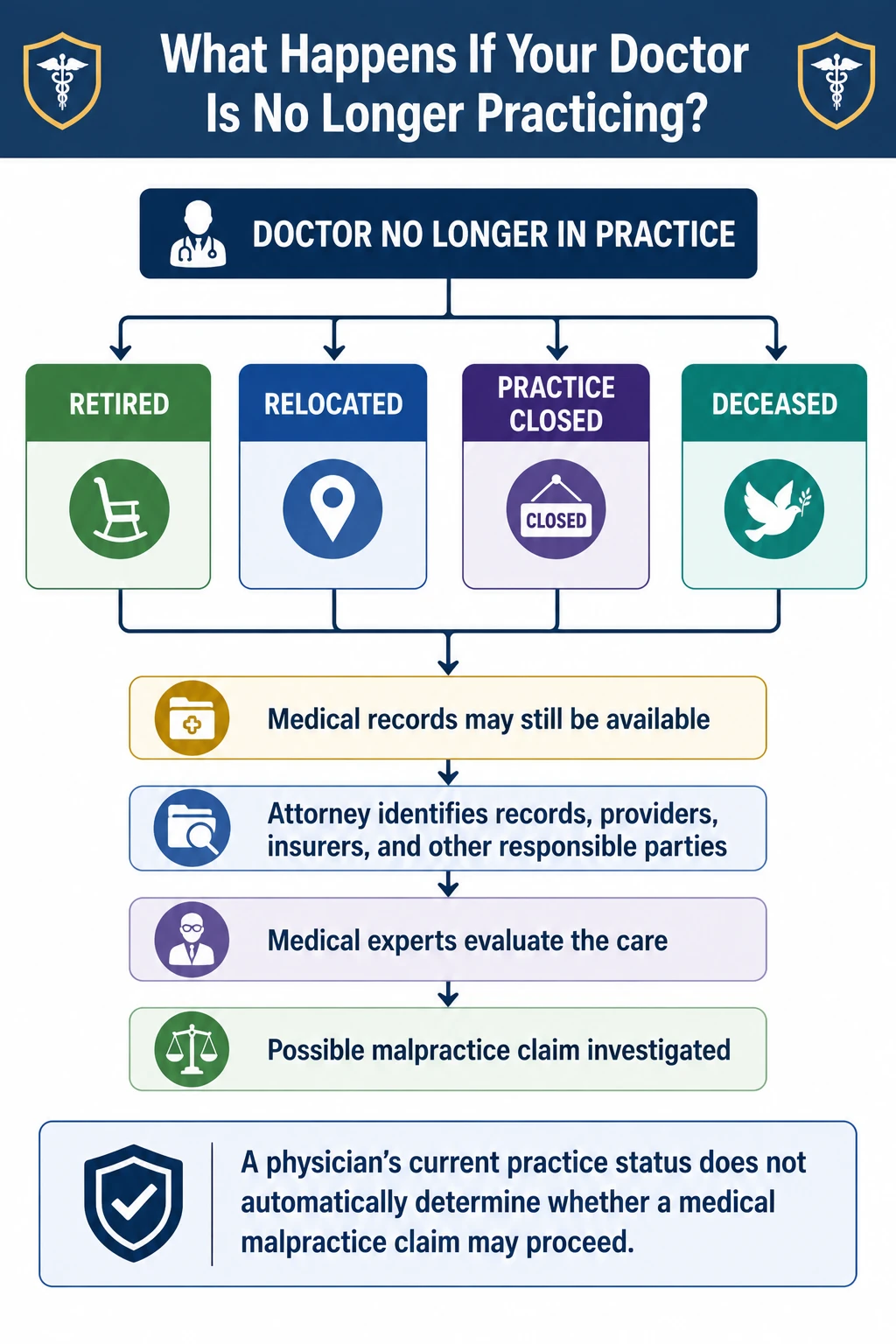
A physician’s current practice status does not automatically determine whether a medical malpractice claim may proceed.
The investigation begins the same way as any other medical malpractice case. An attorney identifies record custodians, prior practice entities, hospitals, medical groups, insurers, and other potentially responsible parties.
Even if the physician is no longer practicing, the medical records and other evidence often provide the information needed to determine whether the healthcare provider departed from the accepted standard of medical care and whether that departure caused or was a substantial factor in causing the patient’s injuries.
Not necessarily. Medical records are often maintained even after a physician retires or leaves a practice, although where they are kept and how long they must be retained depend on the provider, applicable law, and the circumstances. Depending on the circumstances, the records may be retained by the physician, transferred to another healthcare provider, maintained by a hospital or medical group, or stored by a records custodian in accordance with applicable record retention requirements.
An experienced medical malpractice attorney can determine where the records are located and take the necessary steps to obtain them.
Records may be transferred to another practice, maintained by a hospital or affiliated medical practices, stored by a professional records custodian, or retained pursuant to New York record-retention requirements.
A physician’s death does not automatically prevent investigation of a medical malpractice claim. Medical records are often still available, and any claim may involve the physician’s professional corporation, malpractice insurer, estate, hospital, medical practice, or other potentially responsible parties. The specific legal issues depend on the facts and applicable law.
The loss, suspension, or surrender of a medical license does not automatically determine whether malpractice occurred. The investigation still focuses on the care that was provided, whether it departed from the accepted standard of medical care, and whether that departure caused injury.
Not necessarily. Many physicians maintain professional liability insurance that may provide coverage for claims arising from treatment rendered while the policy was in effect, including through extended reporting ("tail") coverage where applicable. Insurance issues depend on the policy, dates of treatment, and other circumstances.
Many physicians practice as part of a hospital or an affiliated medical practice, medical group, or healthcare system. In those situations, additional records may be available through the institution, and the investigation may include evaluating the actions of other healthcare providers who participated in the patient’s care.
Depending on the facts, responsibility may involve more than one healthcare provider or organization.
Closing a medical practice does not automatically prevent an investigation. Records are frequently transferred to another physician, retained by a records custodian, maintained by a medical group, or otherwise preserved under applicable record-retention requirements.
It is not uncommon for patients to contact us months or even years after receiving medical treatment, only to discover that the physician has retired or relocated. In many of those situations, the medical records are still available, qualified medical experts are able to evaluate the care that was provided, and the investigation proceeds in the same manner as any other medical malpractice case.
The physician’s current practice status is often much less important than the quality of the available medical evidence.
Many medical malpractice cases involve more than one healthcare provider. During our investigation, we evaluate everyone who participated in the patient’s care, including physicians, specialists, nurses, hospitals, medical practices, and other healthcare professionals.
By carefully reviewing the medical records and consulting with qualified experts, we determine whether multiple providers or healthcare organizations may have contributed to the patient’s injury.
Many clients worry that they have waited too long or that they no longer have a case because the doctor retired or moved away. Others wonder whether important records have been lost or whether the physician can still be held accountable.
In many cases, those concerns can be addressed through a thorough investigation. The important step is having the circumstances reviewed before assuming that no legal options remain.
Yes. Although a physician’s retirement or relocation does not prevent a medical malpractice claim, it is always better to begin the investigation as soon as possible.
Retirement, relocation, or practice closure does not stop the statute of limitations from running. Legal deadlines are determined by New York law rather than the physician’s current employment status.
Seeking legal guidance promptly helps preserve evidence and allows sufficient time to fully investigate the circumstances of the case.
When a physician has retired, relocated, closed a practice, lost a license, or died, the investigation usually begins by determining where the relevant medical records are now maintained. Records may remain with the former practice, be transferred to another physician or medical group, be stored by a hospital or health system, or be maintained by a professional records custodian.
The attorney will also confirm the identity and legal status of the physician and any related practice entities. This may include determining whether the doctor was employed by a hospital, medical group, professional corporation, or another organization when the treatment occurred. Those relationships can affect which individuals or entities may be responsible for the care.
The investigation may also involve identifying potentially applicable professional liability insurance and determining whether coverage may exist for treatment provided before the physician stopped practicing. Insurance coverage depends on the policy terms, treatment dates, reporting requirements, and other circumstances.
After the relevant records and provider relationships are identified, qualified medical experts may review the care to evaluate whether the physician or another provider departed from the accepted standard of medical care and whether that departure caused or was a substantial factor in causing the patient’s injuries.
If you believe a doctor who is no longer practicing may have caused a serious medical injury, do not assume that you have lost the ability to pursue a claim. Speak with an experienced New York medical malpractice attorney as soon as possible.
An attorney can determine where the medical records are located, evaluate the applicable legal deadlines, consult with qualified medical experts, and explain whether you may have a valid medical malpractice claim. Taking action promptly is the best way to protect your rights and begin understanding what happened.
Retirement alone does not eliminate potential liability.
Records are usually maintained or transferred.
Relocation does not automatically prevent investigation.
Legal deadlines are determined by New York law.
Insurance issues depend on the applicable policy and circumstances.
A physician’s current practice status does not automatically determine whether a medical malpractice claim may proceed.

Michael Bottar is a nationally recognized New York medical malpractice and personal injury attorney and the founder of Bottar Law. Throughout his career, he has dedicated his practice to representing individuals and families affected by medical negligence, catastrophic injuries, wrongful death, and other serious acts of negligence. Michael is committed to helping clients understand their legal rights, navigate the complexities of the legal system, and pursue accountability with compassion, integrity, and unwavering advocacy.
For more than 40 years, Bottar Law has represented individuals and families throughout Syracuse, Central New York, and across New York in complex medical malpractice litigation involving catastrophic injuries and wrongful death. Through educational resources like these FAQs, Michael Bottar and the Bottar Law team strive to provide clear, reliable information to help injured individuals and their families make informed decisions during difficult times. Prior results do not guarantee a similar outcome.
Speak with Bottar Law about whether your claim can still move forward.