 Call833-268-8277

Understand why a signed consent form doesn’t excuse negligent care, and how informed consent differs from negligent treatment.
Attorney reviewed
New York focused
Updated resource
You consent to treatment, not to malpractice.
Yes. In many situations, you may still have a valid New York medical malpractice claim even if you signed a consent form before treatment. A consent form documents that you were informed of certain known risks, benefits, and alternatives associated with a procedure. It does not authorize negligent medical care or excuse a healthcare provider from meeting the accepted standard of medical care.
Some cases also involve a separate legal issue known as informed consent. Under New York law, questions about whether sufficient information was provided before treatment may be evaluated independently from whether the medical care itself was negligent.
No. Patients often use the terms interchangeably, but they serve different purposes. A medical consent form generally documents that the patient received information about the proposed treatment, its reasonably foreseeable risks, potential benefits, and available alternatives. It is not a contract that releases a healthcare provider from responsibility for negligent medical care.
Whether a malpractice claim exists depends on what actually occurred during the patient’s care and whether the provider departed from the accepted standard of medical care.
No. Signing a consent form before a medical procedure does not automatically prevent you from bringing a medical malpractice claim. A consent form acknowledges that certain known risks may occur even when appropriate care is provided. It does not excuse negligence or protect a healthcare provider who fails to meet accepted standards of medical care.
Whether you have a valid claim depends on the facts of the case, not simply on whether you signed paperwork before treatment.
Informed consent means a patient has been given enough information to make an educated decision about whether to proceed with a recommended treatment or procedure. This generally includes discussing the nature of the procedure, its reasonably foreseeable risks, potential benefits, and available alternatives.
Agreeing to treatment is not the same as agreeing to negligent medical care. A patient can consent to a procedure while still expecting that it will be performed competently and in accordance with accepted standards of medical care.
Under New York law, a lack of informed consent claim is different from a claim that treatment itself was performed negligently. A patient may allege that important risks or alternatives were not adequately explained before treatment, that the treatment was performed negligently, or in some cases both. Each legal theory requires its own factual and medical evaluation.
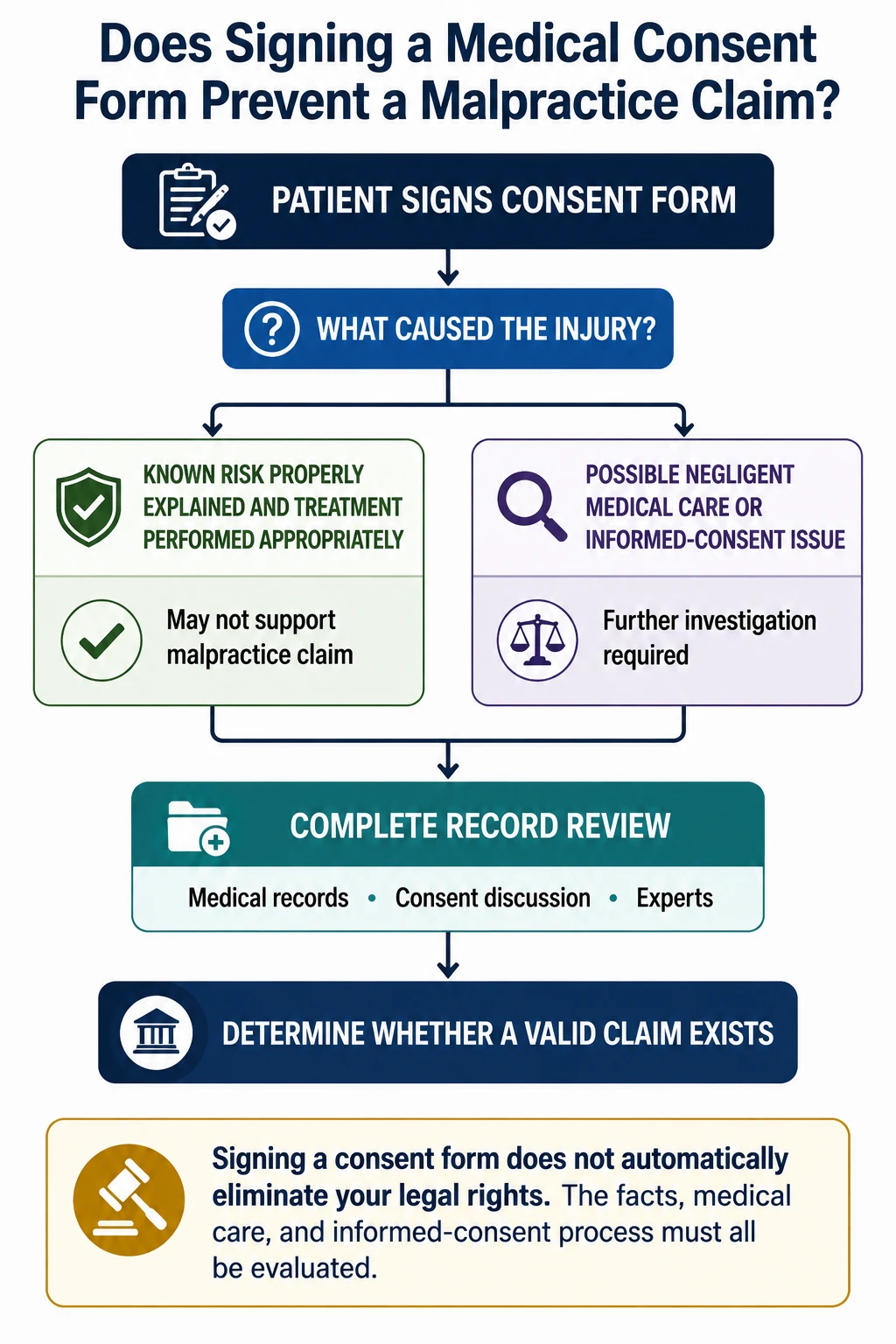
Signing a consent form does not automatically eliminate your legal rights. The facts, medical care, and informed-consent process must all be evaluated.
Known complication fully explained before treatment
Not necessarily
Known complication caused by negligent treatment
Potentially
Wrong-site surgery
Potentially
Wrong medication administered
Potentially
Missed diagnosis
Potentially
Failure to disclose material risks before elective procedure
Potential informed-consent issue
Appropriate treatment with unavoidable complication
Not necessarily
A poor outcome alone does not establish malpractice. The circumstances, medical care, informed-consent process, and medical evidence must all be evaluated.
A signed consent form does not prevent a malpractice claim if the injury resulted from negligent medical care rather than from a known risk that was properly disclosed. For example, a claim may still exist if a healthcare provider made a preventable surgical error, failed to diagnose a serious condition, administered the wrong medication, or otherwise failed to provide care that met accepted standards of medical care.
Each case requires a careful review of both the medical records and the circumstances surrounding the patient’s treatment.
A consent form generally acknowledges that some complications may occur despite appropriate medical care. It does not excuse preventable errors, treatment that departs from the accepted standard of medical care, or failures to obtain informed consent when required.
Determining whether informed consent was properly obtained involves more than reviewing a signed form. The investigation may include examining the medical records, reviewing the consent documents, and evaluating what discussions took place between the healthcare provider and the patient before treatment.
In some cases, testimony from the patient, family members, healthcare providers, and medical experts may help determine whether sufficient information was provided for the patient to make an informed decision.
The investigation may also evaluate whether the discussion occurred early enough for the patient to make a meaningful decision, whether alternatives were explained, whether questions were answered, and whether the patient had an opportunity to decline or postpone treatment.
Many people assume that signing a consent form means they have no legal rights if something goes wrong. That is not always the case. There are situations where a patient signs the necessary paperwork but later learns that the injury resulted from a preventable medical error rather than a known complication of the procedure.
For example, an investigation may reveal that a diagnosis was missed, the wrong procedure was performed, or accepted patient safety standards were not followed. These issues are often discovered only after a detailed review of the medical records by qualified experts.
By contrast, some complications occur despite appropriate treatment and were fully explained beforehand. Those situations do not automatically establish malpractice simply because the outcome was unfavorable.
Patients should have a meaningful opportunity to ask questions and understand the information being provided before consenting to medical treatment. If you felt rushed, pressured, or did not understand the procedure, the risks involved, or the available alternatives, those facts may be relevant when evaluating whether informed consent was properly obtained.
Every situation is different, and an experienced medical malpractice attorney can help determine whether the consent process complied with New York law.
Consent forms are only one part of the overall investigation. An attorney will also review the complete medical records, physician notes, nursing documentation, operative reports, diagnostic testing, and other records related to the patient’s care.
When these records are reviewed together by qualified medical experts, they often provide a more complete understanding of what occurred before, during, and after treatment.
The investigation may also review consultation notes, educational materials provided before treatment, nursing documentation concerning the consent discussion, operative reports, anesthesia records, and any additional documents describing the informed-consent process.
Many clients worry that signing a consent form means they have automatically given up their right to pursue a claim. Others are concerned that they should have asked more questions or that they somehow accepted responsibility for what happened.
I want clients to know that signing a consent form does not necessarily prevent a medical malpractice claim. The important question is whether the healthcare provider met the accepted standard of care and whether the patient received the information necessary to make an informed decision before treatment.
Patients often confuse signing paperwork with giving up their legal rights. In reality, the purpose of most medical consent forms is to document informed decision-making, not to eliminate accountability for negligent care.
The investigation may include reviewing consent documents, operative reports, physician notes, nursing documentation, consultation records, and the complete medical chart. Qualified medical experts may evaluate whether the treatment met the accepted standard of medical care, while the facts surrounding the consent discussion may also be examined to determine whether informed consent was appropriately obtained under New York law.
If you believe you were harmed by a medical mistake, do not assume that signing a consent form prevents you from pursuing a claim. An experienced medical malpractice attorney can review your medical records, evaluate the consent documents, and determine whether the facts support a medical malpractice case.
A timely legal review may help preserve important evidence and determine whether the medical care, the informed-consent process, or both warrant further investigation.
Because important records and witness recollections may become more difficult to obtain over time, seeking a timely legal review may help preserve evidence needed to evaluate both the medical care and the informed-consent process.
A consent form does not automatically prevent a malpractice claim.
Many complications occur despite appropriate treatment and proper disclosure.
Patients consent to treatment, not negligent medical care.
A complication caused by negligent treatment may still support a claim.
Medical records, provider testimony, expert review, and other evidence are also evaluated.
The entire informed-consent process may be examined, not just the signature.
Signing a consent form does not automatically eliminate your legal rights.

Michael Bottar is a nationally recognized New York medical malpractice and personal injury attorney and the founder of Bottar Law. Throughout his career, he has dedicated his practice to representing individuals and families affected by medical negligence, catastrophic injuries, wrongful death, and other serious acts of negligence. Michael is committed to helping clients understand their legal rights, navigate the complexities of the legal system, and pursue accountability with compassion, integrity, and unwavering advocacy.
For more than 40 years, Bottar Law has represented individuals and families throughout Syracuse, Central New York, and across New York in complex medical malpractice litigation involving catastrophic injuries and wrongful death. Through educational resources like these FAQs, Michael Bottar and the Bottar Law team strive to provide clear, reliable information to help injured individuals and their families make informed decisions during difficult times. Prior results do not guarantee a similar outcome.
Speak with Bottar Law about whether your medical care met accepted standards.