 Call833-268-8277

Understand the general filing deadline, the key exceptions, and why waiting can cost you your claim.
Attorney reviewed
New York focused
Updated resource
But exceptions for delayed diagnosis, minors, foreign objects, and wrongful death can change the deadline entirely.
The statute of limitations is the legal deadline for filing a medical malpractice lawsuit. In New York, that deadline is generally two years and six months from the date the malpractice occurred or from the end of a continuous course of treatment for the same condition. However, there are important exceptions that may shorten or extend the time available to file a claim.
Because these deadlines can be complicated, anyone who believes they have been harmed by medical negligence should speak with an experienced medical malpractice attorney as soon as possible. Waiting too long could result in losing the right to pursue compensation, even if the underlying claim is valid.
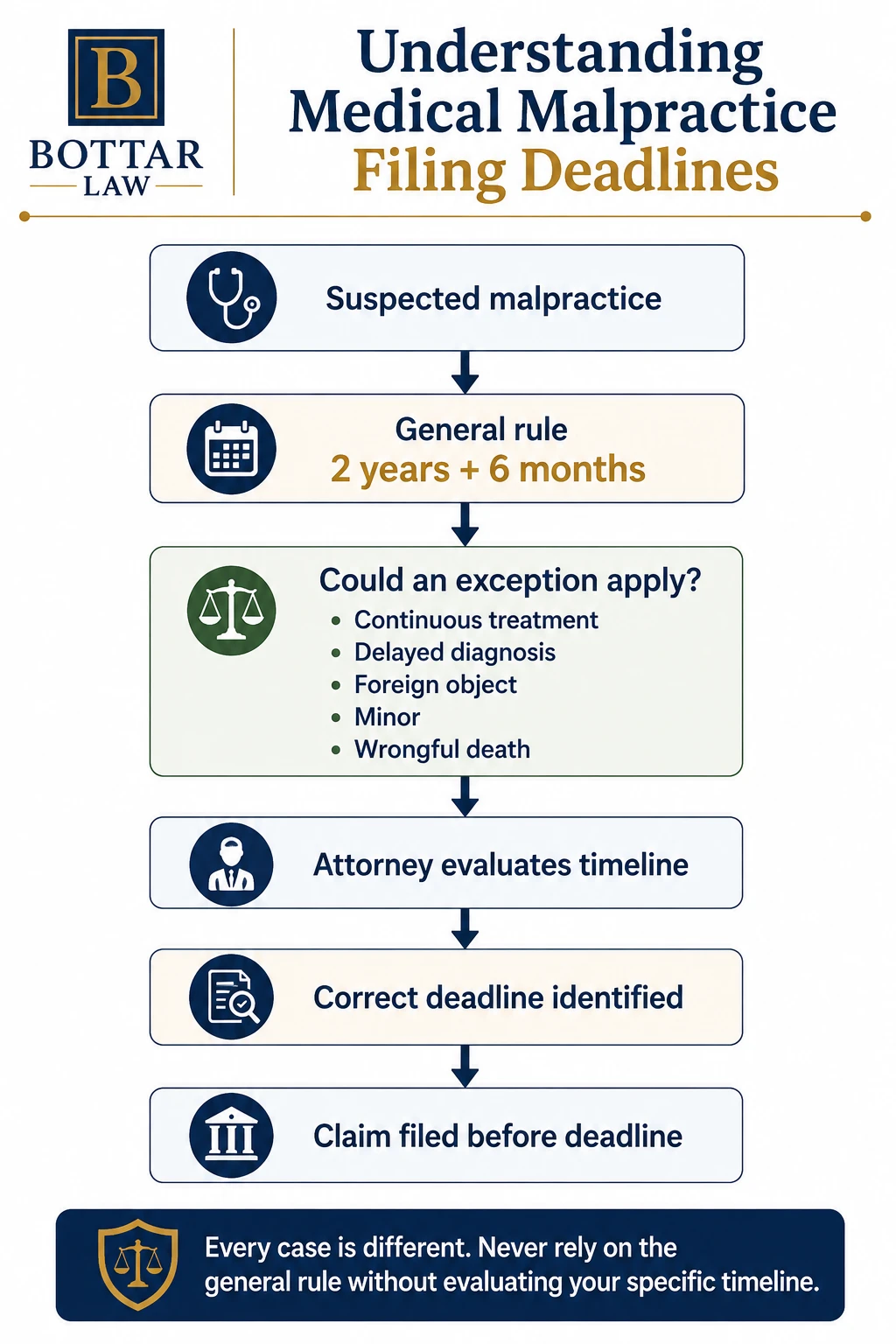
Every case is different. Never rely on the general rule without evaluating your specific timeline.
In most cases, a medical malpractice lawsuit in New York must be filed within two years and six months of the alleged malpractice or the end of continuous treatment related to the condition that gave rise to the claim. While this is the general rule, every case should be evaluated individually because the applicable deadline may vary depending on the specific facts.
Determining the correct filing deadline is one of the first steps an attorney should take when evaluating a potential medical malpractice claim.
Yes. New York law recognizes several exceptions to the general statute of limitations. Depending on the circumstances, different rules may apply in cases involving delayed diagnosis, foreign objects left inside a patient’s body after surgery, injured children, or wrongful death.
Because these exceptions can significantly affect the filing deadline, it is important to have an attorney review the facts of the case rather than relying on the general rule alone.
Yes. While many medical malpractice claims in New York are subject to the general statute of limitations, certain delayed diagnosis cases may be governed by different statutory rules. For example, some claims involving the delayed diagnosis of cancer or a malignant tumor may be subject to specific provisions of New York law that differ from the general filing deadline.
Determining which deadline applies depends on the specific facts of the case, including the nature of the medical condition, when the alleged malpractice occurred, when it was discovered, and the applicable statute. Because these rules can be complex and highly fact-specific, it is important not to assume that the general statute of limitations applies, or that it does not.
If you believe a delayed diagnosis or delayed treatment caused harm, an experienced medical malpractice attorney can review your medical records, evaluate the timeline, and determine which legal deadline may apply to your situation.
Some medical malpractice injuries are not discovered immediately. Under New York law, however, delayed discovery of an injury does not automatically extend the statute of limitations. Certain categories of claims, such as those governed by specific statutory provisions, may be subject to different timing rules depending on the facts.
These cases can be legally complex because determining which legal deadline applies often requires a careful review of the medical records, the course of treatment, and when the injury reasonably became known. An experienced attorney can help determine which deadline applies.
Yes. Medical malpractice claims involving children are often subject to different legal rules than claims involving adults. While certain deadlines may be extended because the injured patient is a minor, those extensions are not unlimited and other statutory restrictions may still apply.
Parents should never assume they have years to decide whether to pursue a claim. Having the case evaluated early helps preserve evidence and ensures that important legal deadlines are not missed.
When medical negligence results in a person’s death, different legal deadlines may apply to a wrongful death claim. In addition to the medical malpractice issues, there are separate legal requirements that govern who may bring the claim and when it must be filed.
Because these cases involve multiple legal considerations, families should seek legal advice promptly so that all applicable deadlines can be identified and protected.
Timing is important in every medical malpractice case. Medical records can become more difficult to obtain, witnesses’ memories may fade, and important evidence can become harder to preserve as time passes. In addition, if a lawsuit is not filed before the applicable statute of limitations expires, the injured person may lose the right to pursue compensation altogether.
For these reasons, we encourage individuals to have their case reviewed as soon as they suspect that medical negligence may have occurred, even if they are not yet certain they have a claim.
Many people delay contacting an attorney because they are focused on recovering from their injuries, continuing medical treatment, or trying to understand what happened. Others are unsure whether a medical mistake actually occurred or worry that they may not have a valid claim.
Unfortunately, waiting too long can make a case more difficult to investigate and may even prevent a claim from being filed if the statute of limitations expires. Speaking with an attorney early allows important evidence to be preserved while providing clarity about your legal options.
Every medical malpractice case begins with a careful review of the medical records and timeline of events. At Bottar Law, we work to identify when the alleged negligence occurred, whether any exceptions to the statute of limitations may apply, and what legal deadlines must be met.
Our goal is to provide clients with clear answers about their rights and help them make informed decisions before important deadlines pass.
The most helpful information usually includes:
Even if you do not have every record, providing the names of your healthcare providers and the approximate dates of treatment can help begin the evaluation.
An experienced medical malpractice attorney can obtain additional records and determine what information is needed to assess the potential claim.
Under New York law, the statute of limitations may, in some circumstances, begin to run from the end of a continuous course of treatment for the same condition rather than from the date of the alleged malpractice. Whether the doctrine applies depends on the facts of the case, including the nature of the treatment and the relationship between the patient and healthcare provider. Because its application is highly fact-specific, an attorney should evaluate the timeline carefully.
If you are unsure whether the statute of limitations has expired, you should speak with an experienced medical malpractice attorney as soon as possible. Do not assume that it is too late or that you still have plenty of time. The applicable deadline depends on the facts of the case, and there may be exceptions that affect your legal rights.
Early legal review also helps identify and preserve records and other evidence that may become more difficult to obtain as time passes.
An attorney can review your medical records, determine which statute of limitations applies, and explain your options. Seeking legal guidance promptly is the best way to protect your rights and avoid missing an important filing deadline.
That is the general rule, but important statutory exceptions may apply.
New York law contains specific rules for certain situations. Discovery alone does not always determine the filing deadline.
Claims involving minors often follow different rules, but important limits still apply.
The applicable deadline depends on the facts, and an attorney should evaluate the timeline before conclusions are reached.
Delay can affect both legal deadlines and the availability of evidence.
Every case is different. Never rely on the general rule without evaluating your specific timeline.

Michael Bottar is a nationally recognized New York medical malpractice and personal injury attorney and the founder of Bottar Law. Throughout his career, he has dedicated his practice to representing individuals and families affected by medical negligence, catastrophic injuries, wrongful death, and other serious acts of negligence. Michael is committed to helping clients understand their legal rights, navigate the complexities of the legal system, and pursue accountability with compassion, integrity, and unwavering advocacy.
For more than 40 years, Bottar Law has represented individuals and families throughout Syracuse, Central New York, and across New York in complex medical malpractice litigation involving catastrophic injuries and wrongful death. Through educational resources like these FAQs, Michael Bottar and the Bottar Law team strive to provide clear, reliable information to help injured individuals and their families make informed decisions during difficult times. Prior results do not guarantee a similar outcome.
Speak with Bottar Law to find out which deadline applies to your case.