 Call833-268-8277

Understand how responsibility is evaluated when several providers were involved in your care.
Attorney reviewed
New York focused
Updated resource
Involvement in your care doesn’t automatically mean legal responsibility.
More than one doctor, nurse, hospital, medical group, or other healthcare provider may be legally responsible when separate acts or omissions combine to cause the same injury. Each provider’s role must be evaluated individually, including what information was available, what duty applied, whether the provider departed from the accepted standard of medical care, and whether that departure caused or was a substantial factor in causing harm. A lawsuit may include multiple defendants when the factual, medical, and legal investigation supports claims against each of them. Defendants may dispute responsibility, seek contribution from one another, or ask that fault be allocated among the responsible parties. The patient does not need to identify every responsible provider before consulting an attorney.
Medical malpractice cases sometimes involve more than one healthcare provider. A patient’s care may include primary care physicians, specialists, emergency room doctors, surgeons, nurses, hospital staff, and other providers who all play a role in diagnosis and treatment. If multiple providers departed from the accepted standard of medical care and their departures contributed to the patient’s injury, more than one person or organization may be legally responsible.
Determining responsibility requires a careful investigation of the medical records, the timeline of treatment, and the decisions made by each provider. An experienced medical malpractice attorney works with qualified medical experts to identify where errors occurred and whether those errors contributed to the patient’s harm.
When several providers participated in the patient’s care, each person’s conduct must be evaluated separately. One provider may have failed to recognize symptoms, another may have failed to communicate a critical result, and another may have delayed treatment after receiving the information. Those acts may involve different duties and medical specialties but still combine to cause one injury.
A viable claim against each provider ordinarily requires evidence of a departure from the accepted standard of medical care and a causal connection between that departure and the injury. The fact that several providers were involved does not mean all of them were negligent, and a provider should not be named merely because the person appears in the medical chart.
When the evidence supports responsibility by multiple parties, they may be joined in the same lawsuit. Questions about contribution, indemnification, and allocation of fault may then arise among the defendants. New York permits parties subject to liability for the same personal injury to seek contribution from one another.
The investigation begins with a detailed chronology showing which provider was responsible at each stage, what symptoms and test results were available, what orders or referrals were made, what information was communicated, and what action was taken.
For each provider, counsel and qualified medical experts should evaluate:
The legal evaluation then determines which individuals or entities are supported as defendants and which providers were involved but did not contribute to the injury.
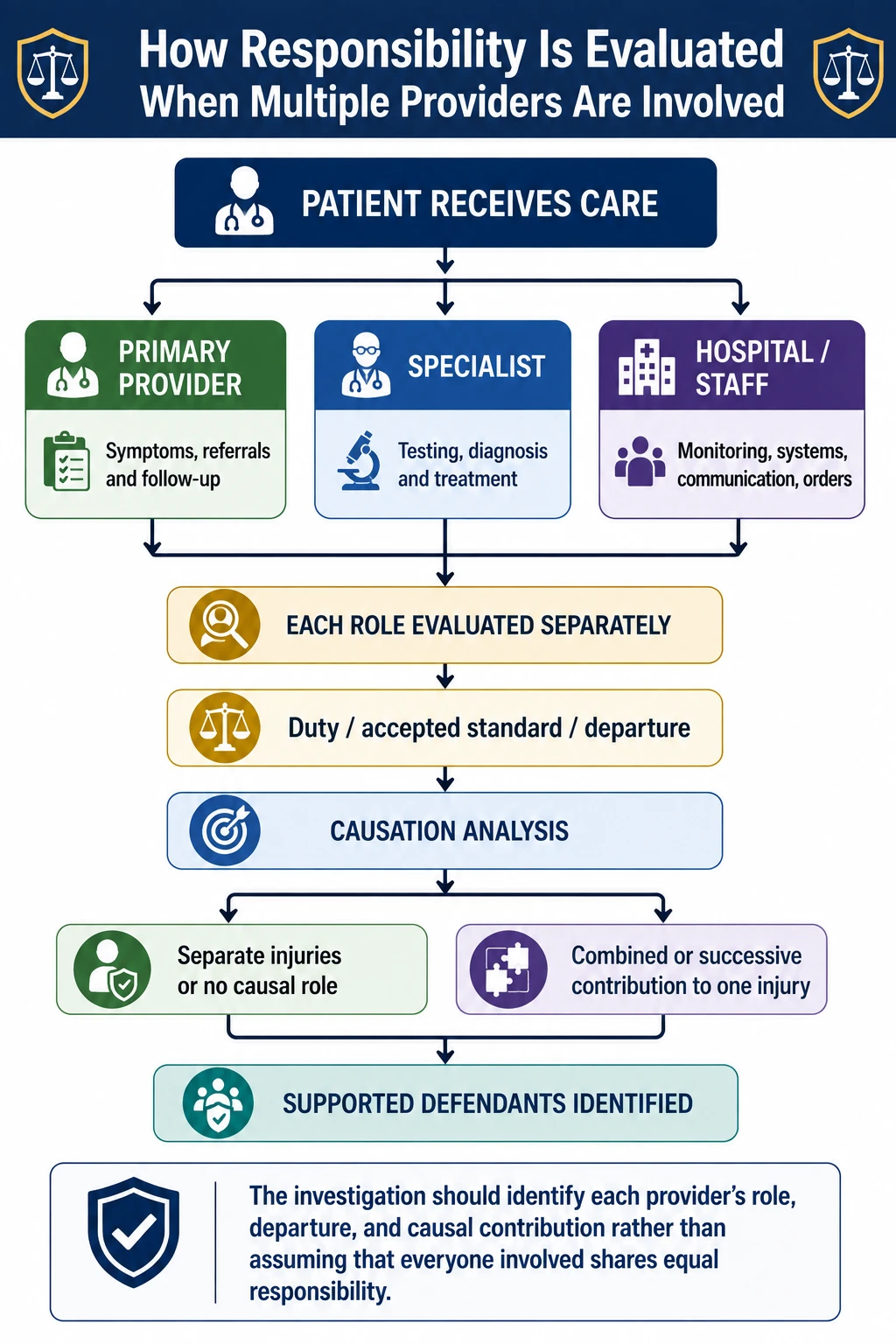
The investigation should identify each provider’s role, departure, and causal contribution rather than assuming that everyone involved shares equal responsibility.
Primary care physician
Recognition of symptoms, referrals, follow-up, and communication of abnormal findings
Specialist
Specialty-specific diagnosis, testing, treatment recommendations, and follow-up
Emergency physician
Triage response, differential diagnosis, testing, consultation, and disposition
Surgeon
Operative judgment, technique, postoperative monitoring, and response to complications
Radiologist or pathologist
Interpretation, reporting, communication, and escalation of critical findings
Nurse or advanced-practice provider
Monitoring, medication administration, documentation, communication, and escalation
Hospital or health system
Employee liability, staffing, supervision, systems, communication processes, and institutional duties
Medical group or professional entity
Employment, supervision, vicarious liability, and control over the provider
Subsequent treating provider
Whether later care reduced, worsened, or failed to prevent additional harm
A provider’s appearance in the chart does not by itself establish liability. The role, duty, departure, causation, and resulting injury must be evaluated.
Yes, when the investigation supports separate claims against them. An individual provider may be responsible for personal clinical decisions. A hospital or medical group may face vicarious liability for an employee acting within the scope of employment, while a hospital may also face direct institutional claims involving staffing, supervision, communication systems, policies, equipment, or other facility-level responsibilities.
The legal theories are not interchangeable. Counsel must determine the employment and agency relationships, the institution’s own conduct, and the causal role of each party. A lawsuit may include several defendants, but each claim should be supported by the evidence and applicable law.
Complex medical malpractice cases require a thorough investigation of every stage of the patient’s care. We review medical records from all providers involved, compare each provider’s conduct with the accepted standard of medical care applicable to that provider’s role and specialty, and develop a complete timeline of the patient’s medical history.
Different specialties may require different experts. A primary care expert may evaluate referral and follow-up responsibilities, while a radiology, surgery, emergency medicine, nursing, or other specialty expert may be needed to evaluate separate portions of the treatment. Because different providers often have different responsibilities, we work with qualified experts in the appropriate medical specialties to evaluate each provider’s role and determine whether a provider departed from the accepted standard of medical care and whether that departure caused or was a substantial factor in causing the patient’s injuries.
Yes. Separate departures may combine or occur in sequence. For example, a primary care physician may fail to respond appropriately to symptoms, a radiologist may fail to identify or clearly communicate an abnormal finding, and a specialist may fail to act promptly after receiving the report. The investigation must determine whether each alleged departure contributed to the delay and whether earlier diagnosis or treatment probably would have changed the outcome.
Other cases may involve a medication ordered incorrectly by one provider, dispensed or administered without appropriate safeguards, and inadequately monitored by another. A surgical case may involve operative conduct, postoperative nursing surveillance, and a delayed response to a developing complication.
These examples do not mean every participant is liable. Each provider’s duty, conduct, and causal contribution must be established independently.
Potentially. An earlier provider may create or worsen a condition, while a later provider may fail to diagnose, treat, or limit the resulting harm. The later negligence does not automatically eliminate the earlier provider’s responsibility, and the earlier conduct does not automatically make the later provider liable.
Qualified experts may need to evaluate how the patient’s condition changed over time, what harm had already occurred, what could still have been prevented, and which portion of the injury is attributable to each departure. Depending on the evidence, the providers may be responsible for the same injury, different portions of the injury, or no compensable harm.
Defendants in a multi-provider case may offer different explanations about who was responsible for ordering tests, communicating results, arranging follow-up, monitoring the patient, or making treatment decisions. Those positions are evaluated against the complete evidentiary record, including the medical chart, orders, communications, policies, audit information, deposition testimony, and qualified expert opinions.
A provider’s explanation is relevant evidence, but it is not conclusive. The investigation must determine which duties actually applied and whether any departures caused or contributed to the injury. Defendants may also assert contribution or indemnification claims against one another when they contend another party bears some or all of the responsibility. New York law permits contribution among parties subject to liability for the same personal injury.
Responsibility may be allocated among defendants based on their respective contributions to the injury. The allocation can affect how damages are assessed and how defendants resolve contribution claims among themselves. The governing rules are fact-specific and can differ for economic and noneconomic losses.
New York law contains rules governing the allocation of fault and responsibility among multiple defendants. How those rules apply depends on the verdict, the parties involved, the types of damages awarded, and applicable statutory provisions. This does not mean that every multi-defendant malpractice case produces the same allocation or collection result. Counsel must evaluate the verdict, fault shares, available parties, applicable exceptions, and type of damages.
Qualified experts evaluate the conduct of each provider within the provider’s specialty and role. They may identify the applicable accepted standard of medical care, determine whether a departure occurred, and analyze whether the departure caused or was a substantial factor in causing injury.
Multi-provider cases may require experts from several specialties because the relevant duties differ. Experts may also help distinguish an original injury from later aggravation, identify which harm could still have been avoided at each stage, and explain whether separate departures combined to produce the final outcome. Experts provide medical opinions. Counsel uses those opinions with the records, testimony, relationships, procedural rules, and damages evidence to determine the supported legal claims and defendants.
Complex treatment may involve repeated handoffs, overlapping responsibilities, multiple facilities, and records created by different departments. Patients may not know which provider received a test result, who was expected to follow up, or when responsibility shifted from one clinician to another.
A structured chronology can clarify those issues by linking each event to the responsible provider, the available information, the required action, and the patient’s changing condition. The purpose is to convert a fragmented medical history into a sequence that can be evaluated by counsel and appropriately qualified experts.
Bottar Law may obtain records from the providers and facilities involved, organize the treatment into a detailed chronology, identify employment and agency relationships, map communications and handoffs, and determine which medical specialties are relevant to the evaluation.
The investigation may then examine each provider separately: the role assigned, information available, accepted standard of medical care, alleged departure, and causal effect. Qualified experts in different specialties may be consulted when separate portions of the treatment require distinct medical analysis.
The goal is not to name every provider involved. It is to identify the individuals and entities for whom the evidence supports departure, causation, and legal responsibility, while excluding those whose care did not contribute to the injury.
Preserve the records and information already available and consult a medical malpractice attorney without unnecessary delay. You do not need to determine which doctor, nurse, hospital, or medical group was responsible before requesting an evaluation.
Counsel can obtain additional records, reconstruct the chronology, identify the providers and entities involved, evaluate employment and agency relationships, and consult qualified experts in the appropriate specialties. Because filing deadlines may differ depending on the defendants and circumstances, uncertainty about responsibility should not delay the investigation.
Each claim should be supported by evidence of duty, departure, causation, and injury.
Separate departures may combine or occur in sequence.
Earlier and later providers may have separate causal roles.
Records, testimony, chronology, and qualified expert analysis may clarify responsibility.
Employment, agency, institutional conduct, scope of work, and control must be evaluated.
Allocation depends on the evidence and each party’s contribution to the injury.
The investigation should identify each provider’s role, departure, and causal contribution to the injury.

Michael Bottar is a nationally recognized New York medical malpractice and personal injury attorney and the founder of Bottar Law. Throughout his career, he has dedicated his practice to representing individuals and families affected by medical negligence, catastrophic injuries, wrongful death, and other serious acts of negligence. Michael is committed to helping clients understand their legal rights, navigate the complexities of the legal system, and pursue accountability with compassion, integrity, and unwavering advocacy.
For more than 40 years, Bottar Law has represented individuals and families throughout Syracuse, Central New York, and across New York in complex medical malpractice litigation involving catastrophic injuries and wrongful death. Through educational resources like these FAQs, Michael Bottar and the Bottar Law team strive to provide clear, reliable information to help injured individuals and their families make informed decisions during difficult times. Prior results do not guarantee a similar outcome.
Speak with Bottar Law about identifying who may actually be responsible.