 Call833-268-8277

Medical malpractice cases are typically built through a detailed investigation of the patient’s medical care, medical records, applicable standards of care, causation, and resulting injuries.
If the evidence supports a potential claim, the process may move from pre-suit investigation and medical expert review into filing a lawsuit, discovery, depositions, additional expert analysis, settlement negotiations, and potentially trial.
Building a medical malpractice case generally begins with investigating what happened, obtaining and reviewing relevant medical records, reconstructing the timeline of care, and consulting qualified medical experts when appropriate.
If the evidence supports proceeding with a lawsuit, the legal process may move to filing the required court documents and serving the appropriate defendants. The parties then typically enter discovery, during which they exchange records and other information, conduct depositions, develop expert evidence, and prepare their respective positions.
The time required can depend on the complexity of the medicine, number of parties, nature and extent of the injuries, discovery process, court schedule, motion practice, and whether the case resolves before trial.
A medical malpractice lawsuit does not necessarily begin when someone believes a medical error occurred. There can be substantial investigation before a case reaches court.
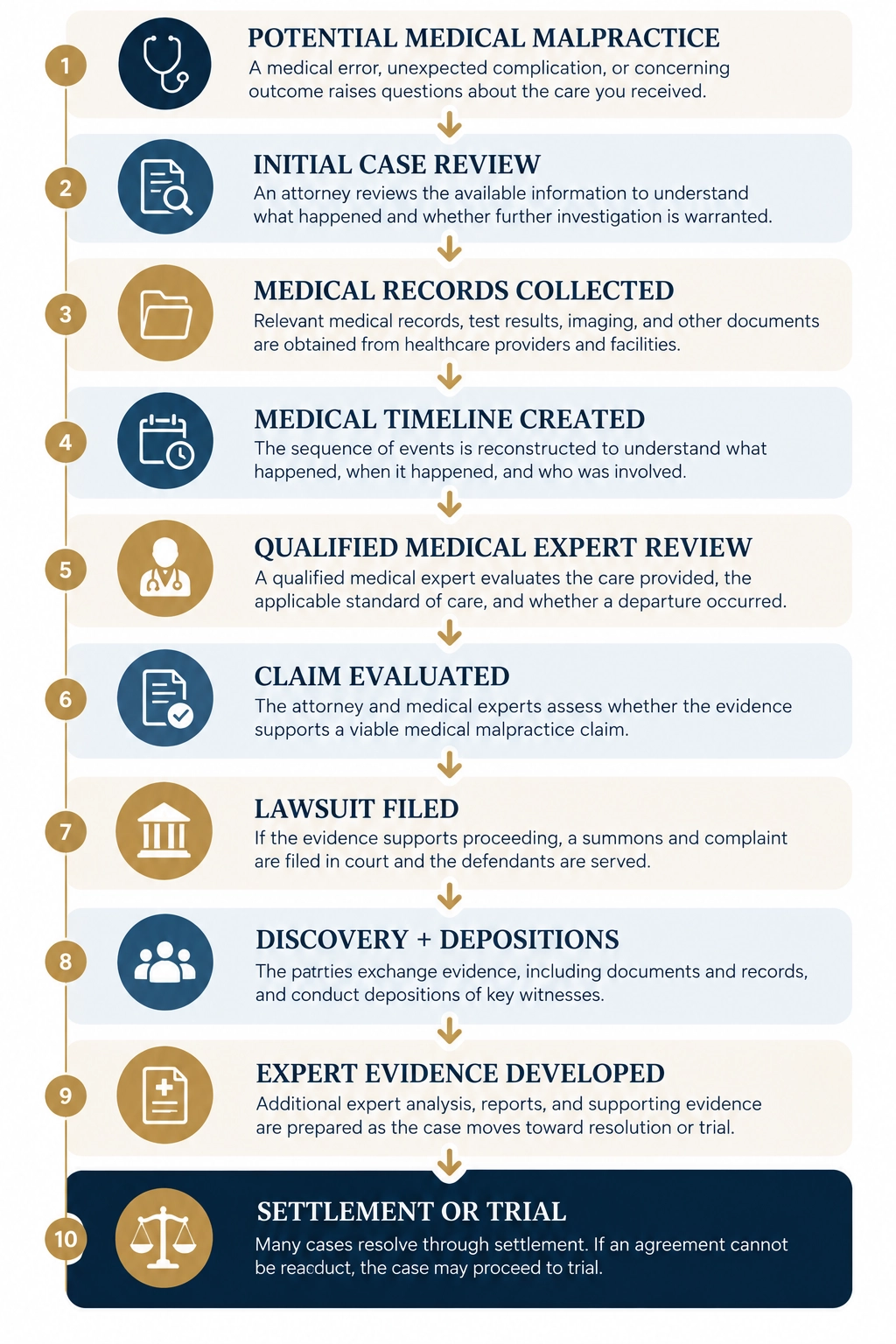
The exact process varies by case. Some matters may end during the investigation, while filed lawsuits can involve extensive discovery, motion practice, settlement negotiations, and trial preparation.
Filing a lawsuit is generally not the first step in evaluating a potential medical malpractice claim. Before deciding whether a case should proceed, attorneys may need to understand both what happened medically and whether the available evidence can support the necessary legal elements of a claim. That investigation can involve several stages.
Medical records provide a documentary history of the patient’s care. Depending on the circumstances, those records may include office notes, hospital records, laboratory results, diagnostic imaging, medication records, surgical reports, pathology results, nursing notes, consultations, discharge instructions, and records of subsequent treatment.
Together, they can help establish what the patient’s condition was, what healthcare providers knew, what testing occurred, what treatment decisions were made, and how the patient’s condition changed.
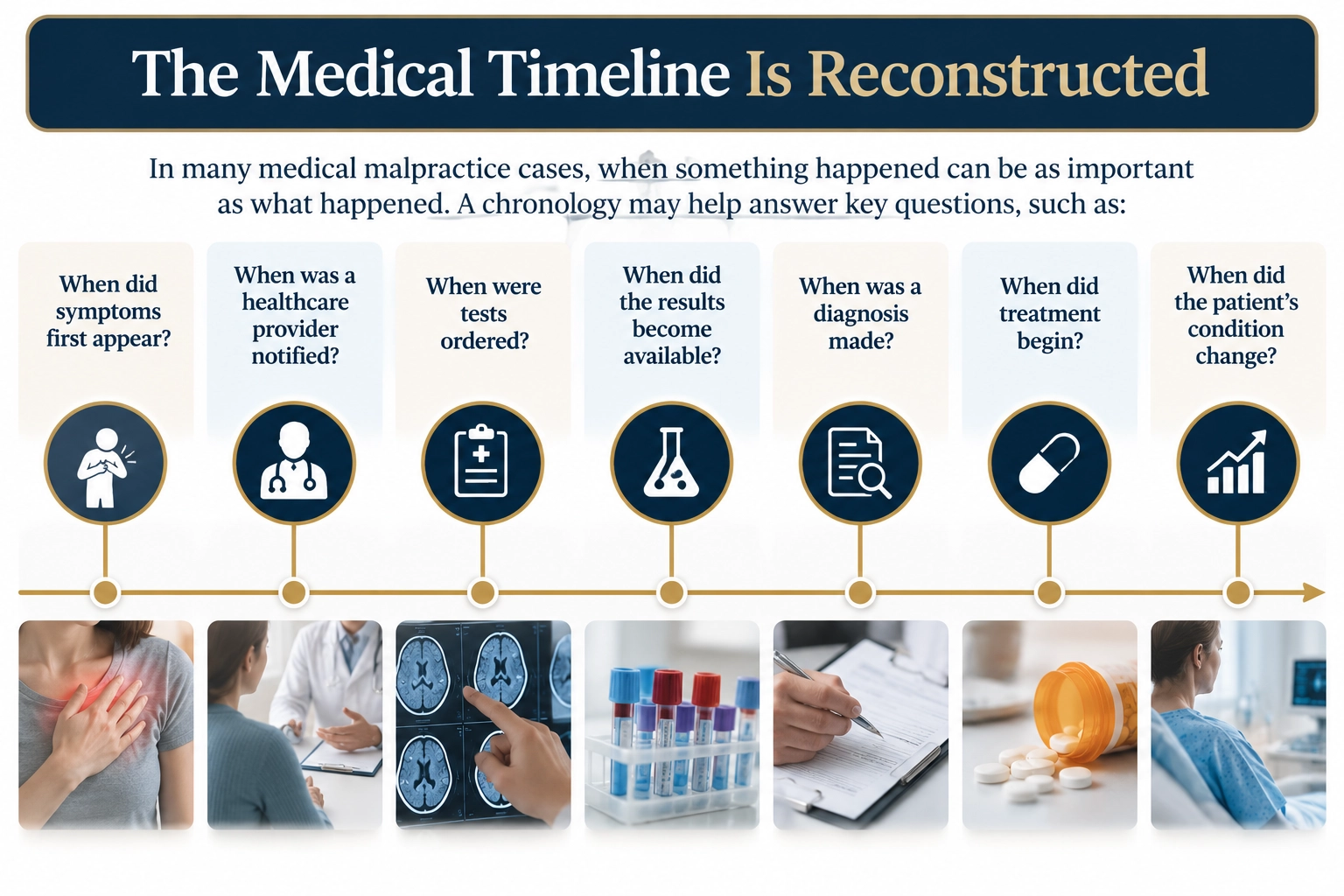
In many medical malpractice cases, when something happened can be as important as what happened.
Reconstructing that sequence can help identify potential delays, missed opportunities, communication failures, or other issues requiring further investigation.
The next question is not simply whether the patient experienced a poor result. The care that was actually provided must be evaluated against the applicable medical standard of care.
That can require determining what an appropriately qualified healthcare provider should have done under the circumstances and whether the defendant’s conduct represented a departure from accepted medical practice.
Identifying a potential medical error is not necessarily enough to establish a viable claim. The investigation must also consider whether the alleged departure caused the patient’s injury, worsened an existing condition, or otherwise resulted in compensable harm.
This can become particularly complex when a patient already had a serious disease or medical condition before the alleged malpractice occurred.
Medical malpractice cases often require specialized medical analysis. The relevant questions can include:
A qualified medical expert can help attorneys understand what appropriate medical practice required under the circumstances, whether the care provided departed from that standard, and whether a departure caused or contributed to the patient’s injuries.
Expert review may also reveal weaknesses in a potential case.
For example, a medical record that initially appears concerning may have a medically reasonable explanation. An apparent error may not have affected the patient’s outcome. Or the evidence may not support the connection between the alleged departure and the injury.
For that reason, expert analysis is not simply about confirming a theory. It can be an important part of determining whether the medical evidence actually supports one.
If the investigation and medical evidence support proceeding, and the applicable legal requirements can be satisfied, the matter may move into formal litigation. Conceptually, the process may look like this:
The exact filing requirements and procedures depend on the circumstances of the case and applicable New York law.
Filing also does not mean the investigation is complete. In many cases, significant evidence is developed after the lawsuit begins through discovery, depositions, expert work, and other litigation procedures.
The terms claim and complaint are related, but they do not mean exactly the same thing.
A medical malpractice claim broadly refers to the allegation or legal right being asserted against a healthcare provider.
A complaint is a formal pleading used in a lawsuit to set out allegations and claims against one or more defendants.
Understanding that distinction can make the litigation process easier to follow, particularly when terms that sound similar are used at different stages of a case.
After a lawsuit is underway, the parties generally use discovery to obtain information and evidence relevant to the claims and defenses. Discovery can be one of the most significant stages of a medical malpractice case because it allows both sides to investigate the factual and medical issues in greater depth. Depending on the case, discovery may involve:
Relevant medical records, documents, photographs, employment information, and other materials may be requested and exchanged. The information sought will depend on the claims and defenses involved.
Depositions involve sworn testimony given outside the courtroom. The plaintiff, defendant healthcare providers, and other witnesses may be questioned about relevant events, treatment, decisions, injuries, and other issues.
Legal mechanisms may be used to obtain relevant medical records, employment records, and other information from healthcare providers or third parties.
Depending on the nature of the injuries and claims, a plaintiff may be required to undergo a medical examination by a physician selected by the defense.
Expert medical and other professional opinions can become increasingly important as the case develops. Experts may address issues including the standard of care, departures from accepted practice, causation, future medical needs, and other matters requiring specialized knowledge.
Discovery is not simply paperwork. It is part of the process through which both sides test the evidence, develop their positions, and prepare the case for potential resolution or trial.
Medical records can become some of the most important evidence in a medical malpractice case. They may contain information about:
But medical records do not automatically favor one side.
The same records that may support an allegation of malpractice can also contain information the defense uses to challenge negligence, causation, or damages.
For example, records concerning a patient’s underlying condition may become relevant to determining whether the alleged malpractice actually caused the claimed injury. Subsequent treatment records may help establish the extent of harm, but they may also reveal other potential causes or changes in the patient’s condition.
Medical records are evidence. Their significance depends on the complete medical history, the issues in dispute, expert interpretation, and how the records relate to the standard of care, causation, and damages.
That is why isolated entries should generally be understood within the broader medical context.
There is no single timeline for every New York medical malpractice case. Some matters may end during the initial investigation. Others may resolve after a lawsuit is filed. Cases involving disputed medical issues, substantial injuries, numerous defendants, or extensive discovery can take considerably longer. Several factors can affect the timeline.
Complex medical issues may require extensive records, specialized experts, and detailed analysis of the patient’s condition and treatment.
A case involving several physicians, hospitals, medical practices, or other healthcare providers can require additional pleadings, records, depositions, experts, and coordination.
The amount of evidence that must be exchanged and developed can significantly affect the duration of litigation.
The parties may ask the court to decide legal or evidentiary issues while the lawsuit is pending, which can affect the litigation timeline.
Court calendars, scheduling orders, judicial availability, and other procedural considerations can also affect how quickly a case progresses.
Some cases may resolve during discovery or after important evidence is developed. Others may not involve meaningful settlement discussions until the parties are much closer to trial.
If a case does not resolve, attorneys may need to prepare witnesses, experts, exhibits, medical evidence, legal arguments, and other materials for trial.
The time a case takes therefore depends not on a single predetermined schedule, but on the medical, factual, and procedural circumstances involved.
Use these resources to explore individual parts of the case-development process in greater depth.
Learn about the process that can lead from investigating potential malpractice to formally pursuing a medical malpractice lawsuit.
Understand the distinction between the legal claim being asserted and the formal complaint used in litigation.
Learn why qualified medical experts can be important when evaluating the standard of care, potential departures, and causation.
Understand how parties obtain and exchange information, conduct depositions, develop evidence, and prepare their positions after litigation begins.
Explore the medical, factual, procedural, and court-related factors that can affect how long a malpractice case lasts.
Learn how medical records can be used as evidence by both sides and why the complete medical context matters.
A process diagram can explain the general stages of litigation, but it cannot predict how an individual case will develop. Several factors can substantially change the investigation and litigation strategy.
A delayed-diagnosis case may require different evidence and experts than a surgical-error, medication-error, birth-injury, or hospital-negligence case.
Some cases involve relatively focused medical issues. Others require analysis across multiple specialties, years of treatment, or complicated underlying conditions.
The involvement of multiple providers can create additional questions about who was responsible for particular decisions and whether more than one person or entity contributed to the injury.
The nature, permanence, and consequences of an injury can affect the medical evidence, damages analysis, experts required, and scope of litigation.
Records, diagnostic studies, witness testimony, communications, and other evidence can affect what can be established.
Qualified experts may support certain aspects of a claim, identify different issues than initially suspected, or conclude that the available evidence does not support proceeding.
Two patients with superficially similar outcomes can have very different cases because the medical facts, applicable standard of care, causation evidence, injuries, and available proof may differ.
As the evidence develops, the parties gain a clearer understanding of the strengths, weaknesses, and disputed issues in the case. The progression may look something like this:
From there, a case may move toward:
The parties may discuss resolving the claim without a trial.
If the parties cannot reach an agreement, the case may continue toward trial.
Building medical evidence is only one part of pursuing a medical malpractice claim.
New York law can impose deadlines and procedural requirements that may affect whether and how a claim can proceed.
That means a potentially strong medical theory does not eliminate the need to evaluate legal requirements.
Likewise, understanding a filing deadline is different from understanding whether the medical evidence supports malpractice in the first place.
Both issues can matter.
Medical malpractice litigation involves both medical and legal analysis. These resources are designed to explain the investigation and litigation process while recognizing that the development of every case depends on its particular facts, medical evidence, applicable law, and procedural circumstances.
Content is reviewed by Bottar Law attorneys for legal accuracy, relevance, and clarity.
Last reviewed: October 2026

Michael A. Bottar is an attorney with Bottar Law who has spent more than 20 years prosecuting medical malpractice, wrongful death, and serious personal injury cases throughout New York. He is the immediate past president of the New York State Academy of Trial Lawyers and has been recognized by The Best Lawyers in America® for his work in plaintiffs’ medical malpractice, product liability, and personal injury law.
Understanding that something may have gone wrong with medical care is different from determining whether the evidence can support a legal claim.
That evaluation may require reviewing medical records, applicable deadlines, qualified expert opinions, causation, and the nature and extent of the patient’s injuries.
If you or someone in your family suffered a serious injury and you have questions about whether a potential medical malpractice claim should be investigated, Bottar Law can review the circumstances and explain the options that may be available.
Tell us what happened.