 Call833-268-8277

Understand what happens during the pretrial exchange of records, depositions, and expert disclosure.
Attorney reviewed · New York focused · Updated resource
Filing a lawsuit doesn’t open your entire life to the defense.
Discovery is the pretrial phase of a New York medical malpractice lawsuit in which the parties exchange information and obtain testimony relevant to the claims and defenses. It may include document demands, medical-record authorizations, depositions, physical or mental examinations, requests for admission, nonparty subpoenas, and expert disclosure. The patient may be required to provide records and authorizations relating to medical conditions, causation, damages, employment, or other issues placed in controversy. Defendants may be required to produce relevant medical records, electronic information, policies, schedules, and other materials within their possession or control. The court generally establishes and supervises a discovery schedule. How long discovery takes depends on the case’s complexity, the number of parties, disputes, expert issues, and court scheduling.
Hearing that your case is entering discovery, especially after waiting months just to get the lawsuit filed, can feel discouraging if you don’t know what that word actually means or how long it takes. Understanding what happens during this phase can replace that uncertainty with a clearer sense of what’s ahead.
Discovery is often one of the longest stages of a medical malpractice lawsuit because the parties may need to exchange extensive records, conduct multiple depositions, address objections, obtain nonparty evidence, complete medical examinations, and comply with court-ordered deadlines. Some cases complete discovery relatively efficiently, while others take substantially longer because of the number of defendants, record volume, scheduling conflicts, motions, or disputes over the proper scope of disclosure.
Discovery is the formal process through which the parties obtain information and evidence that is material and necessary to prosecute or defend the action. It helps each side understand the factual allegations, medical history, causation theories, claimed injuries, damages, defenses, and evidence that may be presented later in the case.
Discovery may include written document demands, medical and employment authorizations, depositions, subpoenas to nonparties, requests for admission, physical or mental examinations when a condition is in controversy, and disclosure concerning expert witnesses. The court may limit, sequence, or supervise these requests when disputes arise.
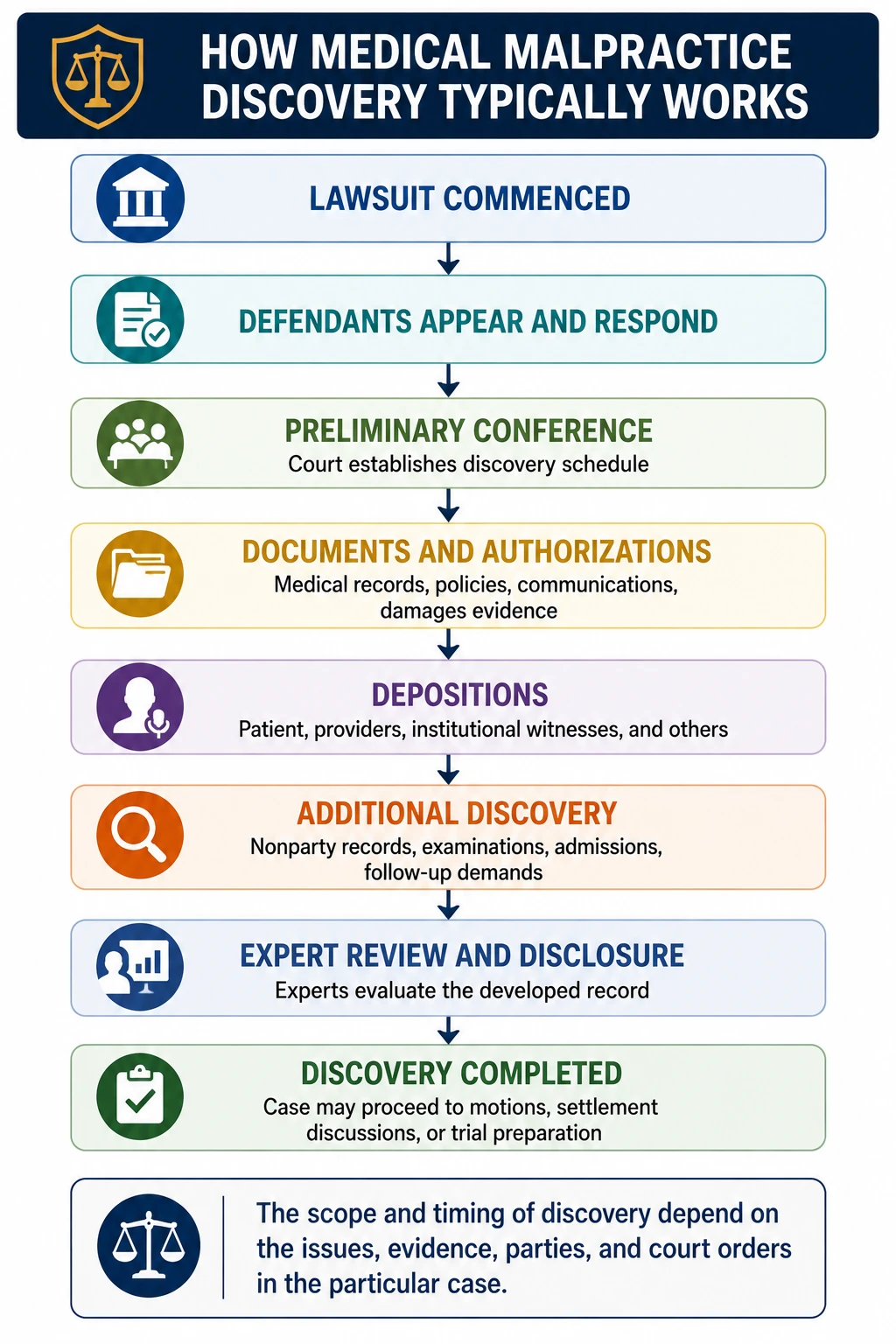
The scope and timing of discovery depend on the issues, evidence, parties, and court orders in the particular case.
In a typical New York Supreme Court action, the lawsuit is commenced by filing a summons and complaint or a summons with notice. The initiating papers must then be properly served, and the defendant may appear and serve an answer or make an authorized motion. Discovery demands may be served with the answer, shortly afterward, or according to a schedule established by the court.
Medical malpractice actions are also subject to specialized case-management procedures. After the required Notice of Medical, Dental or Podiatric Malpractice Action is filed, the court generally conducts a preliminary conference and establishes deadlines for disclosure, depositions, examinations, and other pretrial steps.
The patient may be required to disclose medical records and execute authorizations for treatment that is material and necessary to the injuries, conditions, causation issues, or damages placed in controversy. Depending on the allegations, discovery may also involve employment records, wage information, insurance records, photographs, video, communications, social-media material, and evidence concerning daily activities or functional limitations.
The defendants may be required to produce relevant medical records, electronic chart information, imaging, test results, schedules, communications, policies, procedures, credentialing or staffing materials and other administrative records, to the extent discoverable under applicable New York law. The permissible scope depends on the claims, defenses, objections, confidentiality rules, and court orders.
Internal policies and procedures may provide relevant factual context, but they do not automatically establish the legal standard of care. Their significance must be evaluated together with the medical evidence, governing law, and qualified expert opinions.
Discovery can involve several different methods of obtaining records, testimony, admissions, examinations, and expert information. The tools used depend on the issues and evidence in the particular case.
Document demands
Medical records, electronic records, policies, schedules, communications, photographs, billing information, and other relevant materials
Authorizations
Permission to obtain medical, insurance, employment, or other records relevant to the issues placed in controversy
Depositions
Sworn questioning of patients, healthcare providers, institutional witnesses, and other persons
Nonparty subpoenas
Records or testimony from hospitals, pharmacies, employers, later-treating providers, or other nonparties
Physical or mental examination
Examination by a designated physician when the plaintiff’s physical or mental condition is in controversy
Requests for admission
Requests asking a party to admit specified facts, document authenticity, or other defined matters
Expert disclosure
Information concerning the qualifications and expected opinions of expert witnesses, subject to New York’s disclosure rules
Court conferences and orders
Deadlines governing records, depositions, examinations, motions, and completion of discovery
A deposition is a formal question-and-answer session conducted under oath before trial. It is one of the principal opportunities for attorneys to obtain sworn testimony directly from the parties, healthcare providers, institutional representatives, and other witnesses.
Defense counsel may question the patient about the treatment, prior and subsequent medical history, claimed injuries, employment, daily activities, and damages. Plaintiff’s counsel may question healthcare providers about their education, training, clinical decisions, recollection, documentation, communications, and the basis for the care provided.
Deposition testimony helps the parties identify factual disputes, evaluate credibility and recollection, prepare expert analyses, support or oppose motions, and prepare for trial. A deposition is not limited to what appears in the medical chart, although objections and court rules govern the permissible questioning.
Qualified medical experts may help counsel identify which records, witnesses, clinical policies, imaging, test data, or electronic information should be requested. They may assist in preparing deposition questions, analyzing testimony, evaluating new evidence, and determining whether the developing record supports departure, causation, prognosis, and damages theories.
Expert involvement varies by case and stage. Some issues may require ongoing consultation, while others may be evaluated after key records and depositions are completed. Later in the litigation, the parties may exchange expert disclosure describing the experts’ qualifications and expected opinions, subject to CPLR 3101(d) and any court-ordered deadlines.
Discovery may take substantial time because records must be obtained from multiple sources, authorizations may need revision, several defendants and witnesses may require depositions, experts may need to review developing evidence, and disputes may require court intervention. Scheduling healthcare providers, attorneys, witnesses, and court conferences can also extend the process.
The court generally establishes deadlines through conference orders. If a party fails to comply, the other side may request assistance from the court, seek an order compelling disclosure, or pursue sanctions where authorized. Possible consequences can include evidentiary restrictions, issue-related relief, dismissal, or other orders depending on the circumstances.
Patients often worry that they will not remember every date, conversation, medication, or detail of treatment. Exact recollection is not required when a witness genuinely does not remember, and a patient should never guess or invent an answer. However, the patient’s testimony remains important because it may address symptoms, conversations, informed-consent discussions, the effect of the injury, and facts that do not appear fully in the medical record.
Before a deposition, counsel generally explains the process, reviews relevant records and chronology, and discusses how to respond truthfully and carefully. The witness should listen to each question, answer based on personal knowledge, ask for clarification when necessary, avoid speculation, and follow counsel’s instructions regarding objections and procedure.
Use this checklist to understand what discovery will likely involve:
Anyone who has questions about their medical malpractice case should contact their attorney for answers.
You do not need to navigate discovery by guessing what comes next. Because discovery obligations and deadlines depend on the particular case, counsel handling the lawsuit is best positioned to explain what has been requested, what must be completed, and what will happen next.
Potentially. When a plaintiff’s physical or mental condition is in controversy, another party may serve notice requiring an examination by a designated physician. The notice must specify the time, place, manner, conditions, scope, and examining physician.
This is a litigation examination rather than ordinary medical treatment. The patient should discuss the request and preparation with counsel, who can evaluate its scope and raise appropriate objections.
Social-media material may be discoverable when it is material and necessary to issues such as the patient’s claimed limitations, activities, symptoms, emotional condition, or account of events. Filing a lawsuit does not automatically make every post, message, or account detail discoverable. The request must still be evaluated under New York disclosure rules and may be subject to objections or court limitations.
Patients should preserve potentially relevant content and avoid deleting or altering material after litigation is anticipated or commenced. Questions about privacy settings, preservation, or particular requests should be discussed with counsel.
Discovery is generally limited to information material and necessary to the claims and defenses, although the scope may be broad when multiple conditions or damages are placed in controversy.
Production depends on relevance, possession or control, objections, confidentiality rules, and court orders.
Witnesses must testify truthfully from personal knowledge and should not guess when they do not remember.
Relevant social-media material may be discoverable.
It may also include examinations, subpoenas, admissions, expert disclosure, and other devices.
Timing depends on the parties, evidence, disputes, venue, court orders, and complexity.
The scope and timing of discovery depend on the issues, evidence, parties, and court orders in the particular case.

Michael Bottar is a nationally recognized New York medical malpractice and personal injury attorney and the founder of Bottar Law. Throughout his career, he has dedicated his practice to representing individuals and families affected by medical negligence, catastrophic injuries, wrongful death, and other serious acts of negligence. Michael is committed to helping clients understand their legal rights, navigate the complexities of the legal system, and pursue accountability with compassion, integrity, and unwavering advocacy.
For more than 40 years, Bottar Law has represented individuals and families throughout Syracuse, Central New York, and across New York in complex medical malpractice litigation involving catastrophic injuries and wrongful death. Through educational resources like these FAQs, Michael Bottar and the Bottar Law team strive to provide clear, reliable information to help injured individuals and their families make informed decisions during difficult times. Prior results do not guarantee a similar outcome.
Speak with Bottar Law about what to expect and how to prepare.