 Call833-268-8277

Understand what the defense can and cannot access, and how to prepare for how your records will be reviewed.
Attorney reviewed · New York focused · Updated resource
Disclosure is generally limited to conditions, causation, and damages actually placed in controversy.
Yes, relevant medical records may be used by the defense to challenge parts of a medical malpractice claim, but filing a lawsuit does not automatically make every medical record discoverable. When a patient places a physical or mental condition in controversy, the defense may generally obtain records related to that condition, causation, claimed injuries, and damages. Defense attorneys may compare the records with the patient’s testimony, prior medical history, reported symptoms, medications, and treatment. Any apparent inconsistency may be raised, but an inconsistency does not automatically defeat a claim and may have a reasonable explanation. Reviewing the relevant records early with an attorney helps identify issues, correct misunderstandings, and prepare an accurate case strategy.
Ordinarily, a patient’s medical information is protected by the physician-patient privilege, privacy laws, and other confidentiality rules. When a patient files a medical malpractice lawsuit and places a medical condition, injury, or claimed damage in controversy, the defense may seek records and authorizations relating to those issues. The defense may review relevant records, question the patient about their contents, provide them to retained experts and the defendant’s insurer, and use admissible information to challenge liability, causation, credibility, or damages. The scope of disclosure is not necessarily unlimited, and disputes may arise over whether particular records are sufficiently related to the issues in the case.
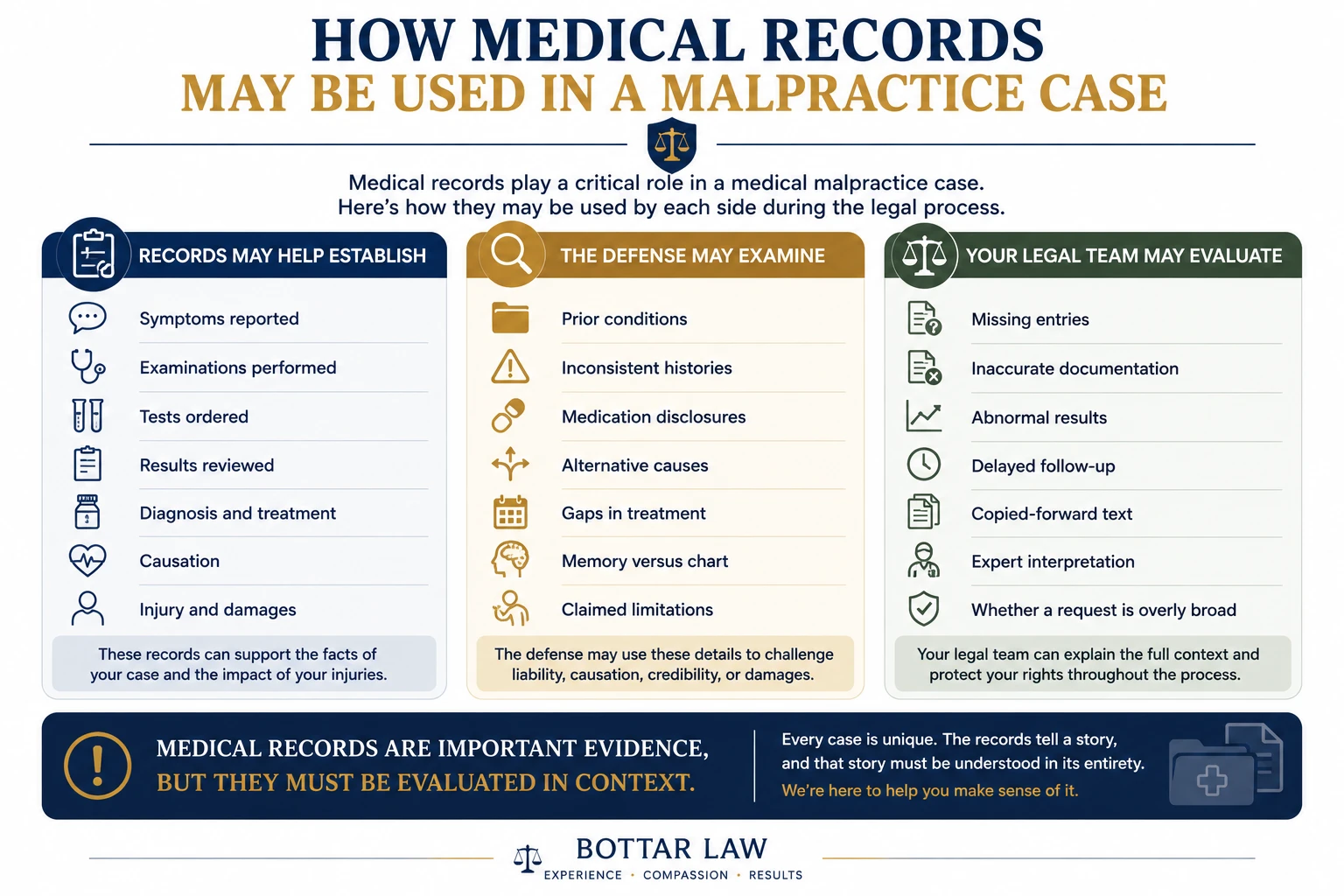
Medical records are important evidence, but they must be evaluated in context.
To prove a medical malpractice case in New York, a patient generally must establish that a healthcare provider departed from the accepted standard of medical care and that the departure caused injury. Evidence may include testimony, medical records, diagnostic studies, policies, and expert opinions. Because memories may differ, contemporaneous records often provide important evidence of what was reported, examined, diagnosed, ordered, and documented at the time. Records may also help establish the nature of the injury, additional treatment, prognosis, and effects on the patient’s daily life.
Once a medical malpractice lawsuit is commenced, defense counsel will usually seek medical records relating to the medical conditions, injuries, causation, and damages placed in controversy. Those records may be reviewed by the defendant, defense attorneys, insurers, and retained experts. The defense may use relevant information to argue that the healthcare provider met the accepted standard of medical care, that another condition caused or contributed to the injury, that some or all of the claimed harm existed previously, or that the patient’s damages differ from those alleged. Filing a lawsuit does not necessarily authorize unrestricted access to every aspect of a patient’s medical history, and disputes sometimes arise over whether particular records are sufficiently related to the claims being made.
Depending on the issues in the case, the defense may also closely examine details throughout the medical records, including:
Many details contained in a patient’s medical record may become important during a medical malpractice investigation, the most critical details tend to be whether a patient accurately reported their medical history, disclosed medications, and described current symptoms, as well as whether a healthcare provider conducted a proper interview, performed a thorough physical examination, ordered correct labwork or diagnostic testing, and timely reviewed the results of any testing ordered.
The biggest fear when you know your records will be reviewed by strangers is not knowing what they’re actually looking for. Here is what tends to matter most.
Medical records are only one part of the evidence in a malpractice case and are evaluated alongside testimony, expert opinions, diagnostic studies, and other relevant evidence.
Reported medical history and medications
The defense may compare prior statements with later testimony and other records
Description and timing of symptoms
Timing can affect arguments concerning diagnosis, causation, and notice
Prior similar conditions or injuries
The defense may argue that some claimed harm was preexisting or caused by another condition
Physical examinations and diagnostic testing
May bear directly on whether the provider met the accepted standard of care
Review and communication of test results
Delays or failures may support or undermine allegations in the case
Follow-up care and treatment compliance
The defense may raise questions about causation or mitigation of damages
Incomplete or conflicting documentation
Ambiguities may be disputed, but incomplete charting may also reflect a provider’s documentation failure
Memory compared with the written chart
Differences may be explored during testimony and may require explanation
Not necessarily. Filing a lawsuit generally places the medical conditions, injuries, causation issues, and damages asserted in the case into controversy. The defense may seek records reasonably related to those issues, including prior records when they may bear on causation or damages. However, the waiver of medical confidentiality is not automatically unlimited. If a request appears overly broad or seeks unrelated private information, the patient’s attorney may object or ask the court to limit disclosure.
Yes. An attorney may object when a request seeks information that is irrelevant, excessively broad, privileged, or unrelated to the conditions placed in controversy. Depending on the dispute, the parties may narrow the request or seek a protective ruling from the court. The outcome depends on the facts, the claims asserted, and the relationship between the requested records and the issues in the lawsuit.
Incomplete, confusing, or inconsistent records can create disputes during a malpractice case. The defense may argue that a missing or conflicting entry undermines the patient’s account, causation, or damages. However, incomplete documentation may also raise questions about whether the healthcare provider accurately recorded the care that was delivered. A missing entry does not automatically establish what did or did not happen. Attorneys and medical experts evaluate the record as a whole, including testimony, diagnostic results, timing, other providers’ records, and surrounding circumstances.
Many injured patients do not know all of the medically significant facts because they have never reviewed the complete chart or because the importance of certain findings was not explained to them. Expert review may identify ignored complaints, overlooked symptoms, abnormal test results, delayed follow-up, incomplete differential diagnosis, or testing that should have been considered.
Medical experts help attorneys understand the clinical issues reflected in the records, including the applicable standard of care, diagnostic reasoning, causation, prognosis, and the significance of particular findings or omissions. An expert in the appropriate specialty may identify facts that support or weaken a claim, explain technical medical terminology, review relevant medical literature, and, when necessary, provide testimony during litigation or at trial.
A difference between a patient’s memory and the written chart can create an evidentiary issue, but the record is not automatically conclusive. Medical records may be incomplete, contain copied-forward information, omit conversations, or reflect documentation entered after the event. Conversely, memory can be affected by pain, medication, trauma, the passage of time, or conditions such as amnesia. The defense may highlight inconsistencies, while the patient’s attorney may use testimony, other records, witnesses, timing, and expert analysis to explain or challenge the documentation.
Clients often are nervous about having strangers review their medical records because they are new to litigation and may feel like they are being singled out for what feels like an invasion of privacy. It is completely normal to feel uncomfortable with litigation. All clients should discuss concerns they have about medical records with an attorney.
Bottar Law’s legal team helps clients understand how the records relate to the legal issues in the case. The firm organizes treatment histories, identifies potentially significant entries or omissions, works with qualified experts, and explains the investigation in plain language while recognizing that expert medical opinions are required for clinical conclusions.
Use this checklist to prepare for how your records may be used during a case:
Any client worried that information contained in his or her medical records will be used against them in a legal proceeding should discuss the concern with an attorney, as there may be a way to prevent or limit harm to a case if the attorney is notified early and can form a plan to manage the issue.
You do not have to figure out on your own what a discrepancy means for your case. The next step is telling your attorney about it early, so there’s time to plan around it.
The defense may seek records related to the medical conditions, injuries, causation, and damages placed in controversy, but disclosure is not necessarily unlimited.
Medical records are important evidence, but they may contain omissions, mistakes, copied text, or disputed descriptions.
Differences between memory and documentation may have reasonable explanations and should be evaluated in context.
Prior conditions may be relevant, but they do not automatically prevent recovery for new injuries or an aggravation of an existing condition.
Missing documentation may create defense arguments, but it may also raise concerns about the provider’s recordkeeping or care.
Early disclosure allows the attorney to evaluate relevance, preserve credibility, and respond appropriately to discovery requests.
Medical records are important evidence, but they must be evaluated in context.

Michael Bottar is a nationally recognized New York medical malpractice and personal injury attorney and the founder of Bottar Law. Throughout his career, he has dedicated his practice to representing individuals and families affected by medical negligence, catastrophic injuries, wrongful death, and other serious acts of negligence. Michael is committed to helping clients understand their legal rights, navigate the complexities of the legal system, and pursue accountability with compassion, integrity, and unwavering advocacy.
For more than 40 years, Bottar Law has represented individuals and families throughout Syracuse, Central New York, and across New York in complex medical malpractice litigation involving catastrophic injuries and wrongful death. Through educational resources like these FAQs, Michael Bottar and the Bottar Law team strive to provide clear, reliable information to help injured individuals and their families make informed decisions during difficult times. Prior results do not guarantee a similar outcome.
Speak with Bottar Law about reviewing your records before the defense does.