 Call833-268-8277

Understand what typically drives the timeline, from pre-suit investigation through trial and any post-verdict proceedings.
Attorney reviewed · New York focused · Updated resource
The actual timeline depends on the court, evidence, parties, motions, and whether the case settles.
In Michael Bottar’s experience, a New York medical malpractice case that proceeds from filing through a jury verdict often takes approximately 24 to 36 months, although the timeline may be shorter or substantially longer depending on the county, court calendar, medical complexity, number of defendants, discovery disputes, motions, and whether the case settles before trial.
That estimate begins when the lawsuit is filed. The investigation before filing may require additional time to obtain records, consult qualified medical experts, identify the responsible parties, evaluate causation, and comply with New York’s procedural requirements.
Some cases resolve through settlement before trial, while others take several years. A longer timeline does not necessarily mean that the case is being neglected. Medical malpractice claims often require extensive records, multiple depositions, expert review, and careful evaluation of the patient’s long-term injuries.
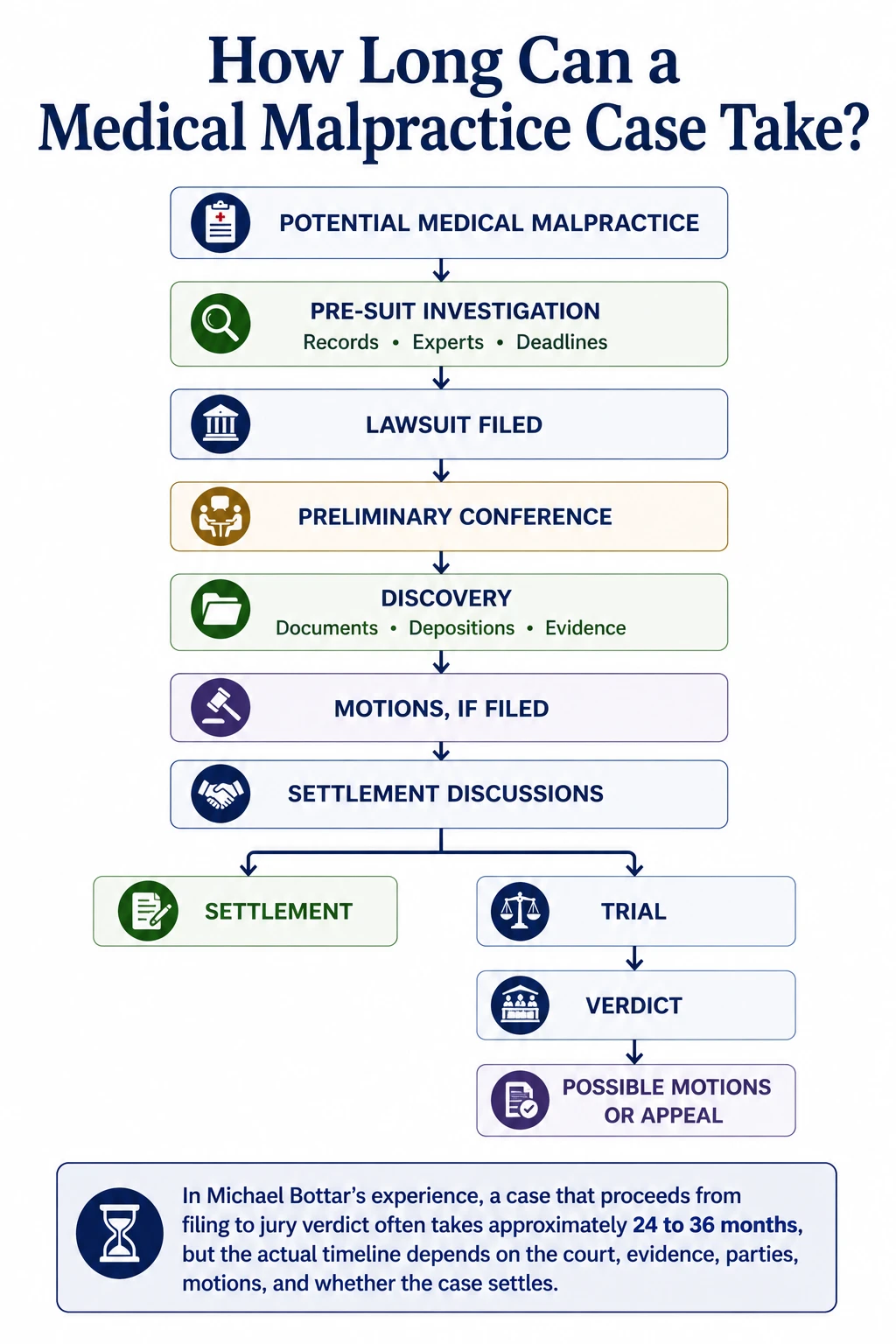
In Michael Bottar’s experience, a case that proceeds from filing to jury verdict often takes approximately 24 to 36 months, but the actual timeline depends on the court, evidence, parties, motions, and whether the case settles.
The pre-suit investigation may take several months or longer depending on the volume of records, the number of providers, the availability of imaging or pathology materials, the medical specialties involved, and the applicable filing deadline.
During this stage, the attorney may obtain and organize records, reconstruct the treatment chronology, identify possible defendants, consult qualified medical experts, and evaluate whether the evidence supports departure, causation, and compensable injury. The investigation must be thorough, but it must also account for the statute of limitations.
New York generally requires a medical malpractice action to be commenced within two years and six months of the challenged act or omission, or from the end of qualifying continuous treatment, subject to statutory exceptions.
Initial investigation
Records, chronology, defendant identification, expert consultation, deadline analysis
Record volume, provider response, imaging availability, expert availability
Filing and responses
Summons and complaint, service, defendant appearances and answers
Number of defendants, service issues, extensions
Preliminary conference
Court establishes a discovery schedule
Court calendar and case complexity
Document discovery
Medical records, authorizations, policies, communications, damages evidence
Incomplete production, objections, multiple institutions
Depositions
Patient, providers, institutional witnesses, and other parties testify
Scheduling, number of witnesses, adjournments
Additional discovery
Nonparty records, examinations, follow-up demands, expert analysis
New evidence and disputed requests
Note of issue and motions
Case is certified as trial-ready; summary judgment motions may follow
Motion briefing, court decisions, appeals of interim rulings
Settlement conferences
Parties and court evaluate possible resolution
Evidence strength, authority, insurer position, client goals
Trial
Jury selection, testimony, evidence, verdict
Court availability and trial length
Post-trial proceedings
Motions, judgment, possible appeal
Issues raised and appellate schedule
New York’s medical-malpractice procedure includes a preliminary conference intended to establish and manage discovery. A note of issue represents that discovery is complete and the case is ready for trial, subject to court review and motion practice.
In Michael Bottar’s experience, a medical malpractice case that proceeds from filing through a jury verdict commonly takes approximately 24 to 36 months. The timeline can be shorter, but in some New York counties it may take longer to complete discovery and obtain a trial date. Court congestion, the assigned judge’s schedule, the number of defendants, motion practice, and the complexity of the medical evidence can all affect timing.
Many cases do not settle early. In Michael’s experience, meaningful settlement negotiations frequently intensify during the final 30 to 60 days before trial, after discovery is substantially complete and both sides have a clearer understanding of the experts, evidence, damages, and trial risks. That does not mean every case settles during that period. Some resolve earlier, some settle during trial, and others proceed to a verdict.
The 24 to 36 month estimate generally refers to the period after filing. The investigation before filing may add time because counsel must obtain medical records, consult appropriately qualified physicians, evaluate the defendants and legal deadlines, and determine whether the evidence supports commencing an action.
Medical malpractice cases usually take longer than many general personal injury claims because they involve complex medical questions that require qualified expert review and extensive discovery. Counsel may need to obtain records from several providers, analyze imaging and laboratory data, take depositions of physicians and other witnesses, investigate hospital or employment relationships, and consult experts from more than one specialty.
The defense also frequently disputes both departure from the accepted standard of medical care and causation. Those disputes may lead to additional discovery, expert analysis, and motions asking the court to dismiss some or all of the claims before trial.
In Michael Bottar’s experience, medical malpractice insurers and defendants often do not make meaningful settlement offers until the case is well developed and trial is approaching. By that point, depositions may be complete, expert positions are clearer, damages are better documented, and each side can evaluate the risk of a jury verdict. This is a frequent litigation pattern, not a rule that applies to every insurer or case.
The first stage is usually focused on investigation rather than courtroom activity. The attorney may gather information about the treatment, identify the providers and facilities involved, request relevant medical records, obtain imaging or pathology materials, and develop a detailed chronology.
Qualified medical experts may then evaluate whether the provider departed from the accepted standard of medical care and whether that departure caused or contributed to the patient’s injury. Counsel must also evaluate the defendants, damages, filing deadlines, and procedural requirements.
Clients may not see immediate public activity during this stage, but substantial work may be occurring behind the scenes. A thorough early investigation often determines whether a lawsuit can responsibly be filed and which claims or defendants are supported.
Yes. After discovery is completed, one or more defendants may ask the court for summary judgment, arguing that the claim should be dismissed before trial. These motions commonly involve expert affidavits concerning departure and causation.
The parties need time to prepare motion papers, obtain expert opinions, respond to the opposing arguments, and wait for the court’s decision.
Depending on the issues and court calendar, motion practice can add months or longer to the timeline. A decision may narrow the case, dismiss particular defendants or claims, or permit the action to proceed to trial.
Settlement discussions can occur at any stage, but Michael Bottar has found that many medical malpractice cases do not enter serious negotiations until the final 30 to 60 days before trial. By then, discovery is usually substantially complete, depositions have been taken, the medical and damages evidence is better developed, and the parties are confronting the immediate risks and expense of trial.
Many New York courts schedule settlement conferences after the filing of the note of issue in medical malpractice actions, although the timing and procedure may vary by county, assigned judge, or local practice. Settlement negotiations may occur before, during, or after those conferences.
The timing depends on the evidence, the parties’ positions, available settlement authority, and the client’s goals.
The investigation and discovery phases are often the most time-consuming parts of a medical malpractice case. Reviewing thousands of pages of medical records, obtaining expert opinions, taking depositions, exchanging evidence, and complying with court procedures all require careful attention.
If the case proceeds to trial, additional time is needed to prepare witnesses, organize evidence, and present complex medical issues to a judge or jury. These steps cannot be rushed without risking the strength of the case.
Not always. After a verdict, either side may file post-trial motions concerning liability, damages, evidentiary rulings, or other issues. A party may also appeal an appealable judgment or order.
Post-trial motions and appellate proceedings can extend the case significantly. A favorable verdict therefore does not always result in immediate payment. The timing depends on the motions filed, the issues raised, whether the parties reach a post-verdict resolution, and the appellate calendar.
Some delays cannot be controlled, including court congestion, expert availability, complex medical treatment, and scheduling among multiple attorneys and witnesses. Counsel can still reduce avoidable delay by requesting records promptly, identifying missing evidence early, meeting court deadlines, preparing witnesses carefully, responding to discovery, and raising unresolved issues with the court when appropriate.
The goal should not be speed at the expense of preparation. Moving too quickly may result in incomplete expert review, overlooked defendants, underdeveloped damages, or decisions made before the patient’s prognosis is sufficiently understood.
Every case follows its own timeline. A case involving clear liability and well-documented injuries may resolve sooner if the parties are able to reach a fair settlement after the investigation is complete.
Other cases involve disputed medical issues, multiple healthcare providers, conflicting expert opinions, or permanent injuries that require years of treatment before the full extent of the damages can be understood.
Rather than comparing your case to someone else’s, it is more helpful to understand that the timeline will depend on the specific facts and legal issues involved.
Factors affecting timing may include:
Thorough preparation cannot eliminate every delay, but it can reduce avoidable problems and help ensure that the case is ready when the court or settlement process moves forward.
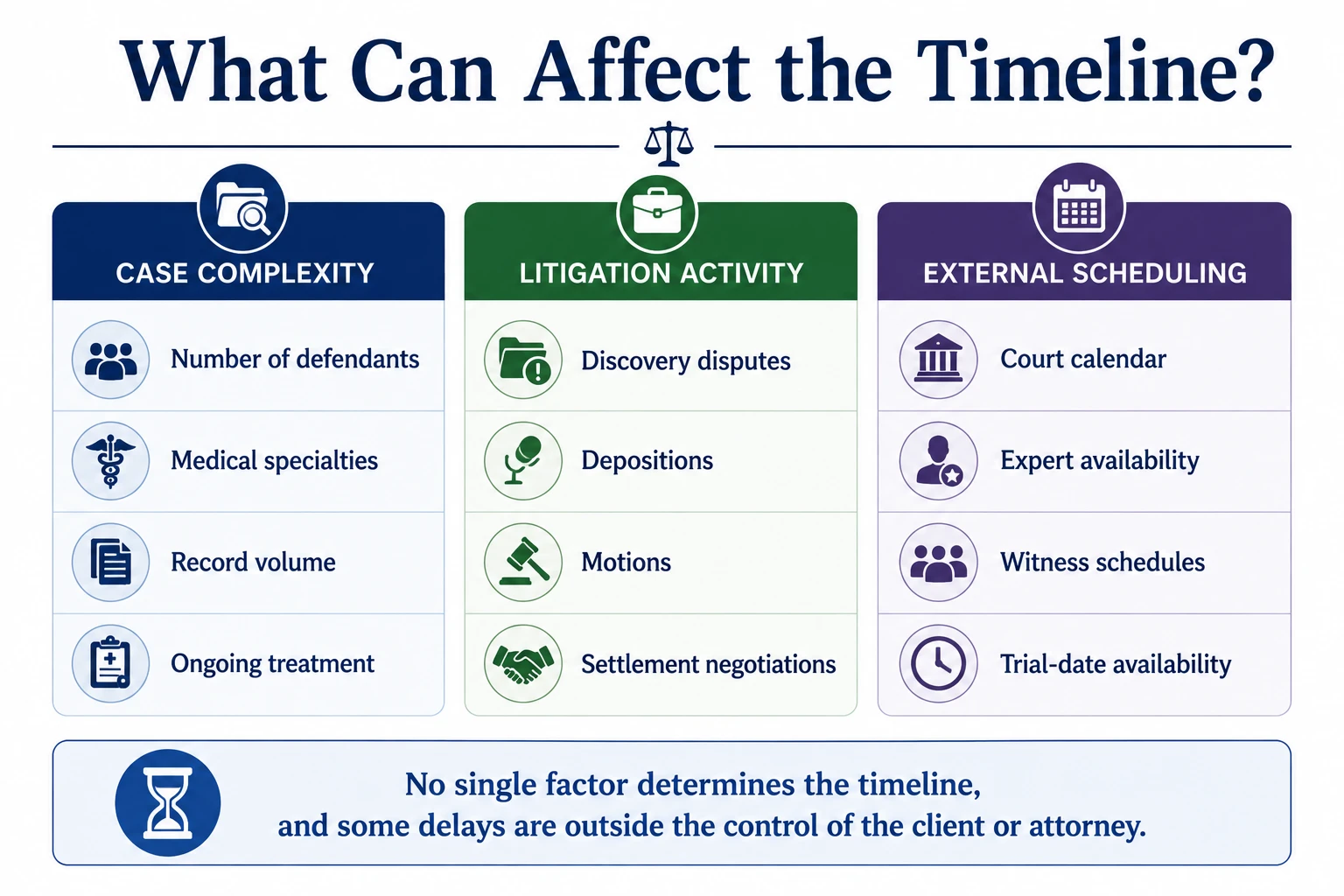
No single factor determines the timeline, and some delays are outside the control of the client or attorney.
At Bottar Law, we understand that medical malpractice litigation can feel overwhelming, especially when the process takes longer than expected. Clients should know what stage their case is in, what work is being completed, why a particular step may take time, and what the next major milestone is likely to be.
We encourage clients to ask questions and work to provide clear, honest communication throughout the representation. Updates may address record collection, expert review, court conferences, discovery, depositions, motions, settlement discussions, or trial preparation.
Keeping clients informed does not eliminate the uncertainty, but it can help them understand that the case is progressing and what remains to be done during what is often a very difficult period in their lives.
Medical malpractice cases should never be rushed simply to reach a quicker resolution. Important evidence must be gathered, medical experts need sufficient time to review the records, and the long-term effects of an injury often become clearer over time.
Patience allows the legal team to fully understand the case, accurately evaluate the damages, and prepare the strongest possible claim. Taking the necessary time at each stage often leads to better-informed decisions throughout the process.
Many clients tell us that waiting is one of the most difficult parts of the process. They are coping with serious injuries, ongoing medical treatment, financial uncertainty, and unanswered questions about what happened. It is natural to feel frustrated when progress seems slow.
Our role is to provide honest communication, explain why the process takes time, and make sure clients understand what is happening behind the scenes. While we cannot eliminate the uncertainty, we can help clients feel informed, supported, and confident that their case is moving forward.
If you believe you or a loved one may have been harmed by medical negligence, it is best to contact an experienced medical malpractice attorney as soon as possible. Early involvement allows your attorney to obtain medical records, preserve important evidence, evaluate the applicable legal deadlines, and begin investigating the claim before memories fade or records become more difficult to obtain.
You do not need to know whether malpractice occurred before reaching out. A consultation can help you understand your legal rights, answer your questions, and provide guidance about the next steps based on the facts of your situation.
Clients generally cannot control the court calendar, but timely communication and evidence preservation can help prevent avoidable delay.
Even strong cases may require extensive discovery and may not receive a meaningful offer until trial approaches.
Record collection, expert review, research, and discovery preparation often occur outside the courtroom.
That is an experience-based general range from filing to verdict, not a guarantee.
Many cases are not seriously negotiated until discovery is substantially complete.
Filing begins the formal litigation process; discovery and motions usually follow.
Post-trial motions or appeals may extend the timeline.
Rushing can prevent a complete evaluation of liability, causation, prognosis, and damages.
Understanding the litigation process and maintaining realistic expectations can make a lengthy case feel far less uncertain.

Michael Bottar is a nationally recognized New York medical malpractice and personal injury attorney and the founder of Bottar Law. Throughout his career, he has dedicated his practice to representing individuals and families affected by medical negligence, catastrophic injuries, wrongful death, and other serious acts of negligence. Michael is committed to helping clients understand their legal rights, navigate the complexities of the legal system, and pursue accountability with compassion, integrity, and unwavering advocacy.
For more than 40 years, Bottar Law has represented individuals and families throughout Syracuse, Central New York, and across New York in complex medical malpractice litigation involving catastrophic injuries and wrongful death. Through educational resources like these FAQs, Michael Bottar and the Bottar Law team strive to provide clear, reliable information to help injured individuals and their families make informed decisions during difficult times. Prior results do not guarantee a similar outcome.
Speak with Bottar Law about the timeline and what to expect at each stage.