 Call833-268-8277

Understand how and when settlement discussions happen, what drives an amount, and who ultimately decides whether to settle.
Attorney reviewed · New York focused · Updated resource
An attorney’s role is to explain the evidence, risks, and options, not to make the decision for you.
Many New York medical malpractice cases resolve through a negotiated settlement rather than a jury verdict, although every case is different. A settlement is a negotiated agreement that resolves a medical malpractice claim between the injured patient and one or more defendants, typically through their legal representatives and insurance carriers, without the need for a jury verdict.
Before recommending any settlement, an experienced medical malpractice attorney should carefully evaluate the evidence, the extent of the injuries, future medical needs, lost income, and the overall impact the injury has had on the patient’s life. The decision to accept or reject a settlement always belongs to the client, and that decision should be made only after receiving clear legal advice and understanding all available options.
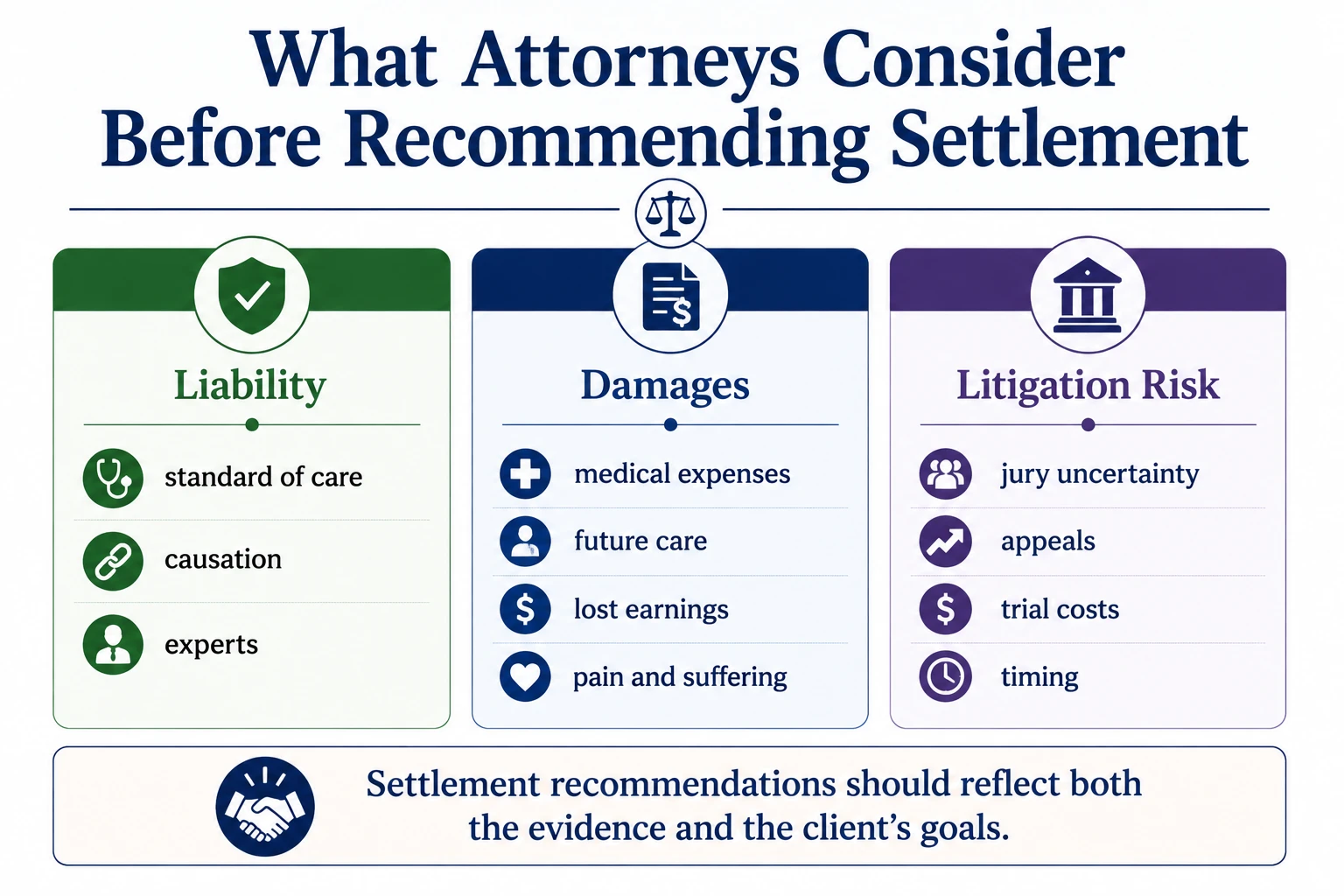
Settlement recommendations should reflect both the evidence and the client’s goals.
Settlement discussions can begin at almost any stage of a medical malpractice case. In some situations, they occur after the medical records and expert reviews have been completed. In others, they take place after depositions, additional discovery, or shortly before trial.
The timing often depends on how much information both sides have about the strengths and weaknesses of the case. As more evidence becomes available, both parties are generally in a better position to evaluate whether settlement is appropriate.
Many factors influence whether a case settles. These include the strength of the medical evidence, the opinions of qualified medical experts, the severity of the patient’s injuries, the anticipated future medical needs, and the damages that can be proven.
The willingness of both parties to negotiate also plays an important role. While many cases settle, others proceed to trial because the parties cannot reach an agreement on fair compensation.
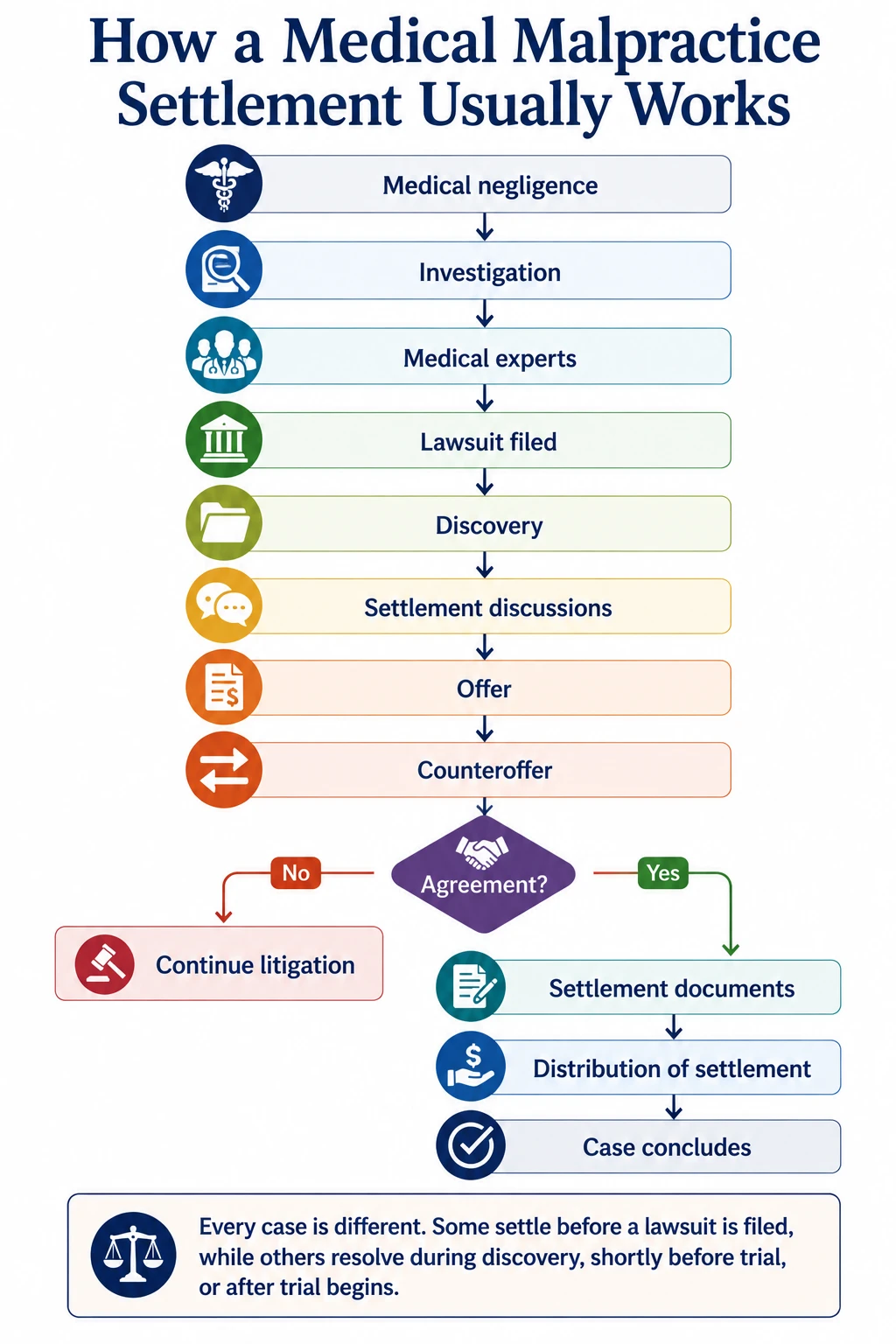
Every case is different. Some settle before a lawsuit is filed, while others resolve during discovery, shortly before trial, or after trial begins.
Evaluating a settlement requires a careful review of all the evidence. An attorney considers the nature and extent of the injuries, medical expenses, future treatment costs, lost wages or reduced earning capacity, pain and suffering, and the overall effect the injury has had on the patient’s life.
Negotiations are based on the facts of the case and the available evidence. An experienced attorney works to present a well-supported claim while advising the client about the strengths, risks, and potential outcomes of continued litigation.
Negotiated resolution
Jury determines outcome
Greater certainty
Outcome remains uncertain
Usually resolves sooner
Additional litigation continues
Avoids trial
Trial preparation continues
Final agreement after signatures
Resolution depends on later proceedings
While many medical malpractice cases settle before trial, every settlement decision should be based on the specific evidence, potential damages, litigation risks, and the client’s goals rather than a general preference for settling or going to trial.
Not necessarily, but many settlement offers serve as the beginning of a negotiation rather than the end of the discussion.
After an initial offer is made, the parties may exchange additional information, make counteroffers, provide updated medical evidence, or continue discussions as the strengths and weaknesses of the case become clearer. In some cases, multiple rounds of negotiations occur before an agreement is reached. In others, the parties remain too far apart and the case proceeds toward trial.
Whether a settlement offer should be accepted, rejected, or answered with a counteroffer depends on the specific facts of the case, the available evidence, and the client’s goals.
Yes. Filing a lawsuit does not end settlement discussions.
In many medical malpractice cases, negotiations continue throughout the litigation process. The parties may discuss settlement during discovery, after depositions have been completed, following the exchange of expert information, shortly before trial, or even while the trial is underway.
As additional evidence is developed, both sides often gain a clearer understanding of the strengths and weaknesses of the case, which may increase the likelihood of productive settlement discussions. Some cases settle early, while others are not resolved until shortly before or during trial.
In most situations, yes. Once a settlement agreement has been reached and the required documents have been signed, the settling parties generally exchange a written release that resolves the claims covered by the agreement.
After the settlement is finalized, the claims against the settling parties are ordinarily dismissed, and those claims generally cannot be pursued again. Before accepting a settlement, it is important to understand exactly which claims and parties are included in the agreement and what legal rights are being resolved.
Because a settlement is typically final, clients should carefully review the agreement with their attorney before deciding whether to accept it.
Medical malpractice cases sometimes involve more than one defendant, such as a physician, hospital, medical practice, nurse, or other healthcare provider. Each defendant may have different legal defenses, insurance coverage, and views about liability or settlement.
As a result, one defendant may decide to settle while others continue defending the case. Settlement with one party does not necessarily resolve the claims against the remaining defendants unless the agreement specifically provides otherwise.
Every case is different, and the timing and terms of any settlement depend on the evidence, the parties involved, and the issues that remain in dispute.
Every case is different, but many clients find that a fair settlement provides an opportunity to move forward after a difficult and often lengthy legal process. A settlement can provide financial resources for ongoing medical care, future needs, and other damages while avoiding the uncertainty that comes with a trial.
The right resolution depends on the individual circumstances of each case. Our role is to help clients understand their options and make informed decisions based on their personal goals and the evidence.
Receiving a settlement offer does not mean you have to accept it. If an offer does not fairly reflect the strength of the case or the extent of the injuries, negotiations may continue. In some situations, additional evidence or expert testimony may strengthen the client’s position.
If a reasonable settlement cannot be reached, the case may proceed toward trial. An attorney should always be prepared to continue advocating for the client if negotiations are unsuccessful.
Once both sides agree to settle the case, the agreement is typically documented in writing. Before any funds are distributed, settlement documents must usually be reviewed and signed. Depending on the circumstances, liens, medical expenses, litigation costs, attorney fees, or other obligations may need to be addressed.
After these matters are resolved, the settlement proceeds are distributed according to the written agreement and applicable law. Although every case is different, receiving payment is usually not immediate after an agreement is reached because administrative and legal steps still need to be completed.
Sometimes, but not always.
Whether a settlement is confidential depends on the terms of the settlement agreement. Some agreements include confidentiality provisions that limit what the parties may disclose about the settlement, while others do not.
Before signing any settlement documents, clients should understand whether the agreement contains confidentiality provisions and what those provisions require. Your attorney should explain any confidentiality obligations before the settlement is finalized.
Mediation is a form of alternative dispute resolution in which a neutral third party, known as a mediator, helps the parties discuss whether a voluntary settlement can be reached.
Unlike a judge or jury, the mediator does not decide the case or impose a result. Instead, the mediator facilitates communication, helps the parties evaluate the strengths and weaknesses of their positions, and explores whether an agreement is possible.
Participation in mediation does not require either side to settle. If the parties cannot reach an agreement, the case generally continues through the litigation process toward trial or other resolution.
Mediation may occur before trial if both parties believe a negotiated resolution is possible, although participation does not guarantee that a settlement will be reached.
At Bottar Law, we prepare every medical malpractice case thoroughly from the beginning. We obtain and review the medical records, work closely with qualified medical experts, develop the evidence needed to support the claim, and carefully evaluate the full extent of the client’s damages.
This preparation not only strengthens settlement negotiations but also ensures that we are ready to present the case at trial if a fair resolution cannot be reached. Being prepared for trial often places clients in a stronger position throughout the negotiation process.
Many clients worry about whether the settlement offer is fair, whether they should continue pursuing the case, or whether going to trial might result in a better outcome. Others are concerned about how long the case may continue if they decide not to settle.
These are important decisions that should never be rushed. An experienced attorney should explain the strengths and weaknesses of the case, discuss the potential risks and benefits of each option, and provide honest guidance so the client can make an informed choice.
Our responsibility is to provide clients with the information they need to make the decision that is right for them. We carefully explain the evidence, discuss the legal and practical considerations involved in settlement, answer every question honestly, and provide our professional recommendations based on the facts of the case.
The decision to accept or reject a settlement always belongs to the client. Our role is to provide thoughtful guidance, not pressure, so clients can move forward with confidence.
If you receive a settlement offer and are unsure whether it is fair, speak with your attorney before making any decision. A settlement is typically final, so it is important to fully understand what you are agreeing to before accepting an offer.
If you have concerns about the advice you are receiving or simply want additional reassurance, seeking a second opinion from an experienced medical malpractice attorney may also be appropriate. Taking the time to understand your options can help you make a decision that is informed and in your best interests.
Many cases involve multiple rounds of negotiation.
Strong trial preparation often improves settlement.
Many settlements resolve disputed claims without any admission of fault.
Many strong malpractice cases resolve through negotiated settlement.
The client makes the final decision.
The client, not the attorney, decides whether to settle.

Michael Bottar is a nationally recognized New York medical malpractice and personal injury attorney and the founder of Bottar Law. Throughout his career, he has dedicated his practice to representing individuals and families affected by medical negligence, catastrophic injuries, wrongful death, and other serious acts of negligence. Michael is committed to helping clients understand their legal rights, navigate the complexities of the legal system, and pursue accountability with compassion, integrity, and unwavering advocacy.
For more than 40 years, Bottar Law has represented individuals and families throughout Syracuse, Central New York, and across New York in complex medical malpractice litigation involving catastrophic injuries and wrongful death. Through educational resources like these FAQs, Michael Bottar and the Bottar Law team strive to provide clear, reliable information to help injured individuals and their families make informed decisions during difficult times. Prior results do not guarantee a similar outcome.
Speak with Bottar Law before accepting or rejecting any offer.