 Call833-268-8277

Understand how these terms differ depending on the court, defendant, and procedural stage of a case.
Attorney reviewed · New York focused · Updated resource
The correct terminology depends on the court, defendant, and stage of the case.
A medical malpractice claim is a broad term for an injured patient’s assertion that a healthcare provider caused compensable harm. Depending on the context, it may refer to a potential case being investigated, a pre-suit demand presented to an insurer, or a formal claim filed in the New York Court of Claims against the State or certain state-related entities. A complaint is a specific pleading that sets out the plaintiff’s allegations and causes of action. In a typical New York Supreme Court case, the lawsuit is commenced by filing a summons and complaint, after which the initiating papers must be properly served on the defendants. Because filing, service, venue, and deadline requirements vary, the terminology should be evaluated in context.
The word “claim” can describe several related but different things. In general conversation, it may refer broadly to a patient’s assertion that medical negligence caused injury and that compensation should be recovered. During an investigation, lawyers may also use “claim” to describe the potential matter before a lawsuit is commenced. In some cases, counsel may present the claim to an insurer or defendant before filing suit to determine whether a resolution is possible.
The term has a different procedural meaning in the New York Court of Claims. There, the document used to commence an action against New York State or certain state-related entities is called a “claim,” not a complaint. The correct meaning therefore depends on the court, defendant, and procedural stage.
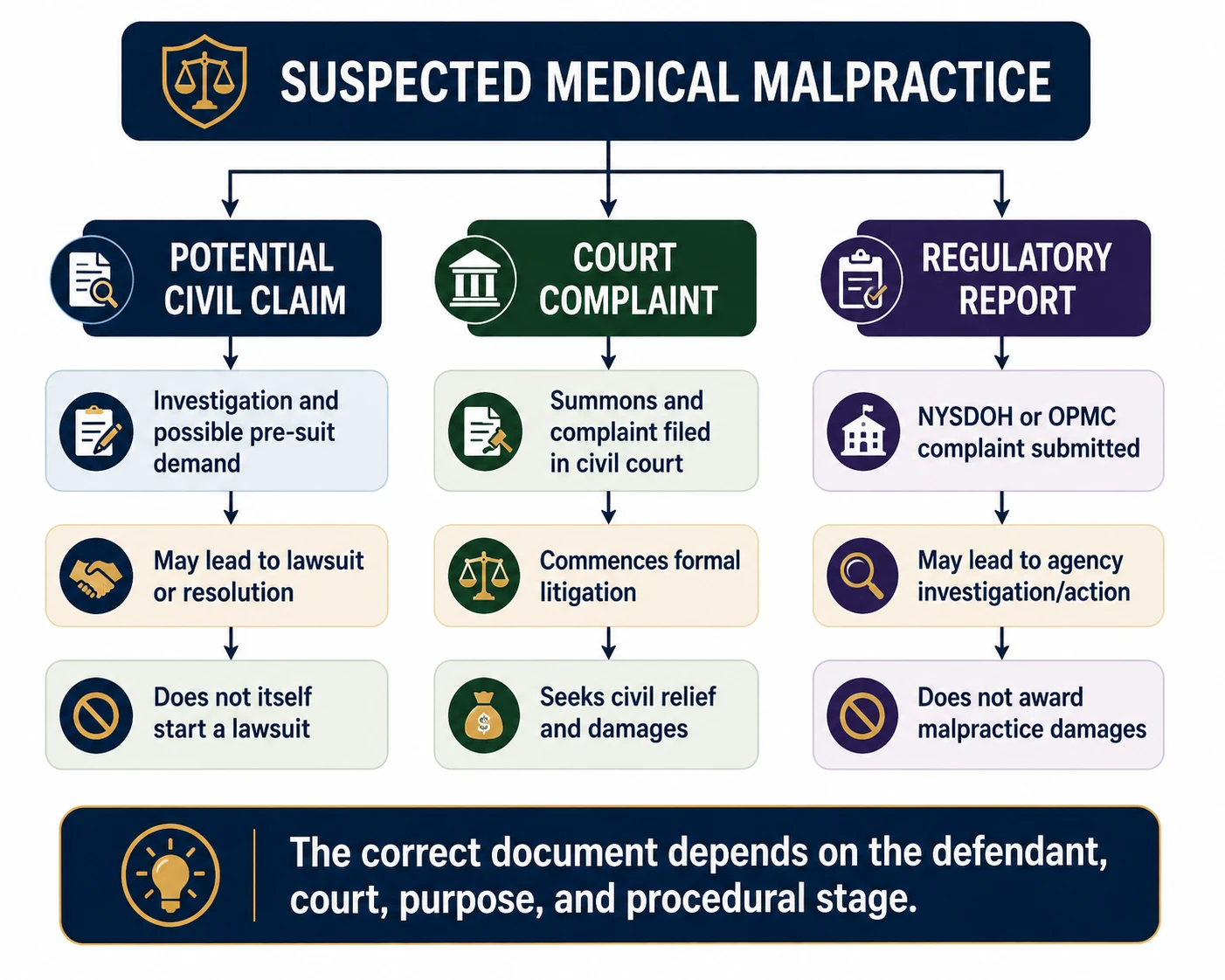
The correct document depends on the defendant, court, purpose, and procedural stage.
A medical malpractice claim is the broader assertion that a patient has a legal right to compensation because negligent medical care caused injury. The term may describe a potential case under investigation, a pre-suit demand, or, in the Court of Claims, the formal document used to seek damages from New York State.
A complaint is a specific pleading used in many civil lawsuits. It identifies the parties, describes the transactions or occurrences at issue, states the material elements of the causes of action, and requests relief. In a typical New York Supreme Court action, the lawsuit is commenced by filing a summons and complaint or a summons with notice. The pleading must give the court and parties sufficiently particular notice of the occurrences and material elements intended to be proved.
A bad medical outcome does not automatically establish malpractice. A potential case generally requires investigation of the treatment, injury, medical records, applicable deadlines, and the relationship between the provider’s conduct and the claimed harm.
Before commencing most New York medical malpractice actions, the plaintiff’s attorney generally reviews the facts and consults at least one appropriately licensed physician who concludes that there is a reasonable basis for the action. The attorney then executes the certificate required by CPLR 3012-a, subject to the statute’s limited alternative when the required consultation cannot be obtained despite specified good-faith efforts.
That medical consultation informs the attorney’s legal evaluation. The decision whether to proceed also depends on causation, damages, defendants, deadlines, venue, available evidence, and the client’s instructions.
A complaint is a pleading that identifies the parties, states the material allegations and causes of action, and requests legal relief. In a typical New York Supreme Court medical malpractice action, the lawsuit is commenced by filing a summons and complaint or a summons with notice and paying the required filing fee.
The complaint should provide sufficiently particular notice of the transactions or occurrences involved and the material elements of each claim. Filing must occur within the applicable limitation period. After commencement, the initiating papers must be served properly and within the applicable service period, subject to any extension authorized by the court.
Yes. A civil complaint is part of a lawsuit seeking legal relief, commonly monetary damages. The case may be resolved through dismissal, negotiated settlement, court decision, or jury verdict.
A regulatory complaint serves a different purpose. The New York State Department of Health accepts complaints concerning hospitals and certain healthcare facilities, while the Office of Professional Medical Conduct investigates complaints involving physicians, physician assistants, and specialist assistants. Those agencies may investigate, close the matter, or pursue regulatory or disciplinary action, but they do not award malpractice damages to the patient.
Regulatory proceedings are subject to confidentiality rules. Filing a regulatory complaint is not the same as commencing a civil lawsuit and ordinarily should not be assumed to pause or extend the applicable lawsuit deadline.
The biggest fear for someone navigating this process is missing a deadline or filing the wrong document at the wrong stage. Here is how the key pieces compare.
Potential malpractice claim
The patient’s assertion that negligent medical care caused compensable injury; the matter may still be under investigation
Pre-suit demand
A request for resolution made before litigation; it does not itself commence a lawsuit
Court of Claims claim
The formal initiating document used for a damages action against New York State or certain state-related entities
Complaint
A pleading stating the plaintiff’s allegations, causes of action, and requested relief
Summons
The process document notifying the defendant that an action has been commenced and requiring a response
Certificate of merit
Attorney-executed certificate generally accompanying a medical malpractice complaint under CPLR 3012-a
Service of process
Formal delivery of the initiating papers using a legally authorized method
Answer
The defendant’s responsive pleading, which may admit, deny, or otherwise respond to allegations and assert defenses
NYSDOH or OPMC complaint
A separate regulatory process that may lead to investigation or discipline but does not award civil malpractice damages
The process generally begins with intake, conflict review, and an initial evaluation of the treatment, injury, possible defendants, and filing deadlines. If further investigation is appropriate, the firm may obtain signed authorizations and request relevant medical records, imaging, billing records, policies, correspondence, and other evidence.
Record collection time varies by provider, record volume, authorization requirements, and whether follow-up requests are needed. Counsel then organizes the treatment history, develops a timeline, identifies the appropriate medical specialties, and consults qualified physicians when appropriate.
If the factual, medical, and legal investigation provides sufficient support and the client authorizes litigation, counsel determines the appropriate court, defendants, causes of action, and initiating documents. Filing and service requirements then must be completed within the applicable deadlines.
Before filing, counsel should have enough reliable information to identify the proper parties, venue, treatment events, alleged departures, injuries, causation theory, applicable deadlines, and a reasonable factual and medical basis for the action. Additional facts and evidence are commonly developed later through discovery.
Legal terminology can be confusing because ordinary words such as “claim,” “complaint,” “action,” and “case” have different procedural meanings. The terminology may also change depending on whether the matter involves Supreme Court, the Court of Claims, a public entity, or a regulatory agency.
A malpractice attorney should explain which document has been filed, what deadlines apply, what the next procedural step will be, and who is responsible for completing it. Clients should not be expected to understand litigation terminology without explanation.
After the action is commenced, the summons and complaint must be served using an authorized method. A defendant may then appear through counsel and serve an answer or make an authorized pre-answer motion. The response period varies depending on how service was completed.
The case may then proceed through discovery, including document demands, medical authorizations, depositions, expert disclosure, and other evidence exchange. Parties may file procedural or dispositive motions, and the court may schedule conferences, motion deadlines, and trial preparation. A case may end through dismissal, settlement, court ruling, or trial. The sequence and timing depend on the particular case and court.
Use this checklist to figure out what stage a potential case is in:
The biggest fear injured patients carry at this stage is running out of time without knowing it. New York deadlines apply to filing a complaint, and a lawsuit filed even one minute late may be dismissed. Here is what to expect when you reach out:
You do not need to already know the legal terminology. You just need to take the next step and have someone explain, in plain English, exactly where your situation stands.
“Claim” is a broader and context-dependent term, while a complaint is a specific pleading.
A typical civil action is commenced by filing a summons and complaint or summons with notice.
Informal negotiations generally should not be assumed to extend the filing deadline.
An action against New York State in the Court of Claims is commenced with a document called a claim.
Regulatory complaints and civil lawsuits are separate processes.
Cases may end through dismissal, settlement, court determination, or trial.
The correct document depends on the defendant, court, purpose, and procedural stage.

Michael Bottar is a nationally recognized New York medical malpractice and personal injury attorney and the founder of Bottar Law. Throughout his career, he has dedicated his practice to representing individuals and families affected by medical negligence, catastrophic injuries, wrongful death, and other serious acts of negligence. Michael is committed to helping clients understand their legal rights, navigate the complexities of the legal system, and pursue accountability with compassion, integrity, and unwavering advocacy.
For more than 40 years, Bottar Law has represented individuals and families throughout Syracuse, Central New York, and across New York in complex medical malpractice litigation involving catastrophic injuries and wrongful death. Through educational resources like these FAQs, Michael Bottar and the Bottar Law team strive to provide clear, reliable information to help injured individuals and their families make informed decisions during difficult times. Prior results do not guarantee a similar outcome.
Speak with Bottar Law for a plain-English explanation of where things stand.