 Call833-268-8277

Understand how hospital responsibility differs from that of an independent physician, and how theories like apparent agency work.
Attorney reviewed · New York focused · Updated resource
Employed staff, private physicians, and institutional failures are evaluated differently.
A hospital may be legally responsible when its own institutional failures or the negligence of an employee acting within the scope of employment causes a patient’s injury. Potential hospital-level failures may involve staffing, training, supervision, communication systems, medication administration, emergency procedures, or other operational responsibilities. A hospital is not ordinarily vicariously liable for an independently selected private attending physician merely because the treatment occurred at the facility. Liability may still arise under an apparent-agency theory when the hospital’s conduct reasonably led the patient to believe the physician was acting for the hospital and the patient relied on that appearance. Evaluating responsibility generally requires the relevant medical records, the provider relationships, the hospital’s role, qualified expert analysis, and legal review.
Trusting a hospital with your care, only to learn something went wrong, can leave you uncertain about what happened and who may be responsible. Understanding when a hospital can actually be held responsible can help turn that feeling into a clearer next step.
An unexpected hospital outcome does not automatically establish medical malpractice or prove that the hospital itself is legally responsible. The investigation must determine what occurred, who made the relevant decisions, whether the care departed from the accepted standard of medical care, whether the hospital had an independent duty, and whether the alleged departure caused or was a substantial factor in causing injury.
Hospital cases may involve several potential theories. The facility may be directly liable for its own institutional conduct, vicariously liable for an employee’s negligence, or potentially responsible for an independent physician under an apparent-agency theory. The applicable theory depends on the relationships, representations, treatment setting, and particular conduct involved.
Hospital malpractice claims may arise from clinical errors by employed providers or from failures in the hospital’s own systems and operations. Examples may include inadequate assessment or monitoring, medication-administration errors, delayed communication of critical test results, failures in emergency response, deficient discharge planning, preventable communication breakdowns, or inadequate implementation of appropriate staffing, training, or supervision.
Not every policy violation, delay, or adverse result creates a malpractice claim. The evidence must ordinarily support an applicable duty, a departure from the accepted standard of medical care or another legally recognized duty, and causally related injury. The precise theory may depend on whether the conduct involved professional medical judgment, ordinary negligence, institutional negligence, or vicarious liability.
Direct or institutional negligence concerns the hospital’s own conduct. Depending on the facts, allegations may involve staffing, hiring, supervision, training, policies, equipment, communication systems, recordkeeping, or other responsibilities belonging to the facility itself.
Vicarious liability concerns negligent conduct by another person for which the hospital may be legally responsible. A hospital may generally be responsible for an employee acting within the scope of employment. It ordinarily is not responsible merely because an independently selected private attending physician treated a patient at the facility, although apparent-agency or other fact-specific theories may apply.
A single case may involve both theories. Counsel must identify the specific conduct, employment or agency relationship, institutional role, and causal connection to the injury.
The evaluation begins by identifying each person and entity involved, the employment or contractual relationships, who selected the provider, what representations the hospital made, and whether the treatment occurred within the provider’s assigned role. Counsel then evaluates whether the hospital may face direct institutional liability, vicarious liability for an employee, apparent-agency liability, or some combination of those theories.
Qualified medical experts may evaluate the accepted standard of medical care, the treatment provided, and causation. Hospital policies, procedures, schedules, administrative and staffing materials, together with other discoverable institutional records, communications, and electronic records may also provide relevant context. A policy deviation may be evidence considered in the investigation, but it does not automatically establish the legal standard of care or prove liability.
The attorney uses the factual and medical evidence to determine which legal theories and defendants may be supported. The expert does not independently decide the ultimate legal question.
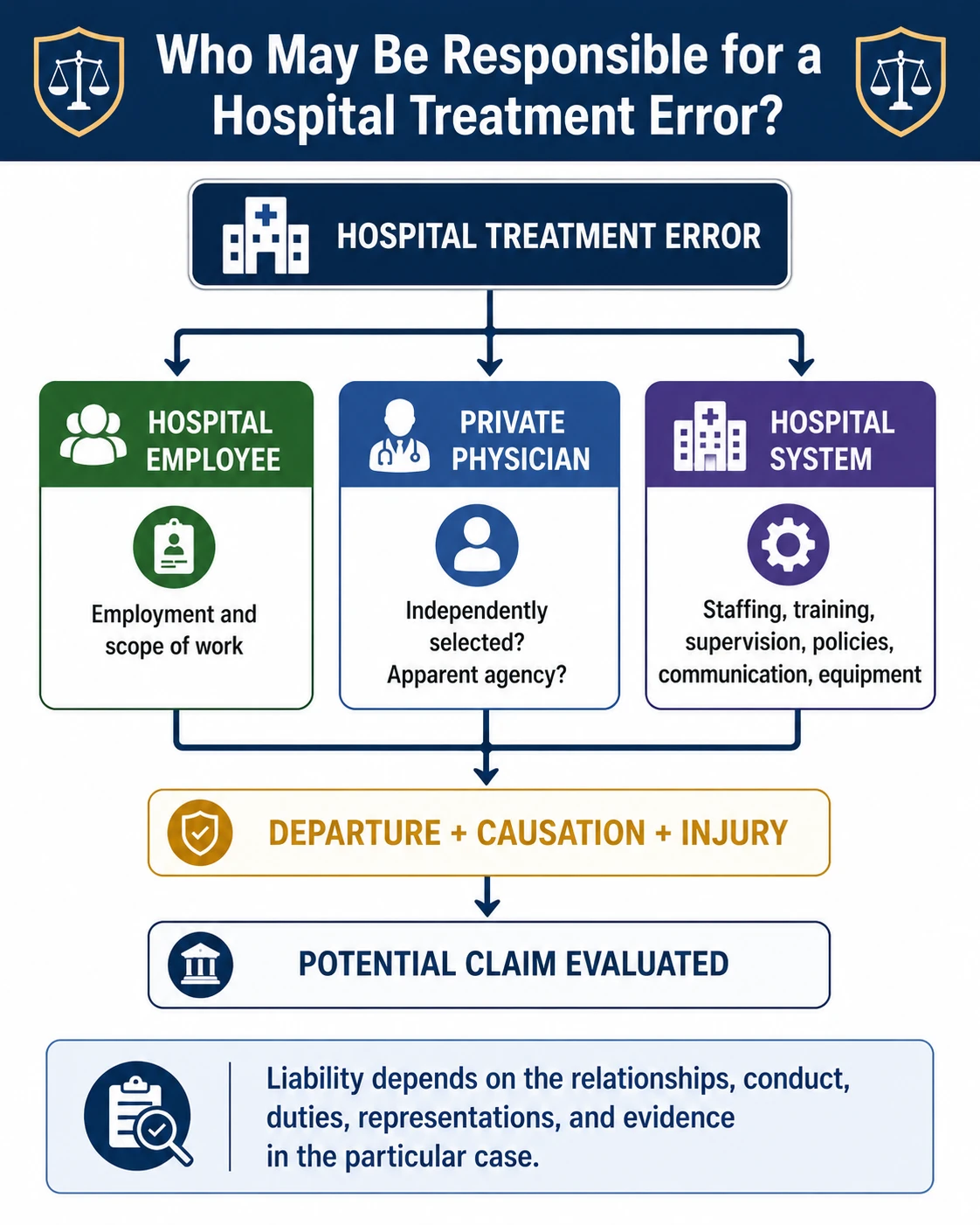
Liability depends on the relationships, conduct, duties, representations, and evidence in the particular case.
Potentially. Hospitals may be vicariously liable for negligent conduct by employed nurses, residents, technicians, pharmacists, or other personnel acting within the scope of their work. They may also face direct claims involving hospital systems, supervision, staffing, medication controls, or communication processes.
Responsibility is not determined solely by a person’s job title. The investigation should identify the individual’s employer, role, authority, supervision, the orders being followed, any independent clinical judgment exercised, and whether the conduct caused injury. In some situations, hospital employees may have been carrying out a private attending physician’s orders, which can complicate the liability analysis.
New York decisions recognize that hospital liability for staff conduct can depend on whether employees independently contributed to the alleged malpractice or merely implemented a private physician’s directions.
Hospital-related claims may involve failures to recognize or respond to time-sensitive conditions such as stroke, heart attack, infection, internal bleeding, aneurysm, fracture, or bowel obstruction. Other potential issues include inadequate triage, incomplete history-taking, insufficient examination, delayed physician involvement, failure to communicate critical laboratory or imaging results, inadequate monitoring, or premature discharge.
These examples do not establish that malpractice occurred in a particular case. Expert review is ordinarily needed to evaluate what information was available, what action was medically required, whether any delay or omission departed from the accepted standard of medical care, and whether earlier or different treatment probably would have changed the outcome.
The biggest concern when several people were involved in your care is assuming no one can be held accountable because it isn’t clear who made the mistake. Here is how responsibility usually breaks down.
Employed physicians, nurses, technicians, aides, and other personnel
Whether the person was a hospital employee, acted within the scope of employment, departed from the applicable standard, and caused injury
Medical residents
Employment or affiliation, supervision, individual clinical decisions, orders followed, and the hospital’s role
Private attending physician
Whether the physician was independently selected and whether the hospital controlled or participated in the relevant care
Apparent or ostensible agency
Whether the hospital held the provider out as its agent, the patient reasonably believed the provider acted for the hospital, and the patient relied on that appearance
Hospital institution
Staffing, training, supervision, systems, communication, equipment, policies, or other facility-level duties
Multiple defendants
Whether separate providers or entities contributed to different departures or injuries
Outside medical group or contractor
Employment, contractual relationship, control, representations, and responsibility for the individual provider
The provider’s location and job title do not determine liability by themselves. The relationships, conduct, representations, duties, and causation must be evaluated.
Relevant records may include emergency-department triage documentation, histories and physical examinations, medication-administration records, physician orders, nursing flowsheets, laboratory results, imaging and reports, consultation notes, progress notes, operative records, monitoring data, admission documents, discharge instructions, and subsequent treatment records.
The ordinary patient chart may not contain every item potentially relevant to litigation. Audit trails, metadata, staffing schedules, internal communications, incident materials, policies, and other administrative records may be maintained separately and may require specifically tailored discovery requests. Whether a particular item is discoverable depends on relevance, privilege, confidentiality rules, possession or control, and court orders.
Patients should preserve records already in their possession, but they do not need to obtain every document before contacting an attorney.
Sometimes. A hospital generally is not vicariously liable for the malpractice of a private attending physician who was independently selected and is not a hospital employee. However, apparent or ostensible agency may apply when the hospital’s conduct reasonably led the patient to believe the physician was provided by or acting for the hospital and the patient relied on that appearance.
The analysis may consider how the patient entered the hospital, whether the patient requested a particular physician, signage and consent documents, how the provider was introduced, billing and identification materials, and the hospital’s representations. Treatment occurring inside the hospital is not enough by itself.
Hospital treatment frequently involves several clinicians, departments, and entities. A patient is not expected to know each person’s employment status, responsibility, or contribution before seeking legal advice.
Counsel can reconstruct the treatment timeline, identify the relevant providers and organizations, evaluate employment and agency relationships, and consult qualified experts about the medical conduct and causation. The investigation may show that one provider, several providers, the institution itself, or no legally responsible party caused the injury.
The objective is not to name every person who appeared in the chart. It is to identify the parties and theories supported by the evidence.
Qualified medical experts review the relevant records, chronology, clinical circumstances, and available policies to evaluate what care was provided and what a reasonably qualified provider or institution should have done under similar circumstances. They may assess departure, causation, prognosis, and whether an outcome was avoidable.
Experts provide medical opinions rather than final legal determinations. Counsel evaluates those opinions together with the employment relationships, institutional duties, procedural rules, damages, and other evidence. New York law does not require a perfect result, but an adverse outcome may support a claim when the evidence establishes a departure from the accepted standard of medical care that caused injury.
Bottar Law’s investigation may include obtaining and organizing relevant hospital records, constructing a detailed treatment timeline, identifying the clinicians and entities involved, and consulting qualified medical experts. When the facts support further investigation, the firm may also evaluate whether electronic audit information, policies, staffing records, communications, or other materials maintained outside the ordinary patient chart are relevant.
The purpose is to determine what occurred, whether the hospital or a provider breached an applicable institutional duty or departed from the accepted standard of medical care, whether the conduct caused injury, and which parties may be legally responsible. Records received during an initial evaluation may be incomplete for many reasons, so additional authorizations, follow-up requests, subpoenas, or litigation discovery may be necessary.
Use this checklist to organize what you need before speaking with a medical malpractice attorney:
Continue obtaining necessary medical care, preserve the information already available, and consult an attorney without unnecessary delay. You do not need to identify the responsible provider or legal theory before requesting an evaluation.
The attorney can examine the treatment chronology, request relevant records, identify the providers and entities involved, investigate employment and agency relationships, and consult qualified experts when appropriate. The evidence may support responsibility by an individual provider, the hospital institution, multiple parties, or no actionable claim.
Because legal deadlines can depend on the defendant and facts, uncertainty about who caused the injury should not delay an initial consultation.
Liability depends on employment, agency, representations, control, and the particular conduct involved.
Apparent-agency or other fact-specific theories may apply.
Policies may be relevant evidence, but they do not automatically establish the legal standard of care.
Counsel and qualified experts can reconstruct the care and evaluate potential responsibility.
Some audit information, metadata, communications, and administrative materials may exist outside the ordinary chart.
The evidence must ordinarily establish an applicable departure and causally related injury.
Liability depends on the relationships, conduct, duties, representations, and evidence in the particular case.

Michael Bottar is a nationally recognized New York medical malpractice and personal injury attorney and the founder of Bottar Law. Throughout his career, he has dedicated his practice to representing individuals and families affected by medical negligence, catastrophic injuries, wrongful death, and other serious acts of negligence. Michael is committed to helping clients understand their legal rights, navigate the complexities of the legal system, and pursue accountability with compassion, integrity, and unwavering advocacy.
For more than 40 years, Bottar Law has represented individuals and families throughout Syracuse, Central New York, and across New York in complex medical malpractice litigation involving catastrophic injuries and wrongful death. Through educational resources like these FAQs, Michael Bottar and the Bottar Law team strive to provide clear, reliable information to help injured individuals and their families make informed decisions during difficult times. Prior results do not guarantee a similar outcome.
Speak with Bottar Law about who may actually be responsible.