 Call833-268-8277

Questions about attorney fees and litigation expenses are an important part of deciding whether to pursue a medical malpractice claim.
These cases can require medical records, qualified medical experts, depositions, court filings, transcripts, exhibits, and other expenses in addition to the attorney’s time and legal work.
Understanding the financial side of representation starts by separating several concepts that are often confused:
This section of the New York Medical Malpractice Knowledge Center explains how contingency fees work, how attorney fees differ from case expenses, what to review before signing a representation agreement, and what may happen if you decide to change attorneys during an ongoing case.
Medical malpractice attorneys may represent injured patients under contingency-fee arrangements, meaning the attorney’s compensation depends on obtaining a financial recovery rather than charging a traditional hourly attorney fee as the case progresses.
New York law specifically regulates contingency fees in medical, dental, and podiatric malpractice claims.
Attorney fees and litigation expenses are separate concepts.
Expenses may include costs associated with obtaining records, consulting qualified medical experts, conducting depositions, filing court documents, preparing exhibits, and performing other work necessary to investigate and litigate a case.
The specific financial terms of representation should be explained in writing before representation begins.
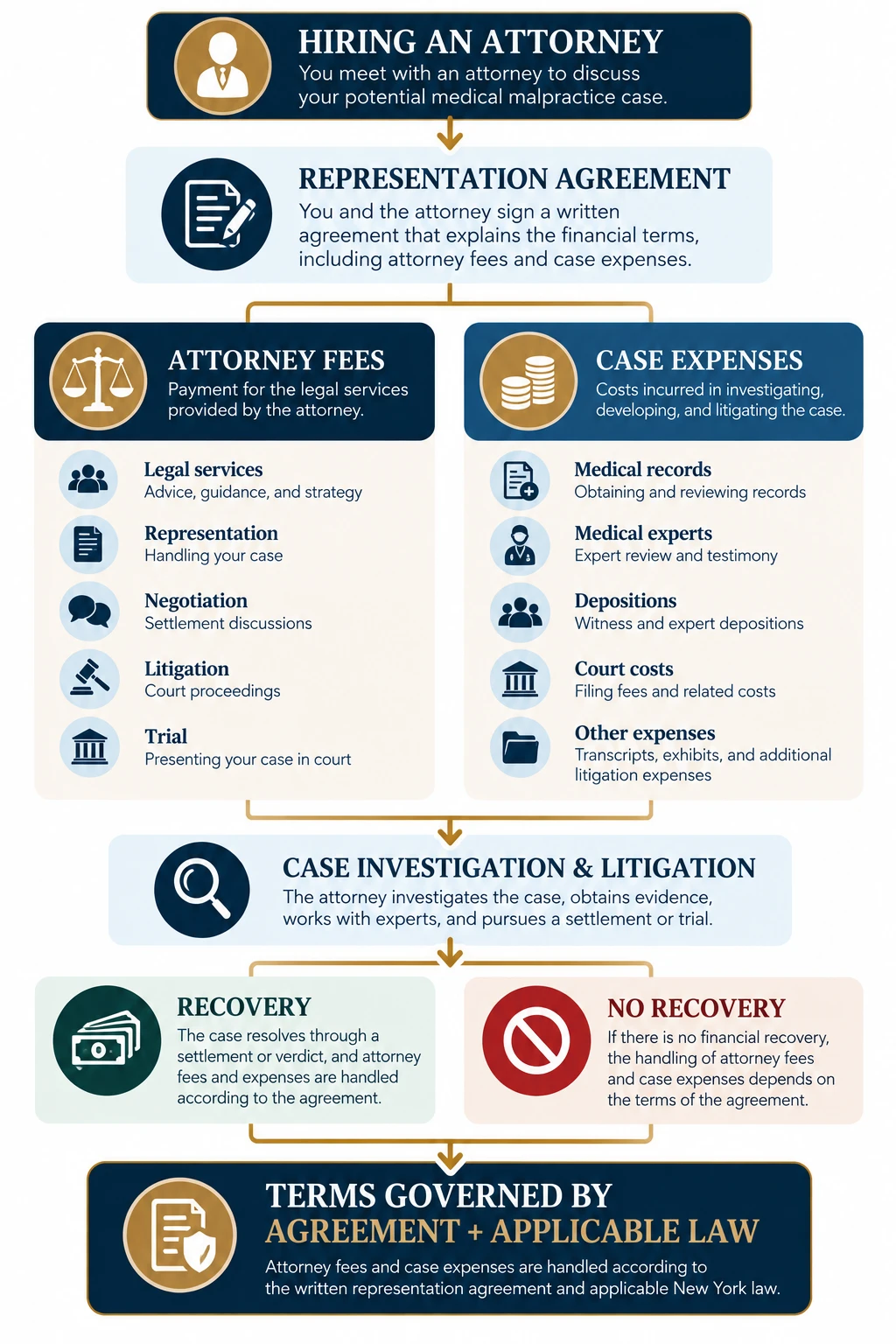
Attorney fees compensate the lawyer for legal services. Case expenses are costs incurred to investigate and litigate the case. They are not the same thing.
A contingency fee generally means that the attorney’s compensation depends on obtaining a recovery for the client rather than billing the client a traditional hourly attorney fee as the case progresses. A potential medical malpractice representation may generally move through this sequence:
The written agreement matters.
Under New York’s Rules of Professional Conduct, a contingent-fee writing must explain the method used to determine the attorney’s fee, including applicable percentages, how litigation and other expenses are deducted, and whether the client may be responsible for expenses regardless of the outcome.
After a contingent-fee matter concludes, the attorney must also provide a writing explaining the outcome and, if there is a recovery, how the amount remitted to the client was determined.
A contingency fee addresses attorney compensation. It should not be confused with litigation expenses.
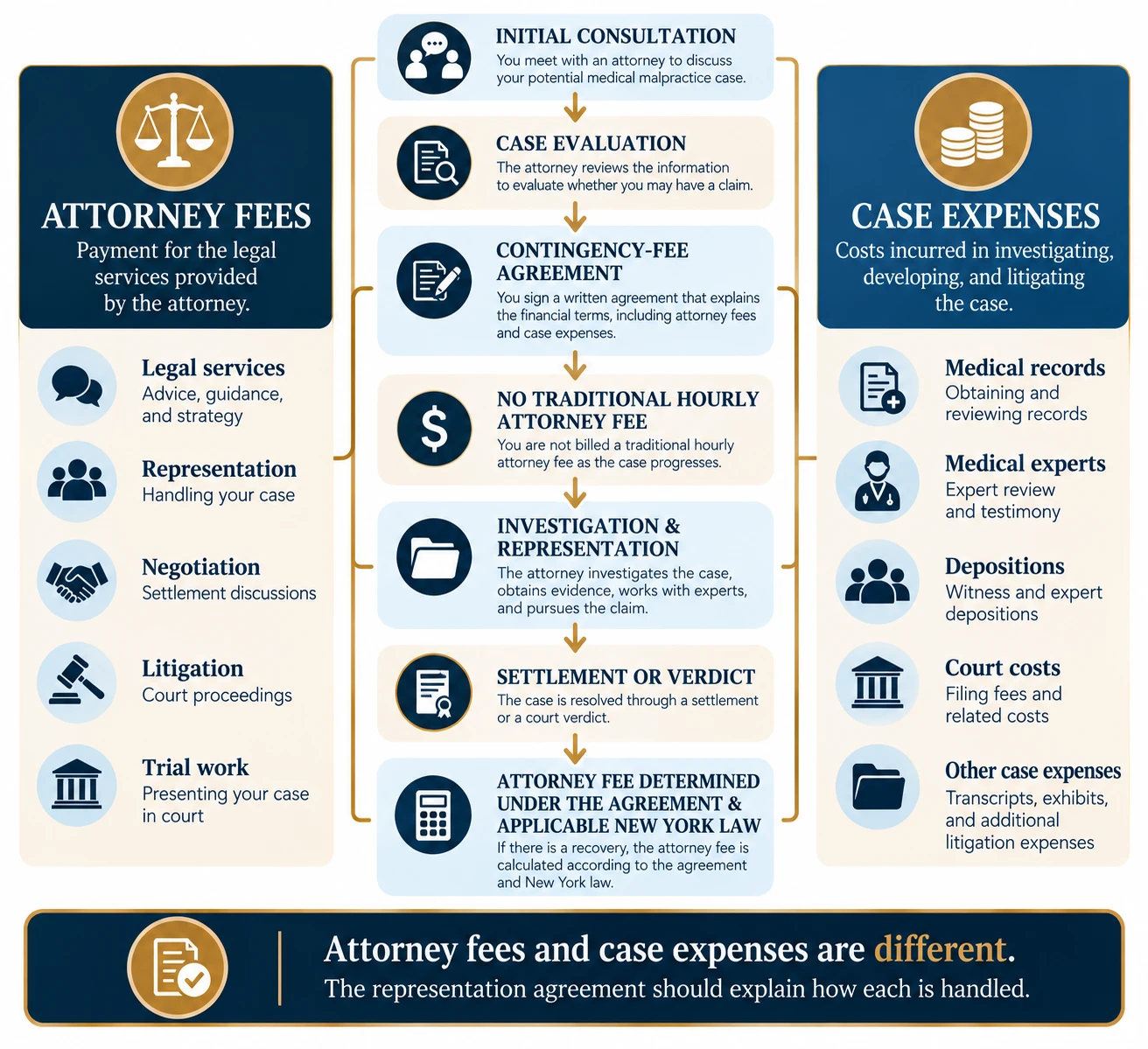
Yes. New York law specifically regulates contingency fees in medical, dental, and podiatric malpractice cases.
Under current New York Judiciary Law § 474-a, a contingency fee generally may not exceed:
First $250,000
30%
Next $250,000
25%
Next $500,000
20%
Next $250,000
15%
Amount over $1.25 million
10%
Importantly, these percentages do not mean that one percentage is simply applied to the entire recovery.
The statute uses a sliding schedule.
It also provides that the percentages are generally computed on the net sum recovered after deducting specified expenses and disbursements for expert testimony and investigative or other services properly chargeable to pursuing the claim.
The statute contains additional provisions, including a procedure through which an attorney may seek court approval for greater compensation in extraordinary circumstances.
Because attorney-fee rules can change and their application can involve case-specific issues, the exact fee arrangement should be explained by the attorney and stated in the written representation agreement.
Last reviewed for New York fee-rule accuracy: 10/21/2026
A contingency-fee arrangement can make legal representation available without requiring the client to pay a traditional hourly attorney fee throughout the case. But that does not mean prospective clients should assume that every financial obligation is identical at every law firm.
There are separate questions to ask:
The answers should be addressed by the attorney and reflected in the representation agreement where applicable.
This is why statements such as “hiring a lawyer costs nothing” can be incomplete.
A clearer question is:
How will attorney fees and case expenses be handled in my particular representation?
This is one of the most important financial distinctions to understand before hiring a medical malpractice attorney.
Compensate the attorney for legal representation
Pay costs associated with developing the case
Governed by the fee arrangement and applicable law
Depend partly on what the individual case requires
Relate to legal services
Relate to investigation and litigation
Should be explained before representation begins
Should also be addressed in the representation agreement
Depending on the case, expenses may include:
Not every case requires the same expenses.
The medical issues, number of parties, experts required, discovery, length of litigation, and whether the case proceeds toward trial can all affect what is needed.
Attorney fees compensate the lawyer for legal services. Case expenses are costs incurred to investigate and litigate the case.
Medical malpractice cases often require both legal and medical evidence. Investigating what happened may involve reviewing large quantities of records, reconstructing treatment, identifying the applicable medical standards, consulting specialists, analyzing causation, and documenting the patient’s injuries.
If a lawsuit is filed, additional work may follow. A case might involve:
Each case is different.
A matter involving one narrow medical issue may require a different investigation from a case involving several physicians, multiple specialties, years of treatment, or a catastrophic permanent injury.
A representation agreement is an important legal document. Read it carefully and ask questions about anything you do not understand before signing. Consider asking:
Under New York’s Rules of Professional Conduct, the contingent-fee writing must address the method by which the fee will be determined and how litigation and other expenses will be treated.
The agreement should give you a clear basis for understanding the financial relationship before the attorney begins representing you.
The financial structure of representation should be evaluated by looking separately at attorney fees and litigation expenses. Hiring an attorney in Syracuse does not eliminate the need to understand the written fee arrangement.
The same core questions remain important:
For a New York medical malpractice case, the attorney-fee arrangement must also operate within applicable New York law.
Changing attorneys may be possible during an ongoing medical malpractice case. But the transition should be handled carefully.
Once litigation is underway, there may be filing deadlines, court appearances, discovery obligations, depositions, expert relationships, pending motions, or other matters that cannot simply be put on hold.
A change in representation may generally involve:
The exact process depends on the status of the case and applicable procedural requirements.
If you are considering changing attorneys, prospective replacement counsel will generally need enough information to evaluate the matter and understand upcoming deadlines before deciding whether to take over the representation.
Changing lawyers can create financial questions involving both the former attorney and new counsel. Depending on the circumstances, issues may include:
New York law also recognizes attorneys’ liens in certain circumstances, which can make the financial consequences of changing counsel more complex than simply ending one agreement and signing another.
That does not mean a client should remain with an attorney solely because the case has already begun.
It means the transition should be understood and handled carefully.
Before changing attorneys, ask prospective replacement counsel how the transition could affect the case, existing expenses, and attorney fees.
Before hiring a medical malpractice attorney, consider asking these questions:
How is your attorney fee calculated?
Do I pay an attorney fee upfront?
What types of case expenses might arise?
Who advances case expenses?
How are expenses handled if there is a recovery?
What happens to expenses if there is no recovery?
Will I be consulted before significant expenses are incurred?
What happens financially if I change lawyers?
How will settlement or judgment funds be distributed?
Will I receive a written breakdown showing fees, expenses, and the amount distributed to me?
You should feel comfortable asking these questions.
A clear discussion of money before representation begins can reduce uncertainty later.
These four resources examine the central financial and representation questions in greater detail.
Learn how contingency-fee representation can affect upfront attorney costs and what questions to ask about litigation expenses and financial obligations.
Understand the distinction between attorney fees and litigation expenses and the financial questions to ask when considering representation in Syracuse.
Learn how contingency representation works, what a written fee agreement should explain, and why attorney fees and case expenses should be evaluated separately.
Understand issues that may arise when changing counsel during an ongoing case, including deadlines, file transfer, expenses, and attorney-fee questions.
Cost matters. But attorney selection should not be reduced to price alone. When evaluating a medical malpractice attorney, consider the financial arrangement alongside:
A fee agreement tells you how the financial relationship works.
It does not, by itself, tell you whether an attorney has the experience, resources, judgment, or approach you want for your case.
Signing a representation agreement begins the attorney-client relationship. It does not end the need for communication and informed decision-making. A medical malpractice case may then progress through:
Clients may have questions throughout the process about medical records, depositions, settlement decisions, communication, expenses, and what happens next.
Understanding your role and your attorney’s role can make a complicated process more predictable.
The financial terms of legal representation should be described accurately and specifically.
For that reason, Bottar Law’s actual engagement terms should control this section rather than generalized statements about how other firms handle medical malpractice cases.
Initial consultation
Free. Discuss your situation with our team, ask questions, and learn about your legal options without financial obligation.
Attorney fee structure
Contingency-based. Our attorney fees depend on obtaining a financial recovery for you.
Upfront attorney fees
No upfront attorney fees. You do not pay attorney fees to begin your case.
Case expenses
Case-related expenses may include medical records, expert witnesses, court filing fees, and other litigation costs. How these expenses are handled will be explained in your representation agreement.
Treatment of expenses if there is no recovery
Whether you are responsible for case expenses if there is no recovery depends on the terms of your representation agreement. This will be discussed during your free consultation.
Written representation agreement
Yes. The terms of representation, including attorney fees and responsibility for case expenses, are outlined in a written agreement for your review before representation begins.
Attorney fees in New York medical malpractice cases are governed by specific legal and ethical requirements.
Bottar Law’s Knowledge Center is designed to explain those concepts in understandable language while recognizing that the actual terms of representation are controlled by the written agreement and applicable law.
Because these rules can change, this page should be reviewed periodically for accuracy.
Last reviewed: 10/21/2026
Last reviewed for New York fee-rule accuracy: 10/21/2026

Michael A. Bottar is an attorney with Bottar Law who has spent more than 20 years prosecuting medical malpractice, wrongful death, and serious personal injury cases throughout New York. He is the immediate past president of the New York State Academy of Trial Lawyers and has been recognized by The Best Lawyers in America® for his work in plaintiffs’ medical malpractice, product liability, and personal injury law.
Before hiring an attorney, you should understand how attorney fees are calculated, how case expenses are handled, who will work on your case, and what the representation agreement requires.
If you or someone in your family suffered a serious medical injury and you have questions about legal representation, Bottar Law can review what happened and explain its current fee and expense policies before you decide whether to move forward.