 Call833-268-8277

Understand your right to change attorneys in New York, how the process differs before and after a lawsuit is filed, and what happens to deadlines and fees.
Attorney reviewed · New York focused · Updated resource
Switching lawyers does not extend filing deadlines or court schedules.
Yes. In New York, a client generally has the right to change medical malpractice lawyers, even after a lawsuit has begun. If the case is already in court, the change ordinarily requires formal substitution of counsel, often through a properly executed and filed Consent to Change Attorney pursuant to CPLR 321(b). Switching lawyers does not extend filing deadlines or court schedules, and the new firm must independently decide whether it can accept the case. Fee and case-expense issues should be explained before the transfer is completed.
Trust and communication are essential in a medical malpractice case, which may take years and require difficult medical, legal, and personal decisions. If a client no longer has confidence in the representation, seeking a second opinion may be appropriate.
Changing attorneys is possible, but the process depends on whether a lawsuit has already been filed, the approaching deadlines and court schedule, the status of the legal and medical investigation, and whether another qualified firm is willing and able to take over the case.
People decide to change attorneys for many different reasons, and every situation is unique. In some cases, the decision reflects a breakdown in the attorney-client relationship. In others, it results from changes in the case, the law firm, or the client’s goals.
Depending on the circumstances, reasons for seeking a second opinion or changing attorneys may include:
Medical malpractice cases are often complex and may involve periods with little visible activity while medical records are collected, experts review the evidence, discovery proceeds, or the court manages the litigation schedule. For that reason, infrequent updates alone do not necessarily mean that a case is being neglected.
If you have concerns about your representation, it is often appropriate to discuss them with your current attorney first. If those concerns remain unresolved, seeking a second opinion from another experienced New York medical malpractice attorney may help you better understand your options.
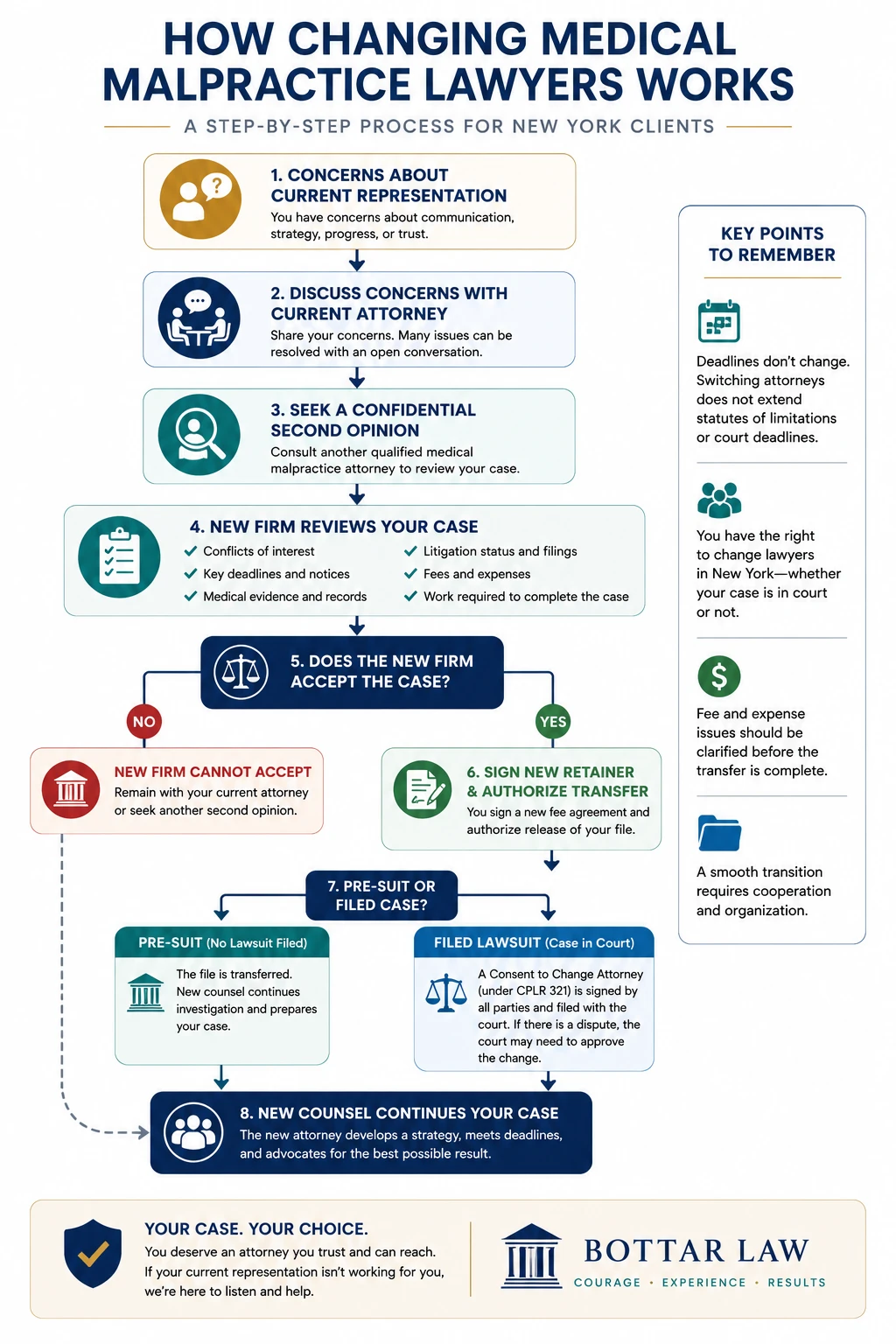
Deadlines don’t change, and no firm is required to accept a case — a smooth transition requires cooperation and organization.
Every case is different, and no single circumstance automatically means that changing attorneys is the right decision. However, there are situations where it may be appropriate to seek a second opinion or discuss your concerns with another experienced medical malpractice attorney.
Depending on the circumstances, signs that may warrant further discussion include:
At the same time, a disagreement with your attorney or a period of limited visible activity does not necessarily mean your case is being mishandled. Medical malpractice cases often involve lengthy periods devoted to obtaining records, consulting experts, conducting discovery, or waiting for court scheduling.
Before deciding whether to change attorneys, the first step is often a direct conversation with your current counsel. If your concerns remain unresolved after that discussion, obtaining a second opinion from another qualified medical malpractice attorney may help you better understand your options.
Yes. Before a medical malpractice lawsuit has been filed, changing attorneys is often more straightforward than changing counsel after litigation has begun. In many cases, the transition is primarily an administrative process.
Depending on the circumstances, the process may include:
Although the transition may be relatively straightforward, it is important to act promptly. New York statutes of limitations, pre-suit requirements, and other legal deadlines continue to apply regardless of whether you are changing attorneys. Delays during the transition could affect your legal rights if important deadlines are approaching.
If you are considering changing attorneys before a lawsuit is filed, the new law firm should explain the transition process, discuss any timing considerations, and help ensure that your case continues to move forward without unnecessary interruption.
Yes. Once a medical malpractice lawsuit has been filed and an attorney has appeared on your behalf in a New York court, changing attorneys generally requires a formal substitution of counsel.
When everyone agrees, the transition is typically completed by executing and filing a Consent to Change Attorney signed by the retiring attorney and acknowledged by the client, allowing the new attorney to become counsel of record.
If the outgoing attorney does not consent to the substitution or another dispute prevents a consensual change, a court application may be required before the substitution can be completed.
Under CPLR 321(b), a consensual substitution of counsel is generally accomplished through a properly executed and filed consent. When consent cannot be obtained, substitution or withdrawal ordinarily proceeds by court order.
Although changing attorneys after litigation has begun may involve additional procedural steps, it does not change the court’s scheduling orders, filing deadlines, or other obligations in the case. Anyone considering a change in representation should discuss the timing with prospective new counsel to help ensure that the transition is handled promptly and without unnecessary disruption.
When a client changes attorneys during a medical malpractice case, the incoming lawyer typically conducts an independent review of the matter before moving the representation forward. Depending on the stage of the case, that review may include the pleadings, court orders, medical records, expert materials (if any), discovery, deposition transcripts, correspondence, litigation expenses, and any approaching deadlines or scheduling obligations.
The law firms generally coordinate the transfer of the client’s file, and if litigation is pending, the substitution of counsel is completed in accordance with the applicable court procedures.
When addressed promptly and cooperatively, the transition can often be completed with limited disruption. However, the amount of time required depends on the stage of the case, upcoming deadlines, the complexity of the medical issues, and how quickly the client file and related materials can be transferred.
For that reason, changing attorneys shortly before a deposition, expert disclosure deadline, significant motion, mediation, trial, or other major litigation event may present additional challenges. Anyone considering a change in representation should discuss the timing with prospective new counsel as early as possible.
Changing attorneys does not ordinarily affect your legal rights or extend the deadlines that apply to your case. Whether your case is in the investigation stage or already in litigation, existing legal and court-imposed deadlines generally remain in effect regardless of who represents you.
Depending on the circumstances, these may include:
Changing attorneys does not revive an expired statute of limitations, cure a missed notice or filing requirement, or automatically postpone a court deadline or scheduled proceeding.
For that reason, it is important not to wait until a significant deadline is approaching before deciding whether to change attorneys. If you are considering a change in representation, speaking with prospective new counsel promptly gives the attorney an opportunity to evaluate the case, determine whether they can accept the representation, and, if appropriate, help ensure that the transition is completed while existing deadlines continue to be met.
Medical malpractice cases are commonly handled under contingency fee agreements, meaning attorney fees are generally paid only if there is a recovery. When a client changes attorneys, the former and incoming law firms may need to determine how any eventual attorney fee will be allocated.
The precise outcome depends on several factors, including the terms of the retainer agreements, the work performed by each attorney, the reason the representation ended, and applicable New York law. In general:
Under New York law, an attorney discharged without cause may have the right to seek compensation for services already performed and, in a litigated matter, may assert a charging lien against any recovery pursuant to Judiciary Law § 475. The application of these rules depends on the specific facts of the case.
Clients ordinarily should not assume that two separate contingency fees will be deducted from the same recovery. Before accepting the representation, the new attorney should explain how any prior attorney fees, potential liens, and litigation expenses are expected to be handled so that the client understands the financial arrangements before deciding whether to transfer the case.
Attorney fees and case expenses are separate issues. In addition to attorney fees, medical malpractice cases often involve litigation expenses (sometimes called disbursements) that may be advanced during the course of the representation.
Depending on the circumstances, these expenses may include:
When a case is transferred to a new law firm, the former firm may assert a claim for reimbursement or seek an agreement regarding expenses it has already advanced. How those expenses are ultimately handled depends on the retainer agreements, the circumstances of the transfer, and any agreement reached between the parties.
Before accepting the representation, the incoming attorney should explain whether the firm expects to assume, reimburse, defer, or dispute any claimed litigation expenses, and how those issues may affect the representation going forward.
Clients should not assume that responsibility for litigation expenses will be handled the same way in every case. The applicable retainer agreements and the specific facts of the matter generally determine how those expenses are addressed.
No. Although a client generally has the right to change attorneys, no law firm is required to accept the representation.
Before agreeing to take over a medical malpractice case, a prospective law firm will ordinarily conduct its own independent evaluation. Depending on the circumstances, that review may include:
A law firm may decide not to accept the representation for many reasons, even if the client has legitimate concerns about the prior attorney or the underlying case. Declining representation does not necessarily mean the claim lacks merit.
For that reason, anyone considering changing attorneys should understand whether replacement counsel is prepared to accept the matter before finalizing the transition whenever practicable. Discussing the timing with prospective new counsel can help reduce the risk of disrupting the case or approaching important legal deadlines without representation.
Yes. Obtaining a second opinion does not necessarily mean you should change attorneys. In many situations, it simply provides additional information that helps you make an informed decision about how to move forward.
Depending on the circumstances, a second opinion may:
Every medical malpractice case is unique. Sometimes a second opinion confirms that the existing representation is appropriate and the case is progressing as expected. In other situations, it may identify issues that warrant further discussion or a change in representation.
The purpose of a second opinion is not to encourage clients to switch attorneys. Rather, it is to help them better understand their case, their options, and whether they remain confident in the representation they are receiving.
It is common for clients to have questions or concerns before deciding whether to change attorneys. Understanding how the process typically works can help you make a more informed decision.
A change in representation does not automatically harm a medical malpractice case. However, timing matters. Changing attorneys shortly before significant deadlines, depositions, motions, or trial may create additional challenges, which is why prospective new counsel should evaluate the case promptly.
When representation changes, the transfer of the client’s file is ordinarily coordinated between the law firms. Although practical or fee-related issues may need to be resolved, the transition process is generally intended to allow the new attorney to continue representing the client without unnecessary disruption.
Not necessarily. In contingency fee cases, the former and incoming attorneys typically determine how any eventual attorney fee will be allocated in accordance with the retainer agreements and applicable New York law. Clients ordinarily should not assume that two separate contingency fees will be deducted from the same recovery.
A new law firm will ordinarily review the existing legal file, medical records, and procedural history. Even so, you should expect to discuss your medical treatment, your concerns about the representation, and any significant developments to help the new attorney fully understand the case.
If no lawsuit has been filed, changing attorneys is generally an administrative process between the client and the law firms. If litigation is already pending, a formal substitution of counsel is generally required in accordance with New York procedure, and court involvement may be necessary in some circumstances.
A prospective law firm must independently evaluate whether it is willing and able to accept the representation. For that reason, it is often advisable to understand whether replacement counsel is prepared to take the case before finalizing the transition whenever practicable.
Every case is different. If you are considering changing attorneys, understanding both the legal process and the practical implications can help you decide whether a change in representation is in your best interest.
Every transferred medical malpractice case requires an independent evaluation. Before deciding whether it can accept a matter, Bottar Law conducts a careful review of the available information to understand the medical issues, the procedural posture of the case, and the work required moving forward.
Depending on the circumstances, that evaluation may include:
Every transferred case presents different legal, medical, and procedural considerations. If Bottar Law determines that it can assist, the firm explains its approach, answers the client’s questions honestly, and provides straightforward guidance so the client can make an informed decision about whether to proceed with the transfer.
Before making a decision to change attorneys, take time to understand both the procedural and financial consequences of the transition. Practical steps may include:
Before ending your existing attorney-client relationship, it is generally advisable to understand whether another attorney is prepared to accept the representation and how the transition would be handled. That discussion should include the process for substitution of counsel (if litigation is pending), transfer of the client file, attorney fees, litigation expenses, and any existing court deadlines or scheduling obligations.
Changing attorneys is a significant decision, but in some circumstances it may be the right one. The most important step is making an informed decision based on a clear understanding of your legal rights, the status of your case, and the practical considerations involved in any transition.
In New York, a client generally has the right to discharge an attorney with or without cause. If a medical malpractice lawsuit is already pending, however, changing attorneys typically requires compliance with the substitution procedures set forth in CPLR 321(b).
Changing attorneys does not automatically extend statutes of limitations, applicable notice or filing requirements, discovery schedules, expert disclosure deadlines, motion deadlines, trial dates, or other court-imposed deadlines. Different relief is available only if authorized by law or ordered by the court.
No law firm is required to accept a transferred case. Every firm must conduct its own review of the medical evidence, legal issues, procedural posture, deadlines, potential conflicts of interest, anticipated litigation expenses, and the work required before deciding whether it can responsibly undertake the representation.
Attorney-fee issues are often more nuanced. A lawyer discharged without cause may retain certain rights under New York law, including the ability to seek compensation for services already performed or, where applicable, assert a charging lien. Clients ordinarily should not assume that changing attorneys means paying two full contingency fees from the same recovery.
A lack of consent may make the process more complicated, but it does not necessarily prevent a change in representation. When a consensual substitution cannot be completed, CPLR 321(b) provides a procedure through which the court may address a disputed substitution or withdrawal of counsel.
Communication concerns may justify requesting clarification or obtaining a second opinion, but they do not automatically establish legal malpractice or constitute “cause” for purposes of attorney compensation under New York law. Whether an attorney has committed legal malpractice or may be discharged for cause depends on the specific facts and applicable law.
Deadlines and court schedules do not automatically change when you change attorneys.

Michael Bottar is a nationally recognized New York medical malpractice and personal injury attorney and the founder of Bottar Law. Throughout his career, he has dedicated his practice to representing individuals and families affected by medical negligence, catastrophic injuries, wrongful death, and other serious acts of negligence. Michael is committed to helping clients understand their legal rights, navigate the complexities of the legal system, and pursue accountability with compassion, integrity, and unwavering advocacy.
For more than 40 years, Bottar Law has represented individuals and families throughout Syracuse, Central New York, and across New York in complex medical malpractice litigation involving catastrophic injuries and wrongful death. Through educational resources like these FAQs, Michael Bottar and the Bottar Law team strive to provide clear, reliable information to help injured individuals and their families make informed decisions during difficult times. Prior results do not guarantee a similar outcome.
Speak with Bottar Law for a confidential second opinion on your medical malpractice case.