 Call833-268-8277

Understand how contingency fees work, who pays litigation costs, and what to ask before signing a representation agreement.
Attorney reviewed · New York focused · Updated resource
You generally don’t pay attorney fees unless compensation is recovered.
Most medical malpractice lawyers in Syracuse represent clients on a contingency fee basis. This generally means you do not pay attorney fees upfront. Instead, attorney fees are typically paid only if compensation is recovered through a settlement or verdict. Medical malpractice cases often involve significant investigation, expert review, and litigation expenses, so it is important to understand how both attorney fees and case costs are addressed in the written representation agreement before deciding whether to move forward.
No attorney fee paid upfront
Client pays as work is performed
Fee generally depends on recovery
Fee owed regardless of outcome
Lawyer assumes significant financial risk
Client funds legal work
Common in medical malpractice
Less common in plaintiff malpractice cases
Understanding how contingency fees work begins with understanding why medical malpractice cases are among the most complex and resource-intensive types of civil litigation.
Medical malpractice cases often require significant investigation and expert review before a lawsuit can be filed. An experienced law firm will explain how attorney fees and case expenses are handled so you understand the financial arrangement before deciding whether to move forward with your claim.
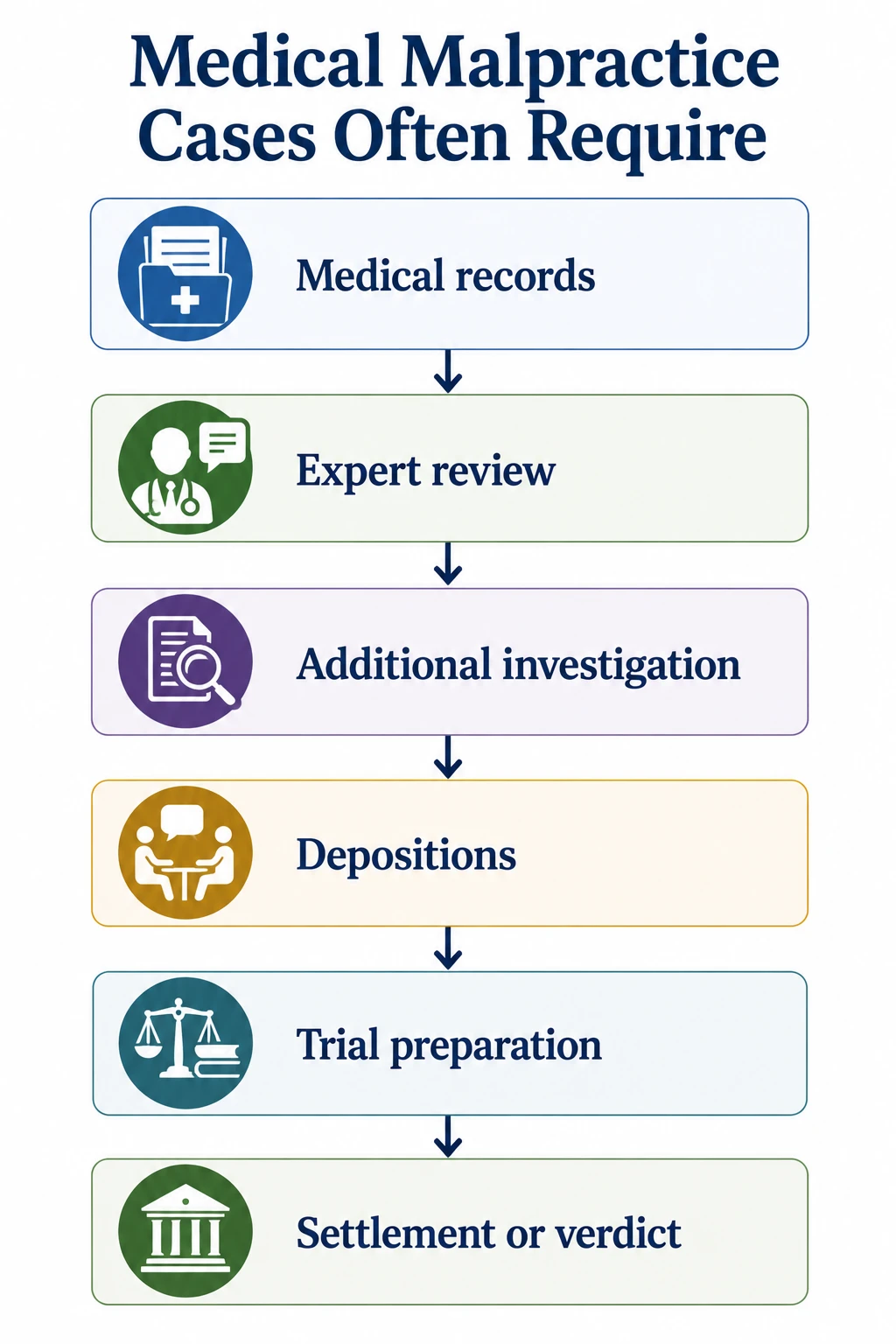
Medical malpractice litigation often requires substantial time, expertise, and financial investment before a case reaches resolution.
Many medical malpractice law firms offer an initial consultation to discuss a potential case, but practices vary from one firm to another. Before scheduling an appointment, it is appropriate to ask whether there is a charge for the consultation and what it will include.
An initial consultation is an opportunity to discuss what happened, ask questions about the legal process, and learn whether further investigation may be appropriate. In most situations, meeting with an attorney does not obligate you to hire that law firm or pursue a lawsuit.
It is also an opportunity to determine whether the attorney has experience handling complex medical malpractice litigation and whether the law firm has the resources necessary to investigate the claim.
Qualified medical experts are often retained as part of the medical malpractice litigation process to evaluate the medical care, explain whether there was a departure from the accepted standard of medical care, and, when appropriate, address causation and damages.
Many medical malpractice law firms advance the costs associated with expert review while the case is pending, although every representation agreement is different. Before hiring an attorney, clients should understand how expert fees and other litigation expenses will be handled throughout the case and how those costs are addressed under the fee agreement.
Most Syracuse medical malpractice attorneys represent clients under a contingency fee agreement rather than charging hourly rates. Under this arrangement, attorney fees are generally paid only if the case results in a financial recovery.
This approach allows injured patients and their families to pursue legal representation without paying attorney fees at the beginning of the case. During your consultation, the attorney should explain how the fee agreement works and answer any questions you may have.
A contingency fee means the attorney’s fee depends on the successful outcome of the case. Instead of paying for legal services as the case progresses, the attorney receives a percentage of the recovery if compensation is obtained through a settlement or verdict.
This arrangement allows many people to pursue medical malpractice claims without paying attorney fees at the outset of the case, making legal representation more accessible than traditional hourly billing for many individuals and families.
Yes. Contingency fee arrangements in New York are governed by applicable law and professional rules. The fee agreement should be in writing and should clearly explain how attorney fees are calculated, how litigation expenses are handled, and how any recovery will be distributed.
Before signing a representation agreement, clients should carefully review its terms and ask questions about anything they do not understand. A reputable attorney should be willing to explain the agreement in clear, straightforward language before representation begins.
Medical malpractice cases are often among the most medically and legally complex types of personal injury litigation. Unlike many other injury claims, they typically require an extensive review of medical records, consultation with qualified medical experts, and a detailed evaluation of whether a healthcare provider departed from the accepted standard of medical care and whether that departure caused the patient’s injury.
Depending on the issues involved, the case may require opinions from specialists in one or more medical fields, expert reports, depositions, additional medical research, court filings, trial exhibits, and other litigation support. The investigation may also involve reviewing years of medical treatment, obtaining records from multiple healthcare providers, and analyzing complicated medical histories.
These additional steps can make medical malpractice cases significantly more resource-intensive than many other personal injury claims. Although every case is different, the time, expertise, and financial investment required to properly investigate and prepare a medical malpractice case are often substantial.
Because of these demands, many medical malpractice attorneys represent clients through contingency fee agreements and may advance many of the litigation expenses required to investigate and pursue the case. Clients should carefully review their written representation agreement so they understand how attorney fees, litigation expenses, and reimbursement obligations are handled.
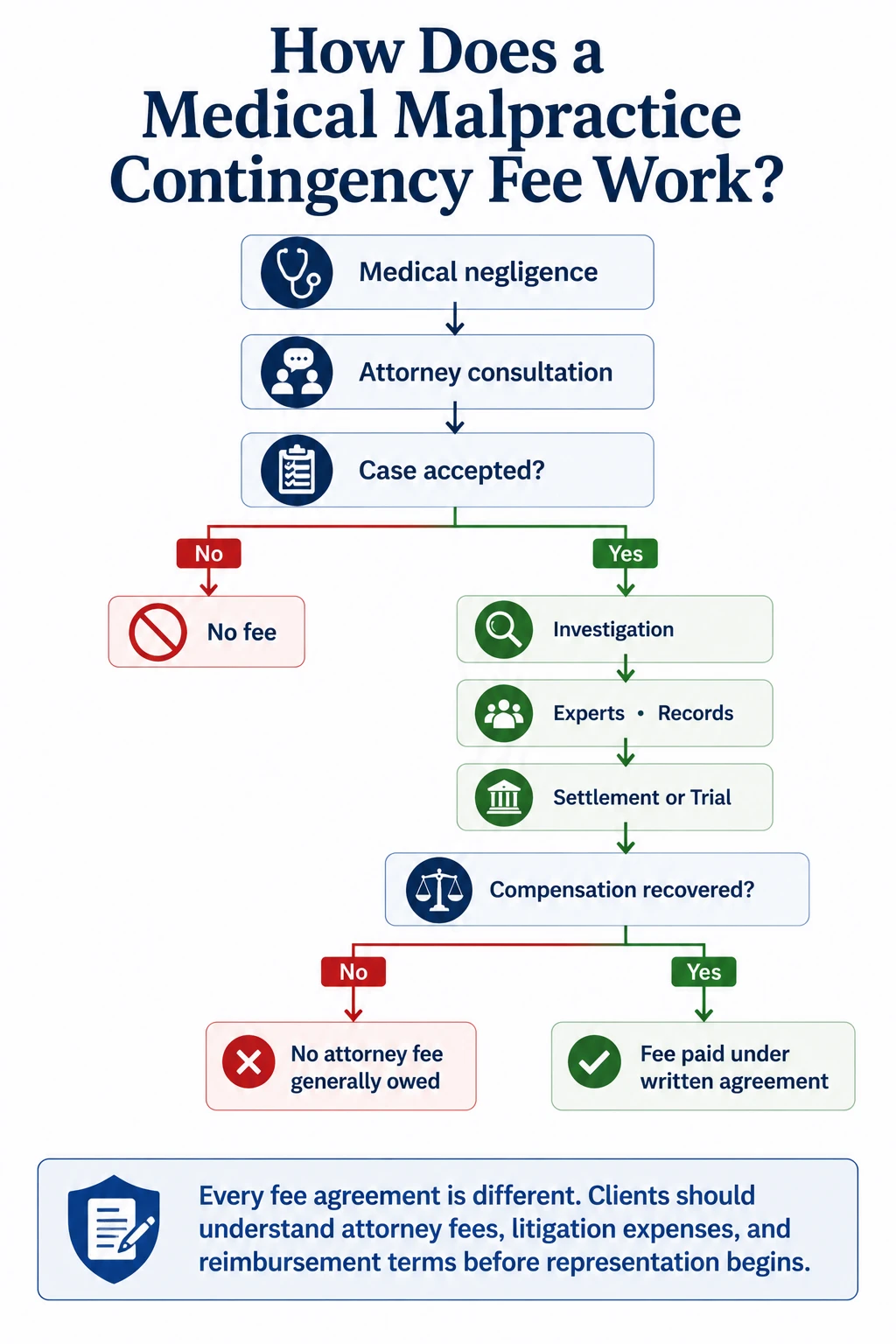
Every fee agreement is different. Clients should understand attorney fees, litigation expenses, and reimbursement terms before representation begins.
In most medical malpractice cases, clients are not required to pay attorney fees upfront. This allows individuals and families to have their case investigated without taking on the immediate financial burden of paying legal fees.
Before representation begins, your attorney should explain the fee agreement in detail so you understand how attorney fees and case expenses will be handled throughout the case.
Medical malpractice cases often involve expenses beyond attorney fees. These may include obtaining medical records, retaining qualified medical experts, taking depositions, securing transcripts, paying court filing fees, preparing exhibits for trial, creating medical illustrations or demonstrative evidence, hiring videographers when appropriate, and covering necessary travel related to the litigation.
Because medical malpractice cases often involve complex medical issues and multiple expert witnesses, these expenses can be substantial. Experienced medical malpractice law firms frequently advance many of these litigation costs while the case is pending. During your consultation, your attorney should explain how case expenses are handled, whether they are advanced by the firm, and how they are addressed under the representation agreement if compensation is ultimately recovered.
Many medical malpractice cases are resolved through settlement before a trial begins. If the parties reach a settlement, the case is concluded without asking a judge or jury to decide the outcome.
When a case settles, the contingency fee agreement generally continues to govern how attorney fees and litigation expenses are handled. The settlement documents, together with the representation agreement, should explain how the recovery will be distributed, including attorney fees, case expenses, liens, or other applicable obligations.
Many people worry that they cannot afford legal representation after losing income because of a serious injury. Because many medical malpractice attorneys work on a contingency fee basis, clients are generally not required to pay attorney fees at the beginning of the case.
Every representation agreement is different, and it is important to understand how attorney fees and litigation expenses will be handled before representation begins. Speaking with an experienced medical malpractice attorney can help you understand your options, ask questions about the financial arrangement, and determine whether pursuing a claim is realistic given your circumstances.
Every representation agreement is different, so it is important to discuss this question before hiring a law firm. Attorneys who work on a contingency fee basis generally do not receive attorney fees unless compensation is recovered.
Your attorney should also explain how litigation expenses are handled under the terms of the representation agreement so you understand your rights and responsibilities before moving forward.
Clients should understand both attorney fees and litigation expenses before signing the representation agreement so there are no surprises later.
At Bottar Law, we believe clients should fully understand the financial aspects of their case before deciding whether to move forward. During the initial consultation, we explain how contingency fee representation works, review the written fee agreement, discuss how litigation expenses are handled, and encourage clients to ask questions about any part of the process they do not understand.
Before representation begins, we strive to provide a clear and transparent explanation of attorney fees, case expenses, and how those costs are addressed under the representation agreement. Our goal is to help every client make an informed decision with confidence, knowing they understand both the legal process and the financial arrangement before moving forward.
Choosing a medical malpractice attorney is about much more than cost. Medical malpractice cases require substantial experience, qualified medical experts, and the resources necessary to thoroughly investigate complex claims. Selecting an attorney based only on the lowest fee or the most aggressive advertising may not result in the representation your case requires.
Instead, look for a law firm with experience handling medical malpractice cases, a commitment to clear communication, and the resources to fully prepare your claim.
During your consultation, you should ask whether the attorney works on a contingency fee basis, how attorney fees are calculated, how case expenses are handled, who advances those costs, and what happens if compensation is not recovered.
Understanding these issues from the beginning helps you make an informed decision and prevents misunderstandings later in the legal process.
If you believe you have been harmed by medical negligence, do not let concerns about cost prevent you from seeking legal advice. Speaking with an experienced medical malpractice attorney can help you understand your legal rights, how contingency fee representation works, and whether you may have a valid claim.
A consultation allows you to ask questions, learn about the process, and make an informed decision without committing to pursue a lawsuit. For many families, that first conversation provides the clarity and reassurance they need to move forward.
A clear understanding of attorney fees, litigation expenses, and the written representation agreement allows clients to make informed decisions before pursuing a medical malpractice claim.
Many plaintiff malpractice attorneys use contingency-fee agreements.
They are separate concepts.
Representation agreements differ.
Experience and resources are often more important.
A consultation is an opportunity to gather information.
Every fee agreement is different. Understand attorney fees, litigation expenses, and reimbursement terms before representation begins.

Michael Bottar is a nationally recognized New York medical malpractice and personal injury attorney and the founder of Bottar Law. Throughout his career, he has dedicated his practice to representing individuals and families affected by medical negligence, catastrophic injuries, wrongful death, and other serious acts of negligence. Michael is committed to helping clients understand their legal rights, navigate the complexities of the legal system, and pursue accountability with compassion, integrity, and unwavering advocacy.
For more than 40 years, Bottar Law has represented individuals and families throughout Syracuse, Central New York, and across New York in complex medical malpractice litigation involving catastrophic injuries and wrongful death. Through educational resources like these FAQs, Michael Bottar and the Bottar Law team strive to provide clear, reliable information to help injured individuals and their families make informed decisions during difficult times. Prior results do not guarantee a similar outcome.
Speak with Bottar Law about how contingency fees and case expenses actually work.