 Call833-268-8277

Understand how New York’s statutory sliding-scale fee works, who pays litigation costs, and what to review before signing.
Attorney reviewed · New York focused · Updated resource
New York’s medical malpractice fee follows a statutory sliding scale under Judiciary Law § 474-A.
New York medical malpractice attorneys are paid only if they win, on a sliding scale set by statute: 30% of the first $250,000 recovered, 25% of the next $250,000, 20% of the next $500,000, 15% of the next $250,000, and 10% of anything above $1,250,000. The firm typically advances all litigation costs, often $50,000 to $100,000 per case, and is repaid only from a recovery. If there is no monetary recovery, no legal fee is owed. Whether the client remains responsible for litigation costs depends on the terms of the contingency fee agreement, although many firms, including Bottar Law, ordinarily do not seek reimbursement of those costs when there is no recovery.
Facing medical bills and lost income while wondering whether you can even afford a lawyer adds one more layer of stress to an already difficult situation. Understanding how contingency fees actually work can take that particular worry off the table.
A contingency fee agreement is a contract between a client and a law firm that obligates the client to pay the attorney’s legal fee if and only if the law firm secures a monetary recovery for the client. The agreement also explains how litigation expenses (often called disbursements) are handled.
Medical malpractice attorneys in New York commonly represent clients on a contingency fee basis. This means the attorney is only paid a legal fee if there is a monetary recovery for the client. New York’s medical malpractice legal fee is calculated on a sliding scale, as set forth in New York Judiciary Law section 474-A. In summary, the medical malpractice legal fee is 30% of a recovery up to $250,000, plus 25% of the next $250,000 recovered, plus 20% of the next $500,000 recovered, plus 15% of the next $250,000 recovered, plus 10% of any amount recovered over $1,250,000.
Judiciary Law § 474-A(4) also permits an attorney to apply to the court for approval of a higher fee, up to one-third of the recovery, in extraordinary circumstances. Such adjustments are uncommon and require judicial approval rather than unilateral agreement by the attorney.
As part of retaining a New York medical malpractice attorney to represent you, the attorney will ask you to sign a contingency fee agreement. This agreement is a contract between the client and the law firm, and obligates the client to pay the firm’s legal fee only if there is a monetary recovery. The amount of the legal fee will be stated in the agreement. After the agreement is signed, the law firm will secure copies of the relevant medical records, consult with a medical expert about the case, file the lawsuit, and conduct discovery. The law firm can advance the costs for the records, expert review, filing fees, and discovery expenses. The costs to litigate a case are called disbursements. If there is a monetary recovery, litigation expenses are reimbursed in accordance with the written contingency fee agreement and applicable New York law. The agreement should explain how litigation expenses and attorney fees are calculated and distributed.
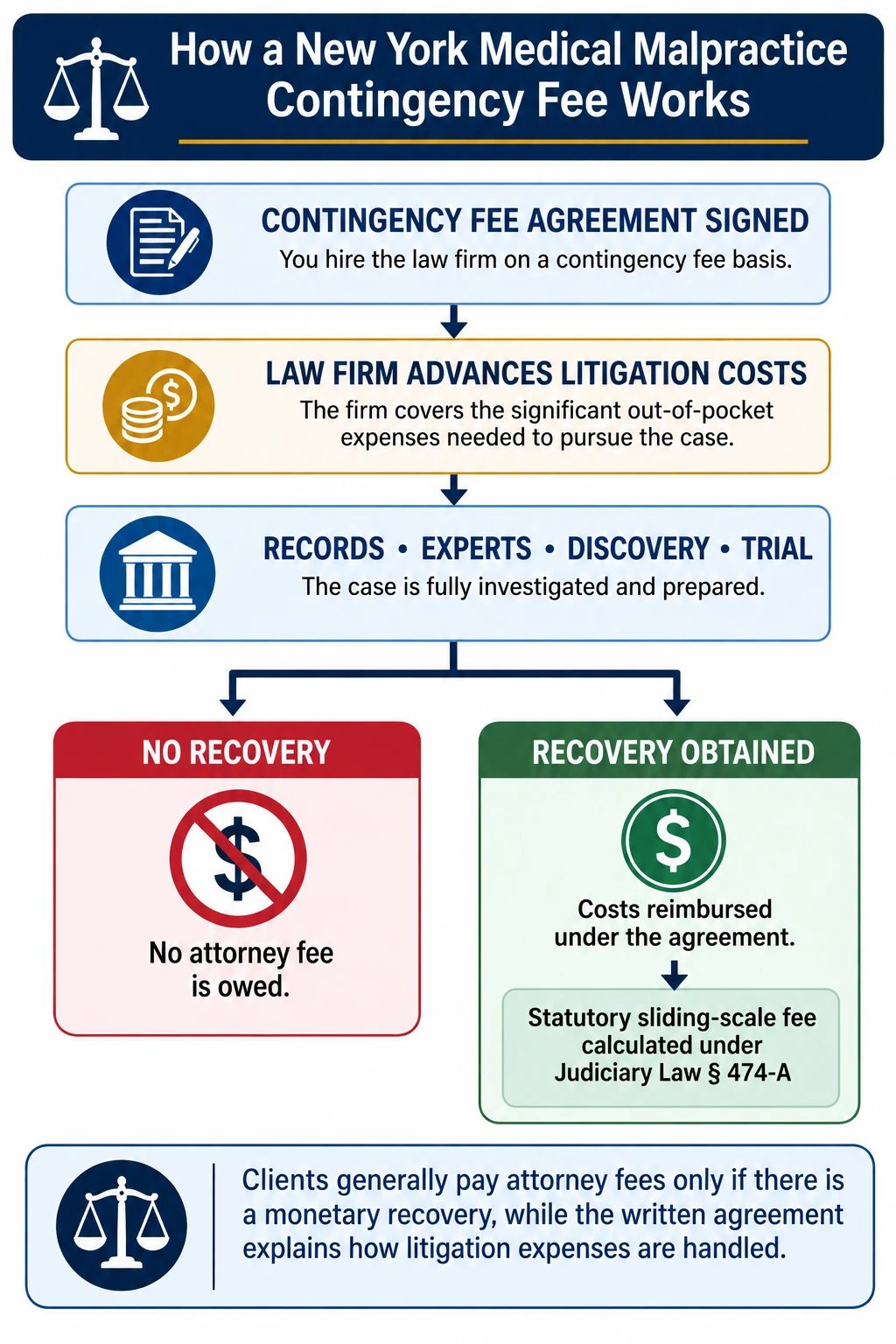
Clients generally pay attorney fees only if there is a monetary recovery, while the written agreement explains how litigation expenses are handled.
Every contingency fee agreement should be reviewed carefully before signing. Clients should understand how attorney fees, litigation expenses, settlement distributions, and any court-approved adjustments are addressed in the written agreement. Asking questions before signing helps avoid misunderstandings later in the case.
Clients generally do not pay attorney fees upfront in a New York medical malpractice case handled on a contingency basis. Many firms also advance litigation costs, although clients should review the fee agreement carefully to understand how those expenses are handled if there is or is not a recovery.
When Bottar Law accepts a case, the firm advances all of the costs associated with the matter, including the cost to collect medical records, secure expert reviews, filing and service fees, stenographer fees, and, when a case does not settle before trial, trial costs including fees for subpoenas, courtroom technology, experts, witnesses, and exhibits.
At Bottar Law, costs incurred in connection with complex medical malpractice litigation (called disbursements) frequently total approximately $50,000 to $100,000 per case, although the actual amount varies depending on the issues, experts, discovery, and whether the case proceeds to trial. Disbursements are separate from the legal fee. If there is a monetary recovery, the firm’s disbursements are deducted from the gross recovery before calculating the legal fee.
One of the most common questions prospective clients have is how the statutory sliding-scale fee is actually calculated.
First $250,000 recovered
Legal fee is 30% under New York’s statutory sliding scale.
Next $250,000 recovered
Legal fee drops to 25% on this portion.
Next $500,000 recovered
Legal fee drops further, to 20% on this portion.
Next $250,000 recovered
Legal fee is 15% on this portion.
Amount over $1,250,000
Legal fee is 10% on anything above this threshold.
Disbursements (case costs)
Advanced by the firm, often $50,000–$100,000 per case, and repaid from the recovery before the legal fee is calculated.
The percentages apply progressively rather than to the entire recovery. Each percentage is applied only to the corresponding portion of the recovery.
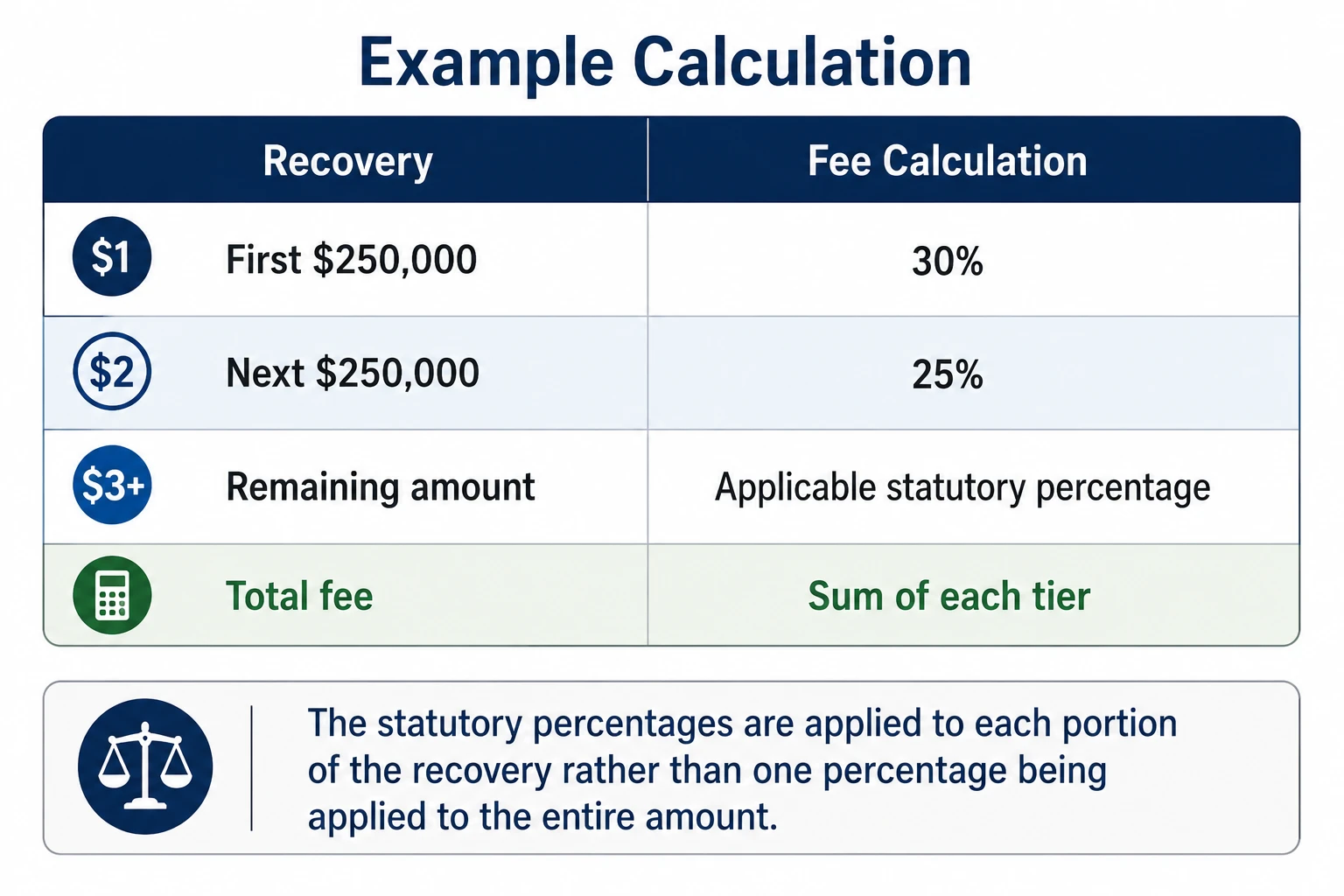
The statutory percentages are applied to each portion of the recovery rather than one percentage being applied to the entire amount.
No legal fee is due if a claim or lawsuit does not produce a monetary recovery for the client. The contingency fee agreement should also explain how litigation costs are handled if no recovery is obtained.
Injured patients facing medical bills and lost income rarely have the means to pay a lawyer by the hour to determine if there is a case and, if there is a case, to prosecute the action. Even those with means rarely have $50,000 to $100,000 to spend on a case without any guarantee of a recovery. Contingency fee agreements often are the only way that a patient can retain a lawyer to seek accountability for harm caused by medical malpractice, since the law firm advances litigation costs and is only paid a legal fee if there is a monetary recovery.
New York’s medical malpractice contingency fees are regulated by statute. The statute is New York Judiciary Law section 474-A.
A contingency fee agreement is a contract. Use this checklist before signing:
A contingency fee agreement is a contract, and the biggest fear for someone signing one is not fully understanding what they are agreeing to. A client should review the agreement before signing, and should ask questions about any language in the agreement that they do not understand.
You do not have to understand every legal term on your own. The next step is having an attorney walk through the agreement with you, line by line, before you sign anything.
New York medical malpractice contingency fees are governed by Judiciary Law § 474-A. Because the statute establishes the fee structure, attorneys generally do not negotiate percentages in the same manner as other types of legal matters. Clients should instead focus on understanding how litigation costs, disbursements, and other terms of the agreement will be handled.
The attorney’s fee depends on a recovery, but litigation costs are addressed separately in the agreement.
New York medical malpractice fees follow a statutory sliding scale.
Firms may differ in how they advance and recover disbursements.
Clients should read every provision and ask questions before signing.
It simply determines how legal fees are paid if a recovery occurs.
Clients generally pay attorney fees only if there is a monetary recovery.

Michael Bottar is a nationally recognized New York medical malpractice and personal injury attorney and the founder of Bottar Law. Throughout his career, he has dedicated his practice to representing individuals and families affected by medical negligence, catastrophic injuries, wrongful death, and other serious acts of negligence. Michael is committed to helping clients understand their legal rights, navigate the complexities of the legal system, and pursue accountability with compassion, integrity, and unwavering advocacy.
For more than 40 years, Bottar Law has represented individuals and families throughout Syracuse, Central New York, and across New York in complex medical malpractice litigation involving catastrophic injuries and wrongful death. Through educational resources like these FAQs, Michael Bottar and the Bottar Law team strive to provide clear, reliable information to help injured individuals and their families make informed decisions during difficult times. Prior results do not guarantee a similar outcome.
Speak with Bottar Law about what the agreement means before you sign.