 Call833-268-8277

Medical malpractice cases can involve lengthy investigations, medical-record review, qualified experts, discovery, depositions, motions, settlement discussions, and other stages that may not always be visible to the client.
Understanding the status of your case, what your lawyer is doing, what decisions require your involvement, and what happens next can make the process easier to navigate.
This section of the New York Medical Malpractice Knowledge Center explores practical questions about attorney communication, case progress, insurance and legal representation, and pursuing a claim when medical malpractice may have resulted in a loved one’s death.
While a medical malpractice case is ongoing, you should generally understand where the matter stands, what significant work has been completed, what the next major step is, and whether any decisions or actions require your involvement.
Medical malpractice litigation can involve periods when substantial work is occurring without obvious day-to-day developments. Medical-record review, expert consultation, written discovery, depositions, motions, settlement discussions, and court scheduling can all take time.
Clear communication with your attorney can help you distinguish between ordinary litigation delays and circumstances that may warrant additional questions.
You do not need to know every procedural detail to stay informed. You should have a reasonable understanding of where your case stands and what is expected to happen next.
When clients become concerned about a case, the first question is often: “Why haven’t I heard anything?” A more useful framework is to ask five questions.
What stage has the matter reached?
Is it still being investigated? Has a lawsuit been filed? Is the case in discovery? Are depositions underway? Is it being prepared for trial or discussed for possible settlement?
Knowing the stage provides context for everything else.
What significant work has occurred?
Depending on the case, that might include obtaining medical records, consulting qualified experts, filing pleadings, exchanging discovery, conducting depositions, addressing motions, evaluating damages, or preparing evidence.
What is the next significant procedural or strategic step?
Sometimes the answer may be a specific event. At other times, the legal team may be waiting for records, discovery responses, an expert analysis, a deposition, a court decision, or another development.
Does your attorney need information, records, authorizations, testimony, documents, or a decision from you?
Knowing your role can help prevent avoidable delays.
Not every case will produce a meaningful development every week.
But you should understand how communication will generally work and who you should contact when you have questions.
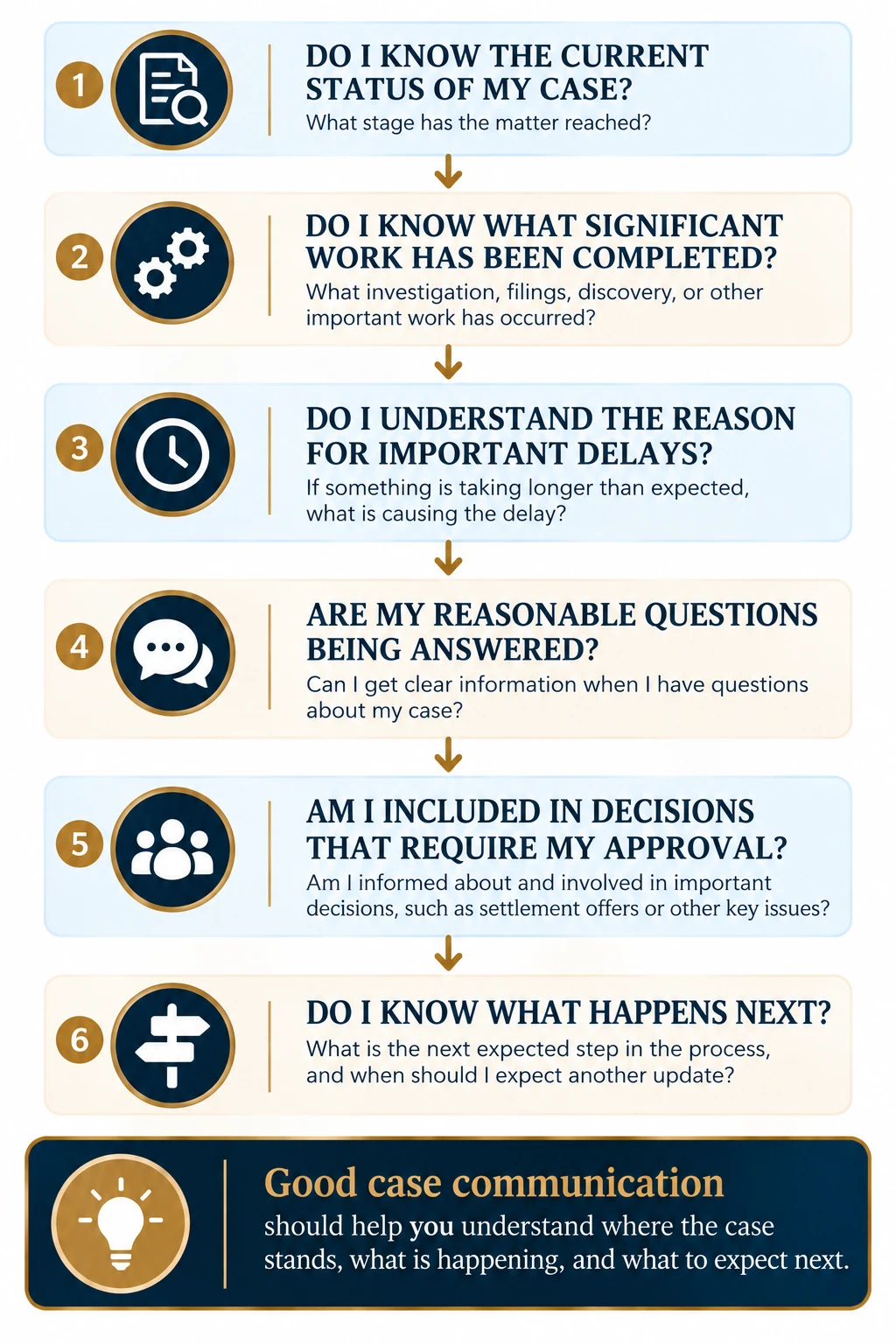
This framework cannot determine by itself whether a particular lawyer is handling a case appropriately. That assessment can depend on the facts, procedural history, deadlines, representation agreement, strategy, and circumstances of the individual case.
A medical malpractice case can become technically complicated. Your lawyer does not need to turn you into a litigation expert, but communication should help you understand the major developments affecting your case.
Is the matter being investigated, filed, litigated, negotiated, or prepared for trial?
Have medical records been collected? Have experts been consulted? Has discovery occurred? Have depositions been taken? Have important motions or other papers been filed?
If something is taking longer than expected, what is causing the delay?
What significant event, task, or decision comes next?
Are there settlement offers, testimony, litigation decisions, or other matters requiring your involvement or authorization?
A useful case update should answer more than “nothing new.” It should help you understand the status of the matter and, where possible, what the legal team is doing or waiting for.
Medical malpractice cases do not always move in a straight line. There may be periods when the client sees no court appearance, deposition, settlement offer, or other obvious development. That does not necessarily mean nothing is happening.
Depending on the case, time may be required for:
Some of these processes depend on people and institutions outside your attorney’s direct control.
A period without a court appearance or major update does not necessarily mean that no work is being performed. A more useful question is whether your attorney can explain the current status, what is pending, and what is expected to happen next.
Delay alone does not establish that a medical malpractice case is being mishandled. The surrounding circumstances matter.
Waiting for medical records
You do not know the current status of the case
Qualified expert review takes time
Significant developments have not been explained
Depositions require scheduling
You repeatedly cannot obtain basic case information
Court dates depend on scheduling
You do not know who is handling the case
Motions may take time to decide
Important decisions have not been explained
Settlement discussions can take time
You do not understand what is expected to happen next
The distinction is important.
A delay is not automatically evidence of a problem.
But if you do not understand what is happening, asking for clarification is reasonable.
The work being performed, applicable deadlines, procedural posture, communication, and explanation for the delay can all be relevant to understanding the situation.
Clients also have a role in keeping a case moving. Depending on the circumstances and your attorney’s instructions, useful steps may include:
Your attorney may provide additional instructions based on your particular case.
If you are uncertain about whether an action could affect pending litigation, ask your attorney before making assumptions.
The attorney-client relationship involves different responsibilities. An attorney provides legal advice, handles litigation responsibilities, and helps develop strategy. The client should also understand important developments and participate in decisions that require the client’s authorization.
If a settlement offer is made, the client should be informed and have an opportunity to understand the offer and relevant considerations before deciding whether to accept or reject it.
Significant developments affecting the case should be communicated appropriately.
When a decision belongs to the client, the attorney should provide enough information and advice for the client to make an informed decision.
If the legal team needs records, testimony, authorizations, or other participation, the attorney should explain what is needed.
Effective representation is not simply about performing legal work. It also requires communication that allows the client to understand important developments and participate in decisions that belong to the client.
Insurance can be confusing in medical malpractice cases because several completely different relationships may be involved. Your health insurance, the healthcare provider’s malpractice insurance, and your relationship with your own attorney do not serve the same purpose.
May pay eligible healthcare expenses subject to the applicable plan
May provide defense or coverage to the healthcare provider subject to the policy
Represents the injured patient pursuing the claim
Concerns healthcare benefits
Concerns potential liability of the insured provider
Concerns the patient’s legal rights
Does not serve as the patient’s malpractice attorney
May provide the provider with defense counsel
Fee arrangement depends on the representation agreement
Your health insurance, the healthcare provider’s malpractice insurance, and your relationship with your own medical malpractice attorney serve different purposes.
Questions about whether a particular insurance policy provides coverage depend on the policy and circumstances involved.
When alleged medical malpractice results in a patient’s death, the legal issues can change significantly.
Questions may arise about who has authority to pursue claims involving the deceased person, whether an estate or personal representative must be involved, what claims may be available, what medical evidence is required, and what damages may potentially be recoverable.
The process differs from a medical malpractice claim pursued directly by an injured living patient.
A potential evaluation may involve:
The death of a family member can make an already difficult situation more complicated. Families may be trying to understand both what happened medically and who is legally permitted to act.
Those questions should be evaluated carefully under New York law.
Concern about your attorney does not always mean the attorney has done something wrong. Sometimes the underlying problem is a lack of information. In other situations, the concern may involve communication, strategy, fees, unexplained delays, or another aspect of the representation. A measured approach can help clarify the issue.
What is actually troubling you?
Is it:
Being specific makes it easier to ask a useful question.
Consider asking your attorney to explain:
Where does the case stand?
What significant work has been completed?
What are we currently waiting for?
What happens next?
Is anything needed from me?
If the concern involves fees, expenses, responsibilities, communication, or ending the attorney-client relationship, review the written agreement you signed.
If significant concerns remain, a client may choose to consult another attorney about the circumstances.
A second attorney would generally need to understand the facts and procedural posture before providing meaningful advice about an ongoing matter.
Changing counsel during an active medical malpractice matter can require coordination. Depending on the stage of the case, a transition may involve:
The effect of a change depends on the circumstances.
That is why a client considering new representation should understand both the reason for the change and what will be required to protect the continuity of the ongoing case.
This final section of the Medical Malpractice Knowledge Center focuses on questions that can arise after representation begins or while a medical malpractice matter is already underway.
Understand case communication, progress, litigation delays, client involvement, and the questions you can ask when you are uncertain about what is happening.
Understand the different roles of health insurance, a healthcare provider’s malpractice insurance, and the attorney representing the injured patient.
Understand the additional estate, authority, medical evidence, and damages questions that may arise when alleged medical malpractice results in death.
A medical malpractice case can pass through many stages before it is resolved.
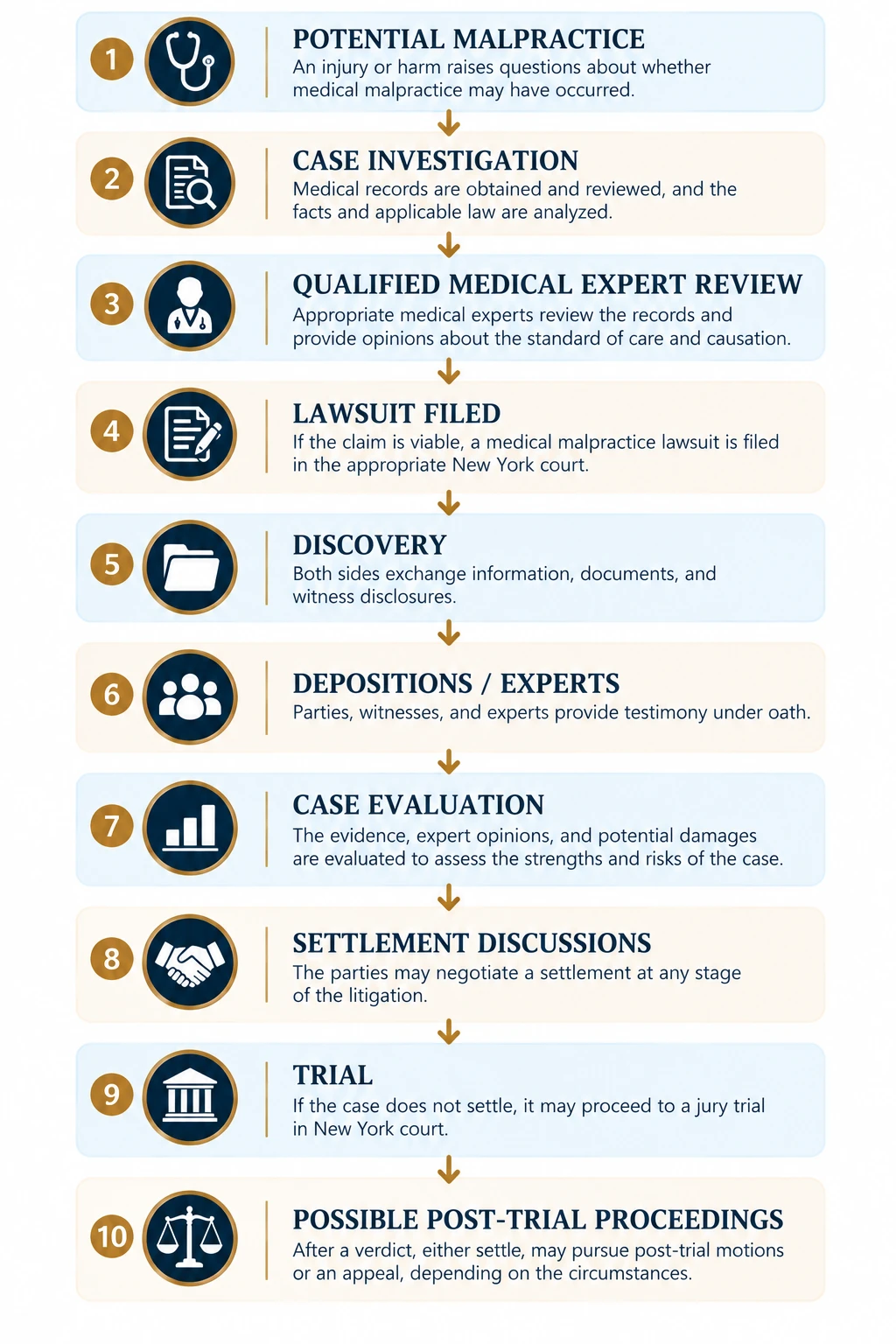
Not every case follows precisely the same path, and a case may resolve before reaching every stage shown above.
Your attorney should be able to explain which stage applies to your matter and what the next significant step is expected to be.
You do not have to know legal terminology to ask useful questions about an ongoing case. Consider asking:
What stage is my case currently in?
What significant work has been completed?
What are we currently waiting for?
Is there a deadline or court date coming up?
What is the next major step?
Is anything needed from me?
Have there been any significant developments?
Are there decisions I will need to make?
When should I expect the next update?
Who should I contact if I have questions?
The answers may vary over the life of the case.
The purpose of these questions is not to demand constant activity. It is to help you understand what is happening and what you should expect.
Not every part of a medical malpractice case is within the legal team’s control. Progress can depend on:
Healthcare providers providing records.
Medical experts completing reviews and analyses.
Other parties responding to discovery.
Witnesses and attorneys coordinating deposition schedules.
Courts scheduling conferences, motions, and trials.
Medical treatment clarifying the nature or extent of an injury.
Some aspects of case management are within an attorney’s control. Others are not.
For that reason, speed alone is not a reliable way to evaluate an ongoing medical malpractice case.
A more useful set of questions is:
Are important deadlines being addressed?
Is necessary work progressing?
Are significant developments being communicated?
Can my attorney explain what is currently pending?
Do I understand what happens next?
A useful update about an ongoing case can often be reduced to four concepts.
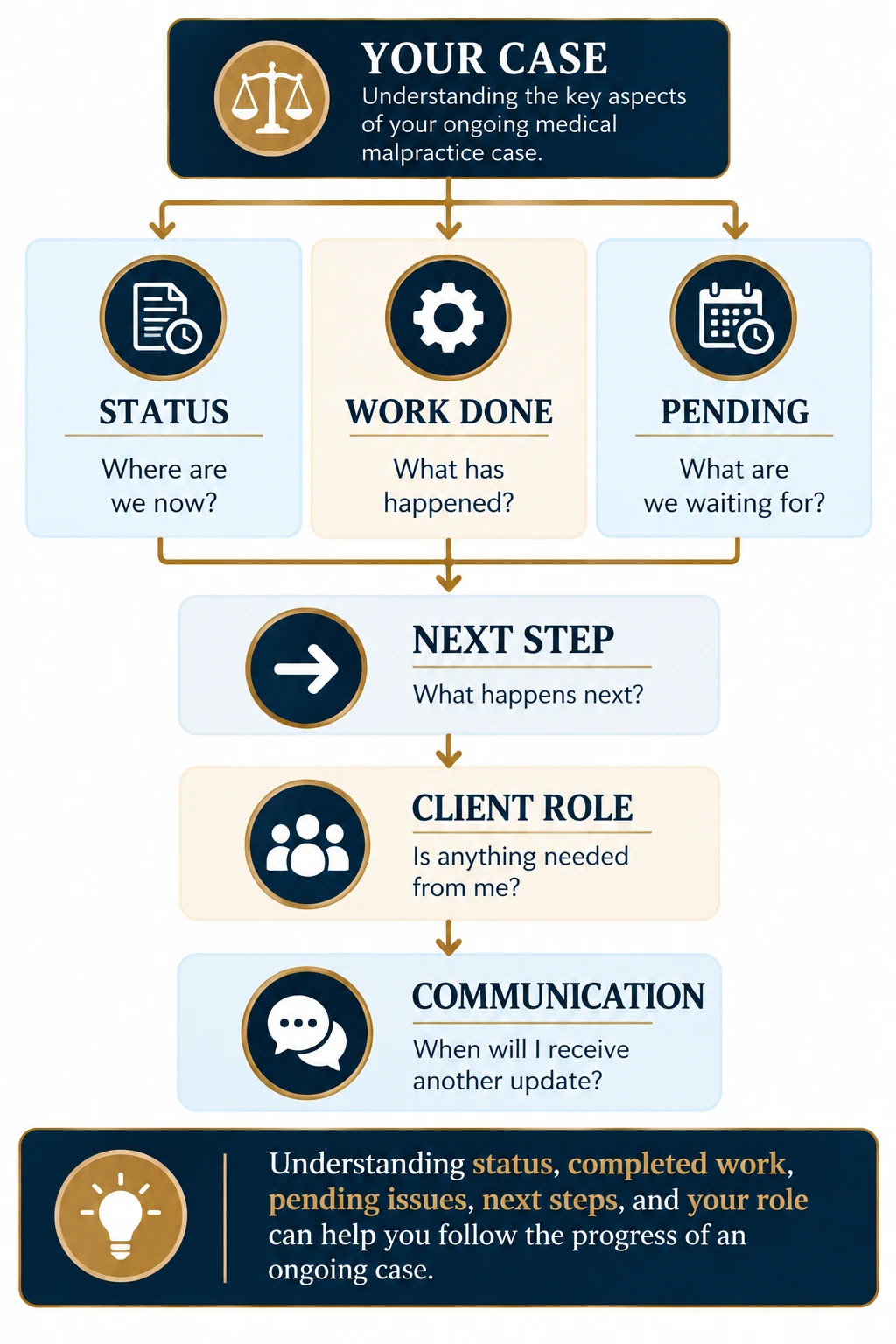
This framework does not require an attorney to predict exactly when a case will end.
Instead, it gives the client a clearer understanding of the present.
Managing an ongoing case connects directly to the other stages of the medical malpractice journey.
Understand medical records, qualified experts, discovery, depositions, and how a malpractice case is developed.
Understand damages, case valuation, settlement, and trial.
Understand the experience, resources, judgment, trial readiness, and communication factors to consider when evaluating an attorney.
Understand contingency fees, case expenses, representation agreements, and issues that can arise when changing attorneys.
This final cluster closes the educational path through the New York Medical Malpractice Knowledge Center:
The questions may change as a case progresses.
The goal of the Knowledge Center remains the same:
Medical malpractice litigation involves both medical and legal issues.
Bottar Law’s Knowledge Center is designed to provide clear, attorney-reviewed educational information about the process while recognizing that no general website can determine whether another attorney is handling a particular case appropriately.
Evaluating an ongoing attorney-client relationship may require review of the:
These resources therefore provide general information about medical malpractice litigation and attorney-client communication, not an evaluation of another lawyer’s conduct in a specific case.
Last reviewed: 10/21/2026

Michael A. Bottar is an attorney with Bottar Law who has spent more than 20 years prosecuting medical malpractice, wrongful death, and serious personal injury cases throughout New York. He is the immediate past president of the New York State Academy of Trial Lawyers and has been recognized by The Best Lawyers in America® for his work in plaintiffs’ medical malpractice, product liability, and personal injury law.
Questions about case progress, representation, changing attorneys, or pursuing a claim after a family member’s death can depend on the procedural posture of the case, applicable deadlines, existing agreements, and the underlying medical evidence.
If you have questions about a medical malpractice matter, Bottar Law can review the circumstances and explain whether the firm may be able to assist.