 Call833-268-8277

Understand who may bring a claim, how estate authority is established, what evidence matters, and how New York wrongful-death and survival claims differ.
Attorney reviewed · New York focused · Updated resource
A relative does not automatically have legal authority solely because of the family relationship.
Yes, but a relative usually cannot file the lawsuit solely because they are a family member. In New York, a medical-malpractice wrongful-death claim generally must be brought by the personal representative of the deceased person’s estate. The Surrogate’s Court may appoint an executor under a will or an administrator when there is no will. An attorney must then investigate whether medical negligence caused the death and whether qualified medical support exists for the claim.
Before any lawsuit is filed, the attorney must investigate the facts, obtain the relevant medical records, and consult with a qualified medical expert to determine whether the legal requirements for a claim can be supported. After reviewing the application and any will, the Surrogate’s court appoints someone as the estate’s executor or administrator. Whoever is appointed will have the authority to file a lawsuit for the decedent’s pain and suffering and wrongful death damages. Of course, before filing a lawsuit, the attorney for the estate representative must review the facts of the case with a medical expert, and the expert must support the claim.
A family member may be able to pursue a medical malpractice lawsuit after losing a loved one, but they generally must first be appointed as the deceased person’s personal representative by the Surrogate’s Court.
If the deceased left a valid will, the court may appoint the executor named in the will to act on behalf of the estate. If there is no will, the Surrogate’s Court may appoint an administrator according to New York law. Once appointed, the personal representative has the legal authority to pursue claims on behalf of the estate, including claims for the decedent’s pre-death pain and suffering and, where appropriate, wrongful death damages.
Before a medical malpractice lawsuit can proceed, the attorney must thoroughly investigate the facts, obtain and review the relevant medical records, and consult with a qualified medical expert. Under New York law, establishing a medical malpractice claim generally requires qualified expert medical support demonstrating that the healthcare provider departed from accepted medical standards and that the departure caused or contributed to the patient’s injuries or death.
Simply being a spouse, child, parent, sibling, or other family member does not automatically provide the legal authority to file a medical malpractice lawsuit. That authority generally comes only after the Surrogate’s Court appoints the appropriate personal representative for the estate.
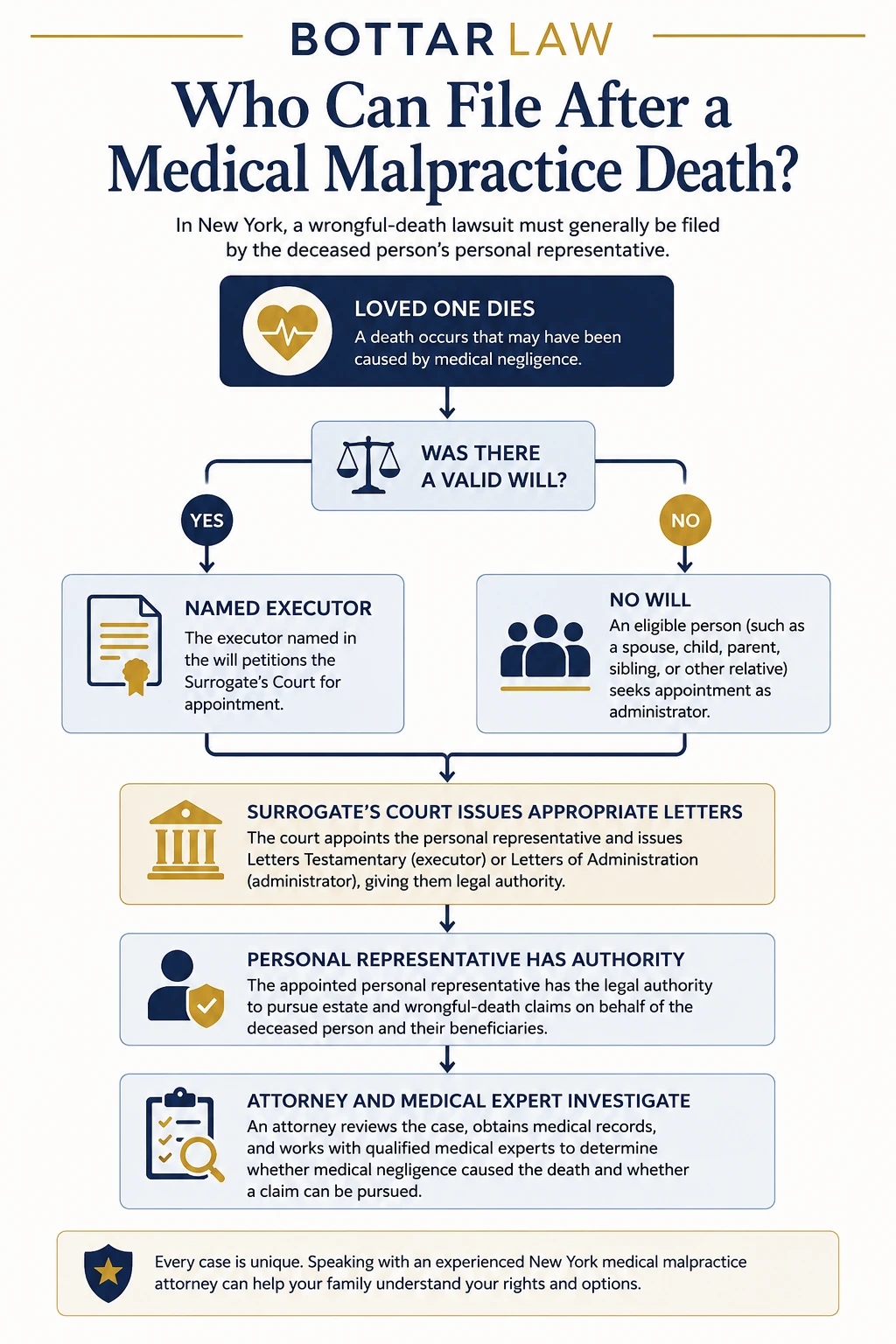
Who may have legal authority to file after a medical malpractice death in New York.
Under New York law, the person with legal authority to bring a medical malpractice wrongful death claim is generally the duly appointed personal representative of the deceased person’s estate.
The personal representative may be an executor named in the decedent’s will or an administrator appointed by the Surrogate’s Court when there is no will. Although a surviving spouse, child, parent, sibling, or another eligible family member may petition the court for appointment, family relationship alone does not create legal standing to file the lawsuit.
Once appointed, the personal representative acts on behalf of the estate and any eligible beneficiaries. Working with experienced legal counsel, the representative may pursue claims for the decedent’s conscious pain and suffering before death, as well as wrongful death damages permitted under New York law, provided the legal and medical requirements for the claim can be established.
When a patient survives medical negligence, that patient generally brings a medical malpractice claim to recover damages for the injuries they personally suffered.
When medical negligence results in a patient’s death, New York law may allow two separate but related causes of action, each serving a different purpose.
Although these claims often arise from the same underlying medical negligence, they compensate different harms and may involve different categories of damages. An experienced medical malpractice attorney can evaluate which claims may be available based on the facts of the case and the evidence supporting them.
Survival Claim
Seeks damages the deceased patient could have recovered had they lived, including conscious pain and suffering before death, medical expenses, and other losses supported by the evidence.
Wrongful-Death Claim
Seeks compensation for certain economic losses suffered by the deceased person’s qualifying distributees as a result of the death. These damages may include the loss of financial support or earnings the decedent would likely have contributed, lost household services, lost parental guidance, and other recoverable economic losses permitted under New York law.
An autopsy can be highly important when investigating a potential medical malpractice wrongful death claim because it may help clarify the cause and mechanism of death. However, it is not the only evidence used to evaluate whether medical negligence occurred.
Attorneys and qualified medical experts typically conduct a comprehensive review of the available evidence, which may include hospital and medical records, physician and nursing notes, diagnostic imaging, laboratory test results, medication administration records, vital sign and monitoring data, operative reports, pathology findings, death certificates, witness accounts, and the patient’s medical history. Together, these records help determine whether a healthcare provider departed from accepted medical standards and whether that departure caused or contributed to the patient’s death.
A case may still be thoroughly investigated even if no autopsy was performed. While the absence of an autopsy can make causation more difficult to establish in some circumstances, experienced medical malpractice attorneys and medical experts may rely on other available medical evidence to evaluate whether the legal requirements for a claim can be supported.
Grieving families often feel overwhelmed, uncertain, and emotionally exhausted after the loss of a loved one. Many struggle with feelings of anger, guilt, or self-doubt, especially when the death followed medical treatment they once trusted. Others worry that contacting a lawyer will be confrontational, or they believe they must already know exactly what went wrong before seeking legal advice. These concerns are common and can make it difficult to take the first step toward understanding what happened.
A consultation with an experienced medical malpractice attorney does not require your family to have all the answers. One of the primary purposes of an initial consultation is to listen to your concerns, preserve important information, identify any legal deadlines that may apply, and determine whether a qualified medical expert should review the care that was provided. Even if it is ultimately determined that no malpractice occurred, obtaining reliable legal guidance can provide clarity during an extraordinarily difficult time.
Under New York law, wrongful death damages have traditionally focused on the financial losses suffered by the decedent’s qualifying distributees rather than grief, sorrow, or emotional distress alone. Because New York’s wrongful death laws have been the subject of proposed legislative changes, the law should be carefully reviewed based on the circumstances of each case at the time a claim is evaluated.
Medical experts play a critical role in evaluating whether a healthcare provider’s care may have contributed to a patient’s death. In a medical malpractice case, they may be asked to:
Identify the applicable standard of care – the level of care and treatment that a reasonably prudent healthcare provider would have provided under similar circumstances.
Determine whether the healthcare provider departed from that standard of care by evaluating the medical records, diagnostic testing, treatment decisions, and other relevant evidence.
Assess whether any departure from the accepted standard of care was a substantial factor in causing or contributing to the patient’s death.
To reach these opinions, medical experts may review hospital records, physician and nursing documentation, diagnostic imaging, laboratory results, operative reports, medication records, autopsy findings when available, and other relevant medical evidence. Their opinions help determine whether the legal requirements for a medical malpractice wrongful death claim can be established under New York law.
A New York wrongful-death action generally must be commenced within two years from the date of death. However, when a death is believed to have resulted from medical malpractice, additional legal deadlines and procedural requirements may apply depending on the specific facts of the case.
For example, the applicable time limits may be affected by the underlying medical malpractice claim, the identity of the healthcare provider, the appointment of the estate’s personal representative, or whether a notice of claim is required before a lawsuit can be filed. Claims involving public hospitals, municipal healthcare providers, or other government entities may require action much sooner than the general wrongful-death deadline.
Because these deadlines can be complex and missing a filing deadline may affect your legal rights, families should seek legal advice as soon as reasonably possible rather than relying solely on the general two-year limitation period. An experienced medical malpractice attorney can evaluate the circumstances of the case, identify the deadlines that may apply, and help ensure that important procedural requirements are addressed in a timely manner.
Bottar Law helps families by separating the immediate legal tasks from the questions that require medical investigation. The firm can obtain and organize records, identify the appropriate estate representative, coordinate review with qualified medical experts, evaluate potential defendants and deadlines, and explain the difference between survival and wrongful-death damages.
At the same time, the firm recognizes that grieving families may need information delivered gradually and clearly. Bottar Law’s role is to provide honest guidance, protect the family’s legal options, and handle the litigation process with sensitivity while the family focuses on personal and practical needs following the loss.
Contact an experienced New York medical-malpractice attorney promptly. Preserve any records, discharge instructions, communications, photographs, medication lists, billing documents, and information about witnesses. Ask whether an autopsy has been or can still be performed, but do not assume the absence of an autopsy prevents investigation.
The attorney can determine whether an estate representative must be appointed, request the complete medical record, identify applicable deadlines, and arrange qualified medical review. Speaking with a lawyer does not obligate the family to file a lawsuit.
In New York, a wrongful death action generally must be brought by the deceased person’s duly appointed personal representative, such as an executor named in a will or an administrator appointed by the Surrogate’s Court. Family relationship alone does not automatically provide legal authority to file the lawsuit.
An autopsy can provide important evidence about the cause and mechanism of death, but it is not the only evidence considered. Attorneys and qualified medical experts may also review hospital records, physician and nursing documentation, diagnostic imaging, laboratory results, medication records, monitoring data, operative reports, pathology findings, death certificates, witness accounts, and the patient’s medical history. A case may still be investigated even if no autopsy was performed, although the absence of one can make causation more difficult to establish in some circumstances.
An unexpected or tragic outcome does not, by itself, establish medical malpractice. In New York, the evidence generally must support both that a healthcare provider departed from accepted medical standards and that the departure was a substantial factor in causing or contributing to the patient’s death.
You do not need to identify every potentially responsible provider before seeking legal advice. Determining whether physicians, nurses, hospitals, or other healthcare professionals may have contributed to a patient’s death is typically part of the legal and medical investigation.
Although a New York wrongful death action generally must be commenced within two years from the date of death, additional deadlines or procedural requirements may apply depending on the circumstances. Claims involving public hospitals or other government entities, as well as other factors affecting the case, may require action much sooner. Because missing a legal deadline can affect important rights, families should seek legal advice promptly rather than relying solely on the general two-year period.
Families do not need to understand every legal or medical detail before asking for help.

Michael Bottar is a nationally recognized New York medical malpractice and personal injury attorney and the founder of Bottar Law. Throughout his career, he has dedicated his practice to representing individuals and families affected by medical negligence, catastrophic injuries, wrongful death, and other serious acts of negligence. Michael is committed to helping clients understand their legal rights, navigate the complexities of the legal system, and pursue accountability with compassion, integrity, and unwavering advocacy.
For more than 40 years, Bottar Law has represented individuals and families throughout Syracuse, Central New York, and across New York in complex medical malpractice litigation involving catastrophic injuries and wrongful death. Through educational resources like these FAQs, Michael Bottar and the Bottar Law team strive to provide clear, reliable information to help injured individuals and their families make informed decisions during difficult times. Prior results do not guarantee a similar outcome.
Speak with Bottar Law about estate authority, medical evidence, filing deadlines, and the next steps that may apply under New York law.