 Call833-268-8277

Understand the difference between normal case delays and real warning signs, and what your lawyer should be explaining along the way.
Attorney reviewed · New York focused · Updated resource
Clear communication, documented progress, and an understandable strategy are the real indicators.
A medical malpractice lawyer may be handling your case properly even when the case appears to be moving slowly. These claims often require extensive medical record review, qualified expert analysis, depositions, court scheduling, and other work that may not always be visible to the client.
You should nevertheless understand what stage your case is in, what work has been completed, why any delays are occurring, and what the next steps are likely to be. A responsible attorney should communicate significant developments, answer reasonable questions, explain strategy and deadlines clearly, and involve you in decisions that require your approval.
Potential warning signs include repeated unanswered calls or emails, an inability to obtain a clear status update, missed deadlines, unexplained inactivity, pressure to make decisions without adequate information, or persistent uncertainty about who is responsible for your case. Delays alone do not necessarily indicate poor representation, but you should feel informed, respected, and confident that your legal team is actively protecting your interests.
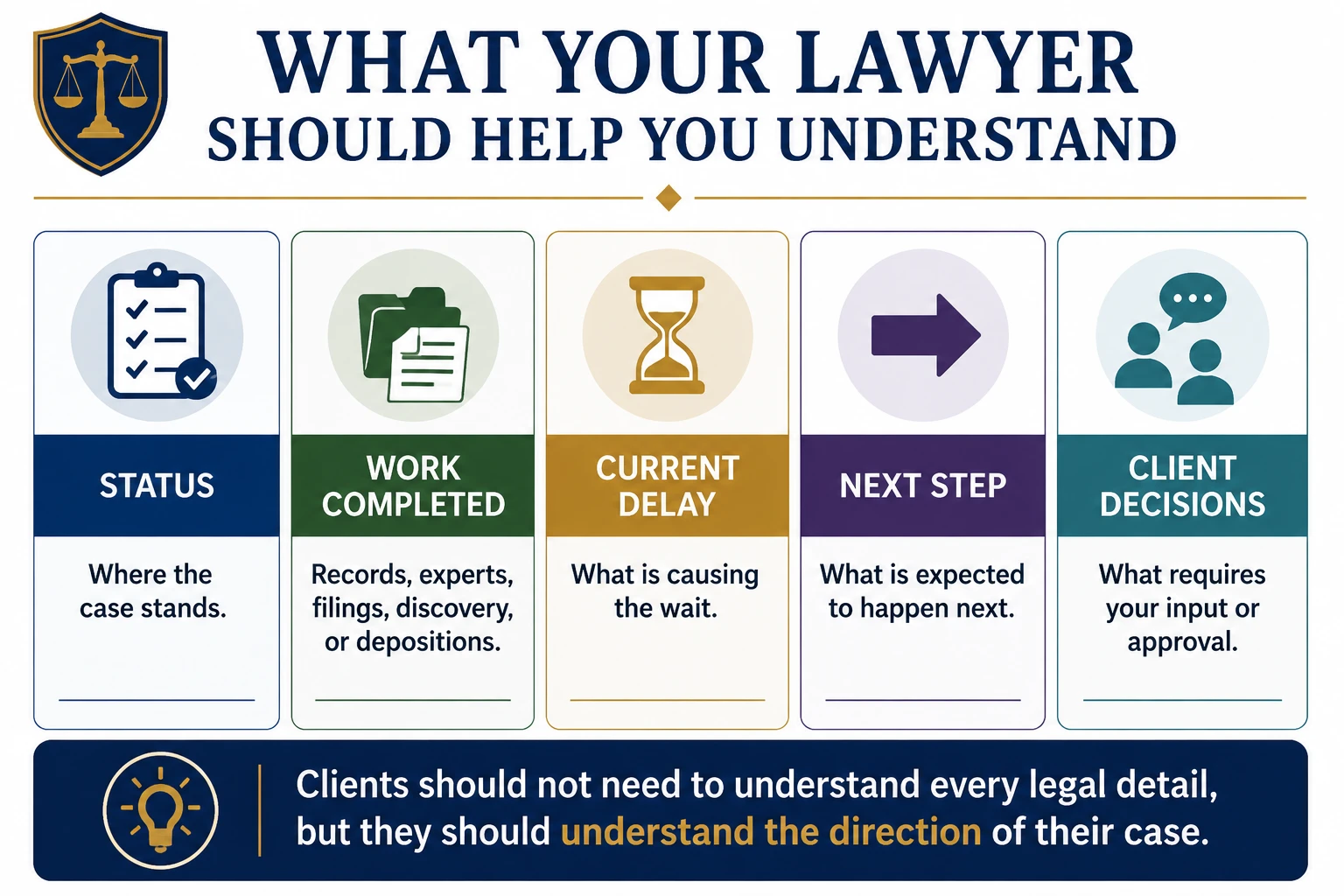
Clients should not need to understand every legal detail, but they should understand the direction of their case.
After hiring a medical malpractice lawyer, you should expect your legal team to begin gathering medical records, reviewing the facts of your case, consulting with qualified medical experts, and determining whether the evidence supports a malpractice claim. As the case progresses, your attorney should explain each phase of the process and answer your questions honestly.
You should also expect professionalism, responsiveness, and regular communication. While no attorney can guarantee a particular outcome, you should always know where your case stands and what to expect next.
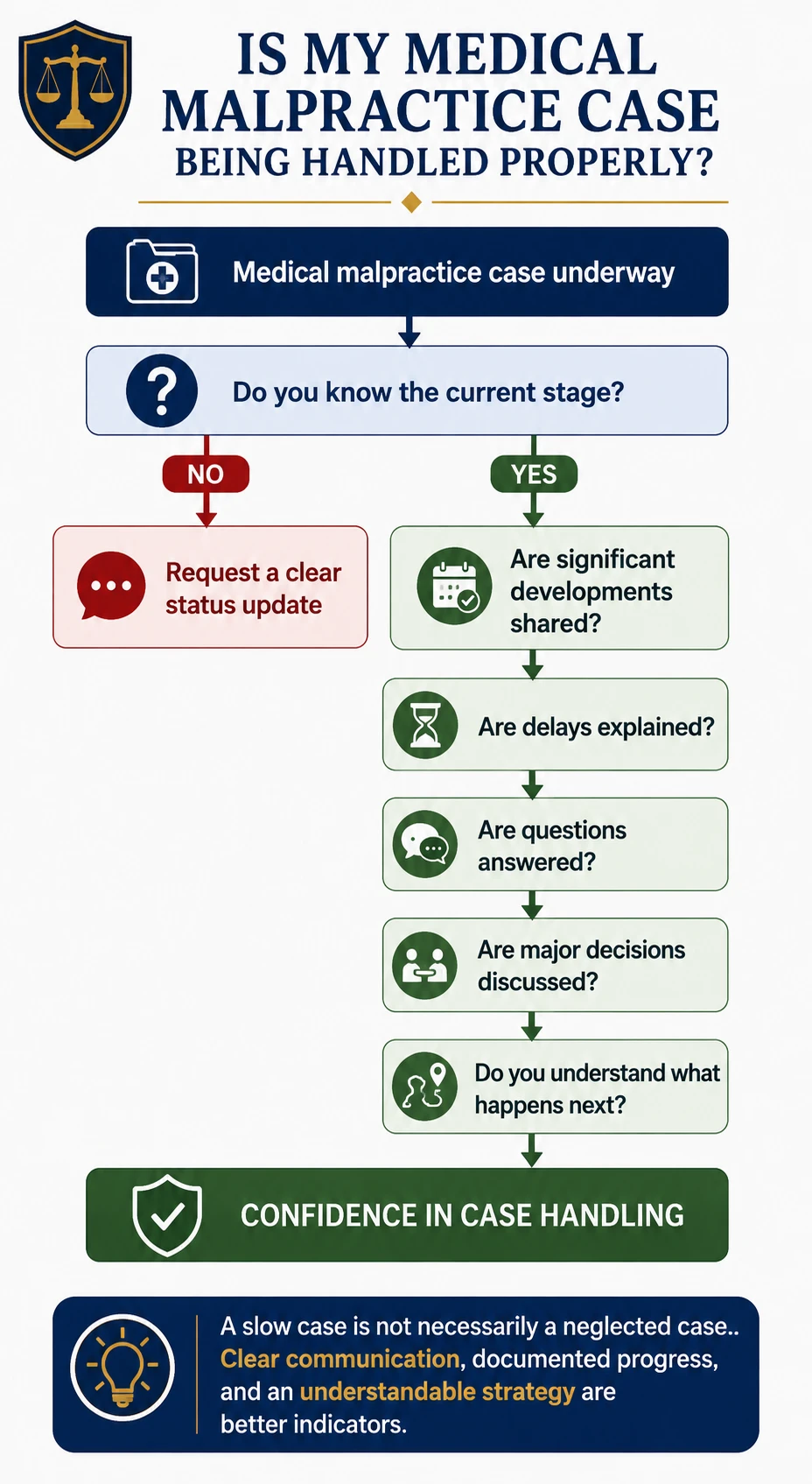
A slow case is not necessarily a neglected case. Clear communication, documented progress, and an understandable strategy are better indicators.
There is no set schedule for communication because every case progresses at a different pace. Some stages of a medical malpractice case involve frequent activity, while others require waiting for medical records, expert reviews, court scheduling, or responses from the opposing side.
Even when there is little new information to report, clients should feel comfortable contacting their attorney with questions. A good law firm makes communication a priority and responds to reasonable inquiries in a timely manner.
Waiting for medical records
No one can confirm whether records were requested
Qualified experts are reviewing the case
No explanation of whether expert review has begun
Waiting for court scheduling
Missed or unexplained court deadlines
Opposing parties are responding to discovery
Your lawyer cannot explain the current discovery status
Depositions are being coordinated
Months pass without a meaningful update or explanation
No major development has occurred
Repeated calls and emails go unanswered
Strategy is being evaluated
You are asked to make decisions without understanding the options
Understanding this distinction can help clients focus on meaningful communication and case progress rather than assuming that every delay reflects a problem with their legal representation.
Your lawyer should keep you informed about important developments in your case. This may include confirming that medical records have been obtained, explaining the results of expert reviews, discussing whether a lawsuit will be filed, providing updates about court proceedings, and preparing you for depositions, mediation, or trial if those stages become necessary.
You should also be informed about any settlement discussions or significant decisions that require your input.
Clients are generally entitled to obtain access to important documents relating to their case, subject to applicable law, privilege, attorney work-product protections, court orders, and other legal restrictions. These may include pleadings, court orders, deposition notices, settlement documents, and correspondence requiring the client’s review or approval.
Not every internal legal memorandum or attorney work product will necessarily be provided, but the client should receive enough information to understand the case and make informed decisions.
Medical malpractice cases often involve long periods when little appears to be happening because medical records are being reviewed, experts are evaluating the evidence, or the court is managing scheduling issues.
The difference between a normal delay and poor communication is whether your attorney keeps you informed. Even if there are no major developments, your lawyer should be willing to explain why the case is taking time and answer your questions about the process.
You should never hesitate to ask questions about your case. Clients commonly ask what stage the case is in, what work has been completed, what happens next, whether any deadlines are approaching, how long the process may take, and whether there have been any new developments.
A good attorney welcomes these conversations because informed clients are better equipped to make important decisions throughout the case.
At Bottar Law, communication is treated as part of effective representation. Clients are informed about significant developments, prepared before major litigation events, and encouraged to ask questions about the status and direction of the case. Because medical malpractice litigation may involve lengthy record review, expert analysis, discovery, and court scheduling, the firm also explains why delays occur and what work remains to be completed.
Every case moves at its own pace, so delays alone do not necessarily indicate a problem. However, repeated unanswered phone calls or emails, difficulty reaching your attorney, a lack of explanation about the status of your case, or uncertainty about what is happening may be reasons to ask additional questions.
If you consistently feel uninformed or lose confidence in your legal representation, it may be appropriate to discuss your concerns with your attorney or seek a second opinion from another experienced medical malpractice lawyer.
Medical malpractice cases often arise after one of the most difficult experiences a person or family will ever face. Clients deserve honest answers about the strengths and challenges of their case, realistic expectations about the legal process, and clear explanations about important decisions.
Transparency builds trust. Even when the news is difficult, clients are better served by straightforward communication that helps them make informed decisions with confidence.
Your attorney should explain legal issues in language that is easy to understand rather than relying on technical legal terminology. You should understand why certain decisions are being made, what deadlines apply, what options are available, and how each decision may affect your case.
An informed client is better able to participate in the legal process, and your attorney should make sure you have the information you need before asking you to make important decisions.
If you have concerns about your medical malpractice case, the first step is to discuss them with your attorney. Many issues can be resolved through an open conversation about the status of the case and what to expect moving forward.
If your concerns remain unresolved or you no longer feel confident in your representation, you have the right to seek a second opinion from another experienced medical malpractice attorney. A second opinion can help you better understand your case, answer your questions, and determine whether your current legal representation continues to be the right fit for your needs.
The attorney manages legal strategy and provides advice, but certain major decisions belong to the client. The client generally decides whether to accept or reject a settlement, whether to proceed to trial after receiving legal advice, and whether to continue the attorney-client relationship.
A lawyer should explain the available options, risks, expected costs, and potential consequences before asking the client to decide. Clients should not feel pressured to approve a major decision they do not understand.
While every case progresses differently, these signs can help you evaluate whether your attorney is communicating effectively and guiding your case in a thoughtful, professional manner.
No client should expect constant activity or daily updates, but every client should be able to obtain a clear, understandable explanation of the case’s status and direction.
Record review, expert analysis, discovery, motion practice, and court scheduling may involve long periods without a visible event. The firm should still be able to explain the status.
Communication frequency depends on the case stage. What matters is timely communication about important developments and reasonable access when questions arise.
Medical malpractice cases frequently take years because of their complexity, number of parties, discovery requirements, and court schedules.
Attorneys advise clients, but major decisions, especially whether to accept a settlement, belong to the client.
A client may seek independent advice to better understand the status of the case before deciding whether any change is appropriate.
A slow case is not necessarily a neglected case. Clear communication, documented progress, and an understandable strategy are better indicators.

Michael Bottar is a nationally recognized New York medical malpractice and personal injury attorney and the founder of Bottar Law. Throughout his career, he has dedicated his practice to representing individuals and families affected by medical negligence, catastrophic injuries, wrongful death, and other serious acts of negligence. Michael is committed to helping clients understand their legal rights, navigate the complexities of the legal system, and pursue accountability with compassion, integrity, and unwavering advocacy.
For more than 40 years, Bottar Law has represented individuals and families throughout Syracuse, Central New York, and across New York in complex medical malpractice litigation involving catastrophic injuries and wrongful death. Through educational resources like these FAQs, Michael Bottar and the Bottar Law team strive to provide clear, reliable information to help injured individuals and their families make informed decisions during difficult times. Prior results do not guarantee a similar outcome.
Speak with Bottar Law for a second opinion on how your case is being handled.