 Call833-268-8277

Choosing a medical malpractice attorney involves more than comparing advertisements, firm size, or promises about results.
Medical malpractice cases can require detailed medical-record review, qualified medical experts, substantial litigation resources, and the ability to understand and explain complex medical and legal issues. Just as importantly, you should understand who will handle your case, how the attorney communicates, and what you can realistically expect from the process.
This section of the New York Medical Malpractice Knowledge Center gives you a framework for evaluating attorneys for yourself.
Explore what to look for in a medical malpractice lawyer, what questions to ask during a consultation, warning signs to consider, and how experience, resources, communication, and local knowledge may affect your decision.
When evaluating a medical malpractice lawyer, consider the attorney’s experience handling malpractice cases, familiarity with complex medical issues, access to qualified medical experts, resources to investigate and litigate the case, trial experience, communication practices, and approach to evaluating potential claims.
You should also understand who will actually handle your case, how fees and expenses work, and whether the attorney gives you a realistic explanation of the strengths, weaknesses, process, and potential risks rather than making promises about the outcome.
The goal is not simply to find a lawyer who says they handle medical malpractice.
It is to understand whether the attorney has the experience, resources, judgment, and approach needed for the specific issues involved in your potential case.
There is no single credential that tells you whether an attorney is right for a particular case. Instead, consider several factors together.
Medical malpractice litigation involves issues that may not arise in ordinary personal injury matters.
Ask how much of the attorney’s work involves malpractice and what role the attorney personally plays in those cases.
A lawyer does not replace a physician or medical expert. But an attorney handling malpractice claims must be able to work effectively with medical records, treatment histories, providers, specialists, and qualified experts.
The attorney should be able to identify the medical questions that require investigation and understand how those questions connect to the legal case.
Expert review can be central to determining the applicable standard of care, whether a departure occurred, and whether that departure caused an injury.
Different cases may require different medical specialties. An attorney’s process for identifying and working with qualified experts can therefore be important.
Medical malpractice cases can require extensive records, expert review, depositions, discovery, medical analysis, and other litigation expenses.
The relevant question is not simply whether a firm is large or small. It is whether the attorney and firm can support the investigation and litigation the case may require.
Good legal judgment is not demonstrated by telling a prospective client what they want to hear.
An attorney should be willing to discuss uncertainty, identify problems, investigate unanswered questions, and explain why additional information may be needed before reaching a conclusion.
Many cases may be resolved without a trial, but settlement is not guaranteed.
Ask who would be responsible for litigating the case and what happens if the matter cannot be resolved through negotiation.
You should know how communication will work, who will provide updates, who you can contact with questions, and what is expected of you during the case.
Trust is not created by guarantees. It develops when an attorney listens, communicates clearly, answers reasonable questions, and establishes realistic expectations.
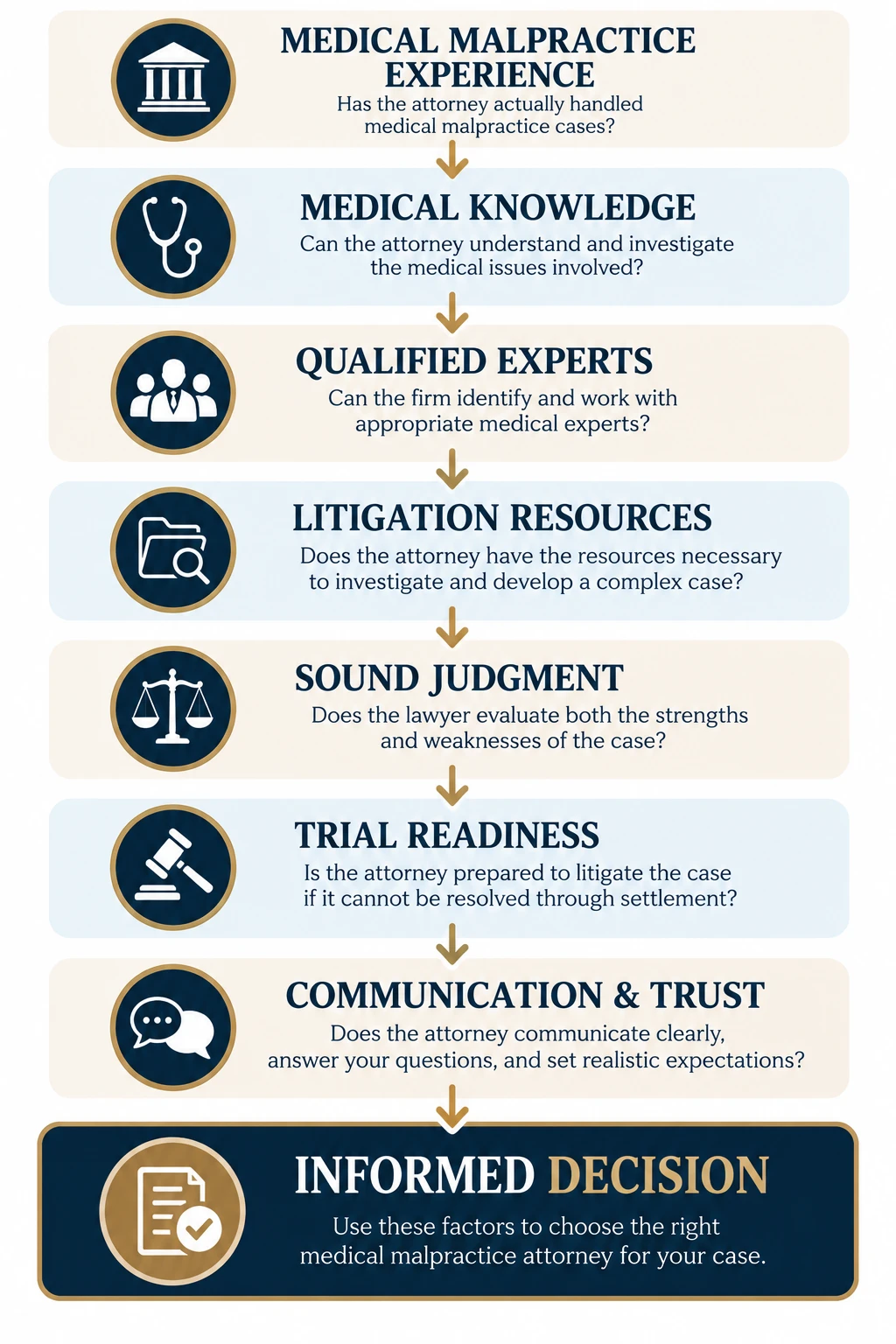
The right attorney should be evaluated on relevant experience, resources, judgment, communication, and the ability to handle the specific issues involved in your case.
Medical malpractice cases can combine medicine, law, expert analysis, and complex evidence. The process may involve:
An attorney may need to reconstruct years of treatment, determine which medical specialties should review the case, understand competing explanations for an injury, work with qualified experts, evaluate substantial past and future damages, and litigate against healthcare providers and their defense teams.
That makes an important distinction worth investigating:
Years practicing law are not necessarily the same as years handling medical malpractice cases.
A lawyer may have extensive legal experience without devoting a substantial portion of that experience to medical malpractice.
When evaluating counsel, ask specifically about the experience relevant to the kind of case you may have.
A consultation is not only an opportunity for an attorney to evaluate your potential case. It is also an opportunity for you to evaluate the attorney. Consider asking questions in these eight areas.
Ask about the attorney’s actual experience investigating and litigating malpractice claims.
No two cases are identical, but relevant experience can help you understand the attorney’s familiarity with the type of medicine involved.
Listen for an explanation of the process, not an immediate promise about the result.
Ask how expert review fits into the firm’s evaluation and litigation process.
Find out whether you will work primarily with the attorney you meet, another lawyer, a team, or some combination.
Ask what communication normally looks like after representation begins.
Make sure you understand both concepts and how they are addressed in the representation agreement.
The answer can help you understand what will happen after the initial consultation and what the attorney may need from you.
Choosing an attorney can be difficult when every website and advertisement seems to make similar claims. Instead of focusing only on marketing, pay attention to how the attorney approaches your questions and potential case.
✓ Listens before evaluating the case
⚠ Reaches definitive conclusions before understanding the facts
✓ Explains strengths and weaknesses
⚠ Promises a specific result
✓ Discusses the investigation process
⚠ Pressures you to sign immediately
✓ Clearly explains fees and expenses
⚠ Avoids explaining financial arrangements
✓ Identifies who will handle the case
⚠ Is unclear about who will actually represent you
✓ Answers reasonable questions
⚠ Discourages questions
✓ Sets realistic expectations
⚠ Uses guarantees or exaggerated claims
Advertising tells you that a lawyer wants your business. It does not, by itself, tell you whether that lawyer is the right person to handle your medical malpractice case.
A polished advertisement is not a substitute for asking about experience, resources, case handling, communication, fees, and the investigation process.
After speaking with an attorney, it may help to evaluate the conversation using the same questions regardless of which firm you contacted.
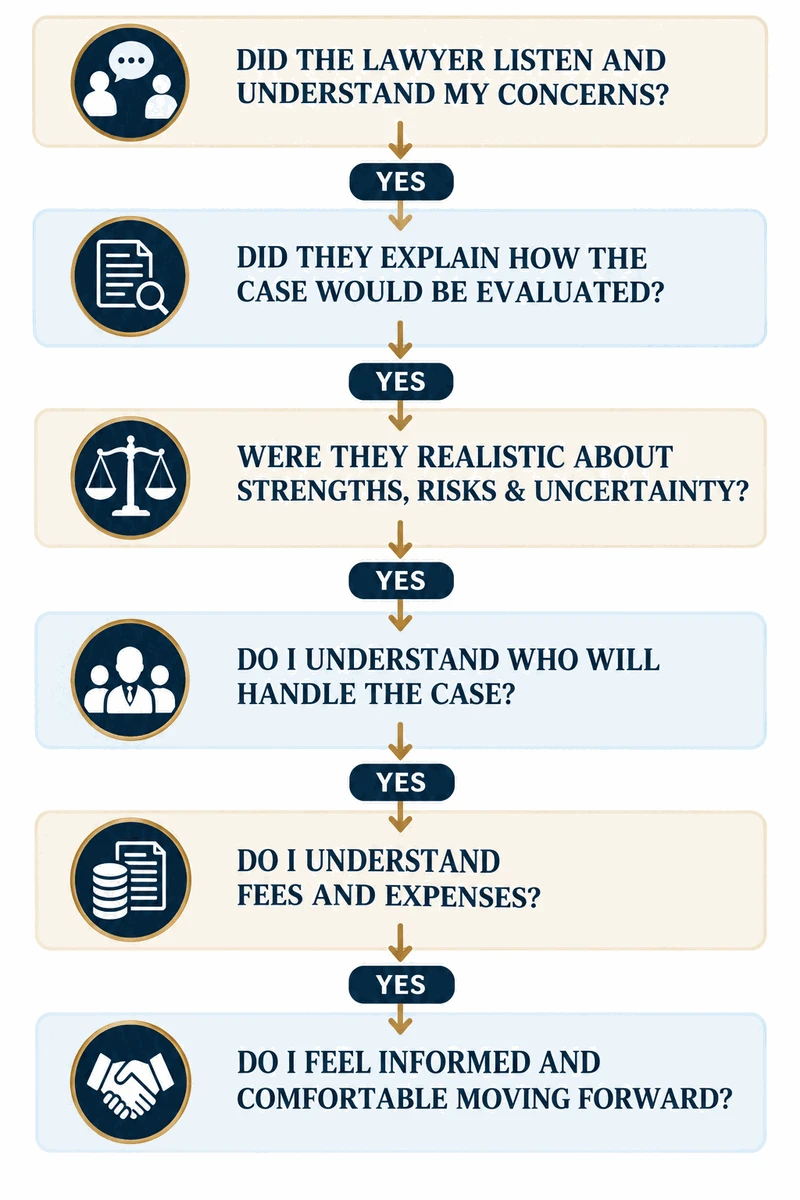
A “no” does not automatically mean that an attorney is unsuitable.
It may mean you need to ask another question before making your decision.
The purpose of this framework is to help you make an informed choice rather than relying solely on advertising, reputation, or the size of the firm.
Large firms and solo practitioners can operate very differently, and firms of similar size can differ substantially in their experience, resources, staffing, and approach to clients.
Instead of asking only whether a firm is “large” or “small,” consider the questions that directly affect your representation.
Attorney access
Who will communicate with me?
Staffing
Who will perform the day-to-day work?
Medical experts
How does the attorney obtain appropriate expert review?
Resources
Can the firm support the necessary investigation and litigation?
Experience
Who actually has relevant medical malpractice experience?
Trial readiness
Who would try the case if necessary?
A larger firm may have substantial resources but still assign different people to different parts of a case.
A solo practitioner may offer direct attorney access but may structure staffing and outside resources differently.
Neither structure, standing alone, answers the important questions.
Location should not be the only reason to choose an attorney. A lawyer is not automatically more qualified simply because an office is nearby. But local and regional experience may provide relevant context when evaluating representation for a Syracuse or Central New York medical malpractice case.
Experience practicing in the region may provide familiarity with local procedures, logistics, and the litigation environment.
Experience involving Syracuse and Central New York healthcare systems may provide useful contextual familiarity with the regional medical environment. That does not replace the need to investigate the specific medicine and providers involved in an individual case.
An attorney who regularly practices in the region may have familiarity with the broader legal and medical environment in which the case is investigated and litigated.
Some clients value being able to meet with their legal team locally, particularly during a case involving a serious injury or major life disruption.
Regardless of office location, the attorney handling a New York medical malpractice case should understand the New York legal and procedural framework that applies.
Local experience can be one consideration. Relevant malpractice experience, resources, judgment, communication, and trust remain important as well.
You do not have to evaluate attorneys from memory. Use this checklist during or after consultations to compare the information each attorney provides.
Relevant medical malpractice experience
☐
☐
☐
Experience with similar medical issues
☐
☐
☐
Access to qualified medical experts
☐
☐
☐
Litigation resources
☐
☐
☐
Trial experience
☐
☐
☐
I know who will handle the case
☐
☐
☐
Communication expectations explained
☐
☐
☐
Attorney fees clearly explained
☐
☐
☐
Case expenses clearly explained
☐
☐
☐
Strengths and weaknesses discussed
☐
☐
☐
No promises or guarantees
☐
☐
☐
I felt comfortable asking questions
☐
☐
☐
These six resources provide more detailed guidance for evaluating medical malpractice attorneys.
Learn about malpractice experience, medical knowledge, expert access, litigation resources, communication, and other factors to consider when evaluating an attorney.
Understand the skills, judgment, resources, and case-management capabilities that may matter in complex medical malpractice litigation.
Use a structured list of questions to learn about an attorney’s experience, investigation process, experts, case team, communication, fees, and next steps.
Learn how to look beyond advertising by examining an attorney’s communication, transparency, evaluation process, expectations, and willingness to discuss risks.
Compare law-firm structures using the factors that may actually affect your case: attorney access, staffing, experts, resources, experience, and trial readiness.
Understand when Syracuse and Central New York experience may be relevant, and why location should be considered alongside experience, resources, communication, and trust.
Once you identify an attorney you are considering hiring, the next questions usually concern how the representation will actually work. Before signing an agreement, you should understand:
If something is unclear, ask.
You should have an opportunity to understand the financial and practical terms of the representation before agreeing to them.
Sometimes an initial consultation reveals significant information about a potential claim. But medical malpractice cases can require much more before liability and causation can be fully evaluated. An attorney may need to:
That means an attorney’s willingness to investigate before reaching a definitive conclusion can itself be relevant when evaluating representation.
A lawyer who says that more information is needed is not necessarily avoiding your question.
In a medically complex case, that may be exactly what a careful evaluation requires.
The criteria on this page should apply to every law firm you evaluate, including Bottar Law.
Rather than asking you to accept generalized claims about why one firm is the “best,” Bottar Law encourages prospective clients to ask the same questions discussed throughout this guide.
For more than 40 years, Bottar Law has represented individuals and families affected by medical malpractice and serious injuries. The firm’s work focuses on helping clients navigate complex legal claims involving significant harm, with an emphasis on careful investigation, clear communication, and pursuing accountability when medical care falls below accepted standards.
At Bottar Law, medical malpractice matters are handled by attorneys whose professional backgrounds and experience can be reviewed before you choose representation. We encourage prospective clients to learn about the attorneys involved, ask who will oversee their case, and understand how the legal team will communicate throughout the process.
See Attorney Michael Bottar
See Attorney Anthony Bottar See Attorney Samantha Riggi
Medical malpractice claims often require a detailed review of medical records and an assessment of whether the care provided met accepted medical standards. Where appropriate, qualified medical professionals may be consulted to evaluate the circumstances, identify potential departures from accepted care, and assess whether those departures contributed to a patient’s injuries.
Medical malpractice litigation can involve extensive medical documentation, specialized expert analysis, and complex legal procedures. Bottar Law evaluates the evidence, investigates potential claims, and develops legal strategies based on the circumstances of each case. Our goal is to help clients understand the process while pursuing accountability through appropriate legal action.
Bottar Law represents clients in serious injury and medical malpractice litigation, including matters that may require preparation for trial. Our attorneys evaluate the available evidence, explain the potential legal options, and prepare cases according to their individual circumstances. We believe clients deserve a clear understanding of the litigation process and the decisions that may affect their case.
Bottar Law is based in Syracuse, New York, and serves clients in medical malpractice matters under New York law.
The firm’s Syracuse headquarters are located at the Historic Fairfield Estate, a landmark setting that reflects Bottar Law’s longstanding connection to Central New York.
At Bottar Law, we believe clients deserve clear communication, honest answers, and a legal team that listens. We take time to explain each stage of the legal process, provide updates as cases progress, and help clients understand important developments and decisions. Our attorneys and support staff work together to address questions, discuss next steps, and ensure clients understand who to contact when they need assistance. Our goal is to reduce uncertainty and help every client feel informed, respected, and supported throughout their case.
Choosing an attorney is a personal and consequential decision. Bottar Law’s Knowledge Center is designed to give readers practical questions they can use when evaluating any attorney or law firm.
The goal is clarity:
Last reviewed: 10/21/2026

Michael A. Bottar is an attorney with Bottar Law who has spent more than 20 years prosecuting medical malpractice, wrongful death, and serious personal injury cases throughout New York. He is the immediate past president of the New York State Academy of Trial Lawyers and has been recognized by The Best Lawyers in America® for his work in plaintiffs’ medical malpractice, product liability, and personal injury law.
An initial consultation gives you an opportunity to ask about the attorney’s experience, how a potential claim would be investigated, who would handle the matter, how communication works, and how fees and expenses are structured.
It also gives the attorney an opportunity to hear what happened and determine what information may be needed to evaluate the potential case.
If you or someone in your family suffered a serious medical injury and you are considering legal representation, Bottar Law can review the circumstances and answer your questions about the process.