 Call833-268-8277

Understand why firm size matters less than experience, resources, and trial readiness, and what to ask during a consultation.
Attorney reviewed · New York focused · Updated resource
The stronger choice is whichever attorney has the experience, resources, and trial readiness your case needs.
Neither a large law firm nor a solo practitioner is automatically the better choice for a medical malpractice case. The stronger option is the attorney or firm with substantial malpractice experience, access to qualified medical experts, sufficient financial and staffing resources, a manageable caseload, and the ability to take the case through trial when necessary. During the consultation, ask who will lead the case, who will communicate with you, how expenses are handled, and whether the attorney personally has experience litigating similar claims.
Choosing the right attorney for a medical malpractice case is one of the most important decisions you can make. While firm size may be a consideration, it is often less important than the firm’s experience handling medical malpractice cases, its available resources, and its commitment to client communication.
The best fit is not necessarily the firm with the most attorneys or the smallest caseload. It is the legal team with the relevant experience, qualified personnel, financial capacity, expert network, and trial readiness to investigate the specific claim. The client should also understand who will make strategic decisions, who will provide updates, and how accessible the lead attorney will be throughout the case.
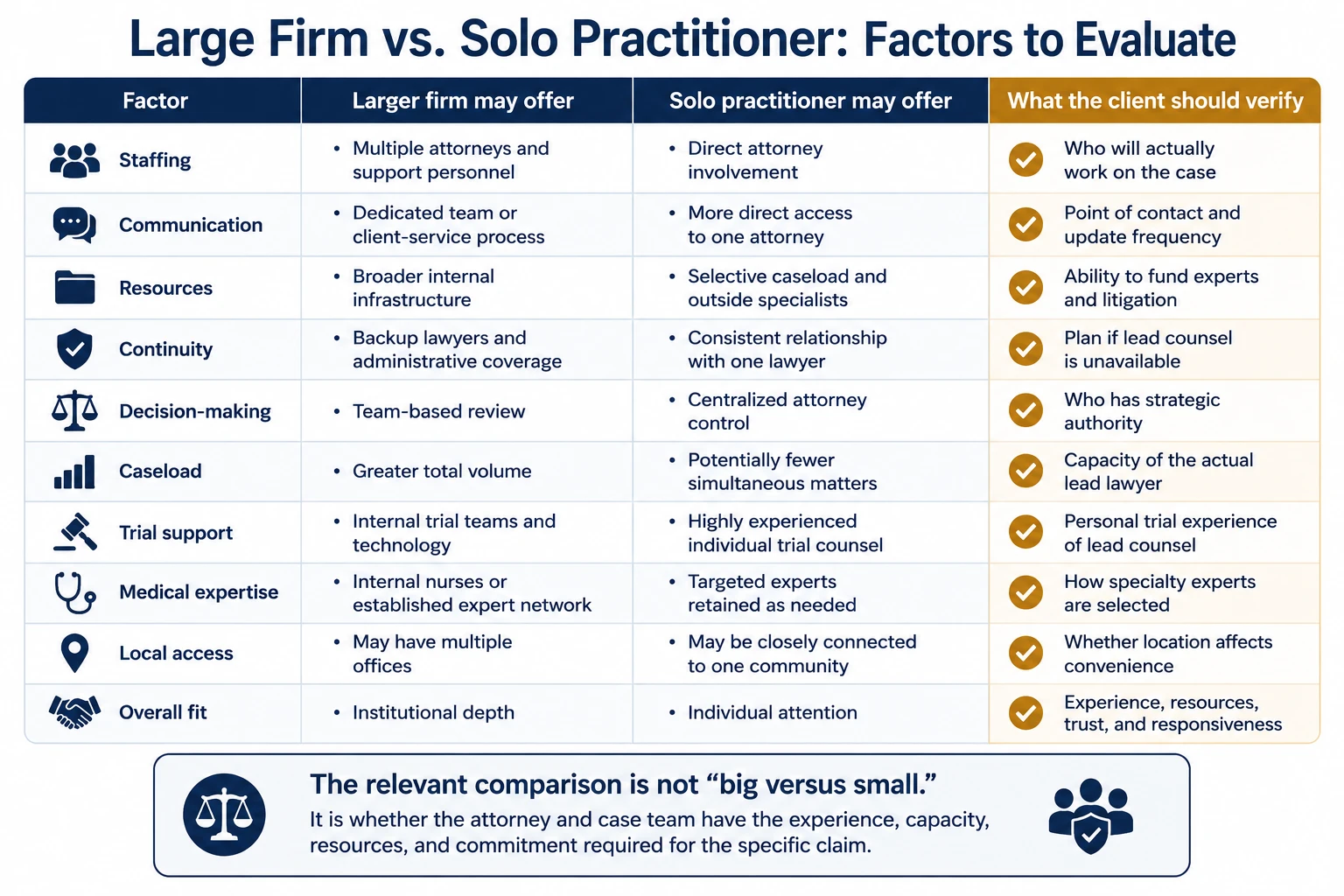
The relevant comparison is not “big versus small.” It is whether the attorney and case team have the experience, capacity, resources, and commitment required for the specific claim.
Firm size can affect how a malpractice case is staffed and managed, but size alone does not predict quality. A larger firm may have multiple attorneys, paralegals, nurses, investigators, technology systems, and administrative personnel available to support complex litigation. A smaller law firm may provide more direct access to the attorney and maintain closer personal involvement in each matter.
The important question is how the particular case will actually be handled. A client should ask who will serve as lead counsel, which work may be delegated, how coverage is maintained if the lead attorney is unavailable, and whether the firm has the capacity to finance expert review and litigation through trial.
Medical malpractice is one of the most complex areas of civil litigation. These cases require a detailed understanding of medicine, New York law, and the legal procedures that govern malpractice claims. They also require the ability to work with highly qualified medical experts and present complicated medical issues in a clear and persuasive manner.
An attorney who regularly handles medical malpractice cases is often better equipped to recognize important issues, anticipate defenses, and develop an effective strategy than someone who handles only an occasional malpractice claim.
Experience should be evaluated at the attorney level, not only through the firm’s general marketing. Ask whether the lawyer who will lead the matter regularly handles claims involving comparable medical issues, qualified-expert review, depositions of healthcare professionals, and malpractice trials or negotiated resolutions.
A thorough medical malpractice investigation often requires obtaining extensive medical records, consulting with medical specialists, reviewing diagnostic studies, conducting legal research, and preparing detailed expert analyses.
Qualified medical-expert review and testimony are generally required to establish the applicable standard of care, departure, and causation, subject to limited circumstances. Before hiring an attorney, it is reasonable to ask whether the firm has the experience, personnel, and financial resources necessary to fully investigate and pursue a complex case.
Qualified medical experts
Evaluate the accepted standard of medical care and causation
Attorney and paralegal capacity
Review records, research issues, and manage discovery
Medical-record systems
Organize extensive clinical documentation
Litigation funding capacity
Advance expert, deposition, filing, and trial expenses
Trial technology and exhibits
Explain complex medicine to judges and juries
Continuity and backup staffing
Keep the case moving during absences or emergencies
Appellate or motion support
Address complex legal issues when they arise
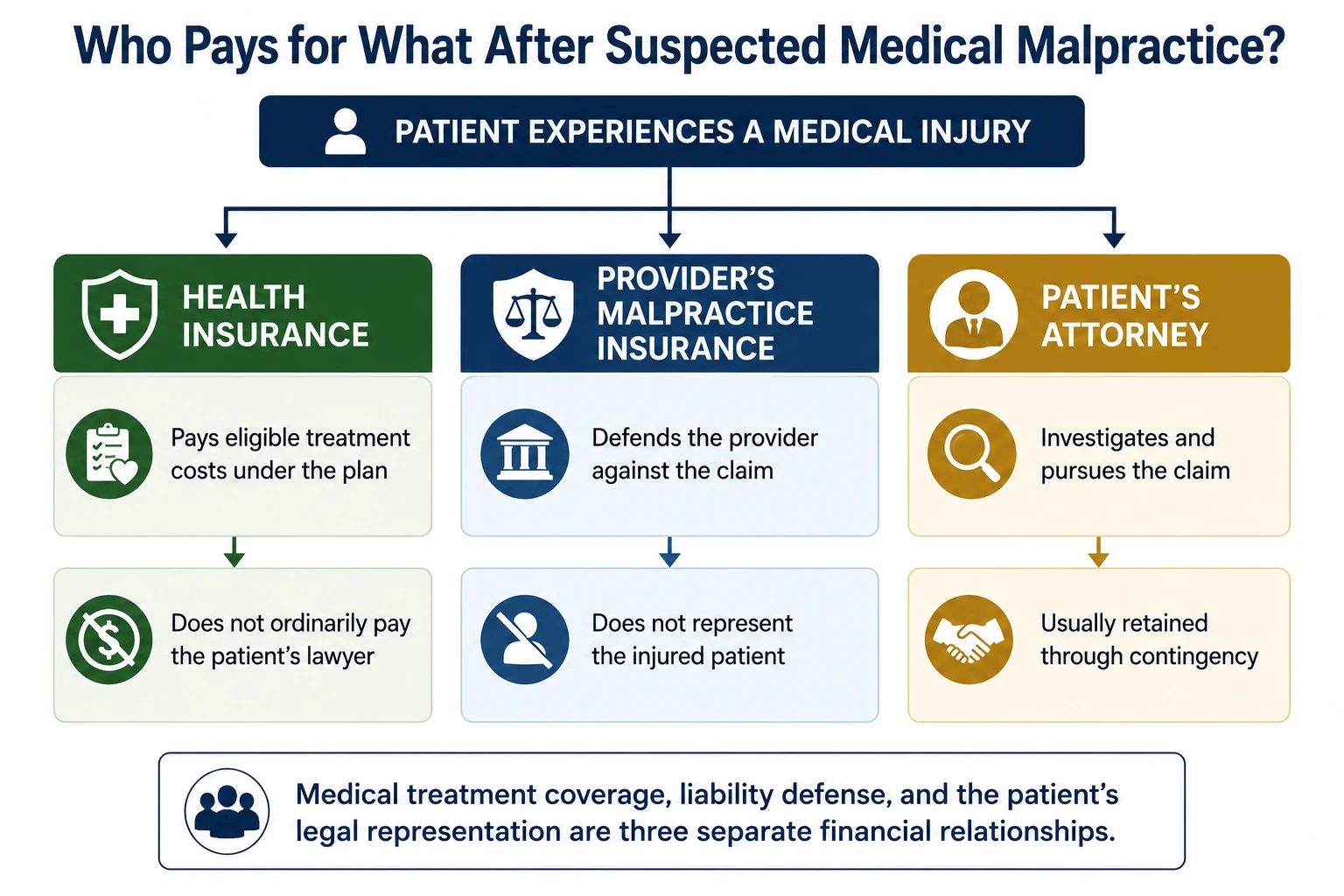
A firm’s litigation funding capacity matters because health insurance and the provider’s malpractice insurance do not cover the patient’s legal representation; that cost is generally advanced by the patient’s own attorney.
When evaluating a law firm, ask about the experience of the attorney who will actually lead your case rather than relying solely on the firm’s overall reputation. An established firm may have many attorneys with different levels of experience, while a smaller law firm personally handles every matter. Understanding who will make strategic decisions, take depositions, work with medical experts, negotiate with defendants, and appear in court provides a clearer picture of how the case will actually be managed.
A polished consultation does not necessarily show how a medical malpractice case will be managed after the retainer agreement is signed. Ask who will serve as lead counsel, how many active malpractice matters that attorney is handling, what work may be delegated to associates or paralegals, and whether another qualified attorney can step in if the lead lawyer becomes unavailable.
The goal is not to find a firm with the fewest cases. Medical malpractice claims vary significantly in complexity, and an experienced team may handle multiple matters effectively when it has appropriate staffing, systems, and support. More useful indicators include whether the firm has a clear case-management process, sufficient time to review the medical records, access to qualified experts, the financial capacity to advance litigation expenses, and a defined schedule for updating the client.
A prospective client should also ask what happens after the initial consultation. The firm should be able to explain who will review the records, who will make strategic decisions, how frequently the case will be evaluated, and how the client will be informed when important developments occur. Vague answers about staffing, responsibility, or communication may indicate that the firm has not established a clear plan for handling the matter.
A consultation is an opportunity to learn how the law firm approaches medical malpractice cases. You may want to ask who will be handling your case on a day-to-day basis, how often you can expect updates, whether the firm regularly handles medical malpractice litigation, how medical experts are selected, and what the next steps would be if the firm agrees to investigate your claim. The answers to these questions can help you determine whether the law firm is the right fit for your needs.
Who will be the lead attorney?
Primary responsibility for the litigation, while recognizing that major decisions, such as settlement, remain the client’s to make.
How often does that attorney handle malpractice cases?
Relevant subject-matter experience
Who will communicate with me?
Day-to-day point of contact
Have you handled cases involving this type of medical issue before?
Relevant experience with similar medical conditions, procedures, and malpractice issues.
What work will be delegated?
Roles of associates, paralegals, nurses, and outside counsel
How are experts identified and retained?
Access to appropriate specialty expertise
Does the firm have the resources to finance the case?
Ability to advance substantial litigation expenses
Has the lead lawyer taken malpractice cases to trial?
Trial readiness and leverage
Could the case be referred or handled with co-counsel?
Actual representation structure
How frequently will I receive updates?
Communication expectations
What happens if the lead attorney becomes unavailable?
Continuity planning
How are fees and expenses handled?
Financial obligations under the retainer
What are the next steps after the consultation?
Evaluation and intake process
A Syracuse-based firm may offer practical advantages for a case arising in Central New York, including familiarity with regional healthcare institutions, local filing procedures, travel logistics, court scheduling, and the communities from which jurors may be selected. Local proximity may also make in-person meetings and document coordination more convenient.
Local presence should not outweigh malpractice experience, resources, or trial capability. Courts apply the same governing law regardless of where counsel’s office is located, and the strongest choice is the attorney best equipped to handle the specific claim.
Communication is an important part of the attorney-client relationship because medical malpractice cases can involve long periods of investigation, expert review, discovery, motion practice, and negotiation. Clients should understand who will provide updates, how routine questions will be handled, and when the lead attorney will become directly involved.
Accessibility does not necessarily mean that the lead lawyer will personally answer every telephone call or email. A well-managed firm may use associates, paralegals, nurses, or client-service personnel to provide routine updates while the lead attorney remains responsible for major strategy, settlement decisions, expert preparation, and trial planning. What matters is that the communication structure is explained clearly before representation begins and that the client knows whom to contact.
During the consultation, ask how frequently the firm typically communicates, how quickly routine inquiries are usually acknowledged, and how urgent issues are escalated. The attorney should also explain legal and medical issues in understandable language, discuss important risks and uncertainties, and give the client a meaningful opportunity to participate in major decisions.
Strong communication does not guarantee a favorable result, but poor communication can make an already difficult process more stressful. The best fit is a firm that combines responsiveness with clear case ownership, realistic expectations, and a defined process for keeping the client informed.
Clients should also understand whether communications are documented through a secure client portal, email, telephone, or another established process.
Primary contact
Who handles routine questions and updates
Lead-attorney access
When the lead lawyer will communicate directly
Update frequency
Whether updates occur on a schedule or when material events happen
Response expectations
How quickly calls and emails are generally acknowledged
Decision-making
Which decisions require the client’s approval
Plain-language explanations
How complex legal and medical issues will be communicated
Urgent matters
How time-sensitive questions are escalated
Credentials and professional recognition are important, but they should not be the only factors when choosing an attorney. Integrity, preparation, experience, communication, and a genuine commitment to understanding each client’s situation are equally important. Medical malpractice cases require careful investigation, thoughtful legal strategy, and a willingness to devote the time and resources necessary to pursue justice. Clients should choose a lawyer they trust to guide them through the process with honesty, compassion, and professionalism.
Look beyond award badges, slogans, office size, and total verdict figures. More useful indicators include the lead attorney’s malpractice-specific experience, professional standing, disciplinary history, trial work, written explanations of fees, willingness to discuss staffing, and ability to identify both the strengths and limitations of a potential claim.
Trial experience is important even when a claim may settle. Medical malpractice defendants and insurers evaluate whether the plaintiff’s attorney has the resources, preparation, and willingness to present the case to a judge or jury if a fair resolution cannot be reached. Ask whether the lawyer who will lead the matter has personally handled malpractice trials, expert examinations, dispositive motions, and complex settlement negotiations.
Past trial experience does not guarantee a particular outcome, but it can indicate whether the attorney is prepared to pursue the case beyond the initial investigation and negotiation stages.
Yes. A law firm may decline a matter, refer it to another attorney, or associate with co-counsel when additional experience, capacity, or geographic coverage would benefit the case. Collaboration is not inherently a warning sign, but the client should understand who will be responsible for the matter, who will communicate with the client, how strategic decisions will be made, and whether the fee arrangement changes. These terms should be disclosed and documented as required.
Speak with more than one malpractice attorney when practical and compare the substance of their answers rather than office size alone. Ask who would lead the case, what relevant experience that lawyer has, how the claim would be evaluated, what resources are available, how communication works, and whether the firm is prepared to pursue the matter through trial.
A trustworthy attorney should explain both the potential strengths and the uncertainties of the case. Be cautious of guarantees, pressure to sign immediately, or reluctance to identify who will actually perform the legal work.
Resources matter, but the relevant question is whether the assigned attorney and team have the required experience, capacity, and trial readiness.
Communication and accessibility depend on the individual attorney’s caseload, systems, and working style, not only firm size.
Advertising visibility does not establish who will handle the case or whether that attorney has relevant malpractice experience.
Local familiarity may improve logistics and procedural efficiency, but it does not determine the legal outcome.
Associates, paralegals, nurses, and experts may appropriately support the matter while lead counsel remains responsible for strategy and major decisions.
Collaboration may strengthen a case when responsibilities, communication, and fee arrangements are clearly disclosed.
The relevant comparison is not big versus small. It’s whether the team has the experience your case needs.

Michael Bottar is a nationally recognized New York medical malpractice and personal injury attorney and the founder of Bottar Law. Throughout his career, he has dedicated his practice to representing individuals and families affected by medical negligence, catastrophic injuries, wrongful death, and other serious acts of negligence. Michael is committed to helping clients understand their legal rights, navigate the complexities of the legal system, and pursue accountability with compassion, integrity, and unwavering advocacy.
For more than 40 years, Bottar Law has represented individuals and families throughout Syracuse, Central New York, and across New York in complex medical malpractice litigation involving catastrophic injuries and wrongful death. Through educational resources like these FAQs, Michael Bottar and the Bottar Law team strive to provide clear, reliable information to help injured individuals and their families make informed decisions during difficult times. Prior results do not guarantee a similar outcome.
Speak with Bottar Law about the experience, resources, and trial readiness that actually matter for your case.