 Call833-268-8277

Understand who pays for what after suspected malpractice, and how contingency-fee representation actually works.
Attorney reviewed · New York focused · Updated resource
Legal representation is typically arranged through a contingency-fee agreement instead.
Health insurance generally does not pay for a patient’s medical malpractice attorney. Health insurance may help cover medical treatment, but legal representation is usually arranged separately through a contingency-fee agreement. Under that arrangement, the attorney’s fee depends on obtaining a monetary recovery through a settlement or judgment, so the client ordinarily does not pay attorney fees upfront. Case expenses, such as medical-record, expert-review, filing, and litigation costs, are separate from attorney fees and should be addressed in the written retainer agreement.
Health insurance generally helps pay for covered medical care. It does not ordinarily provide the injured patient with an attorney to pursue a medical malpractice claim. Instead, plaintiffs’ medical malpractice attorneys commonly accept cases under written contingency-fee agreements.
This arrangement allows an injured patient to obtain legal representation without paying hourly attorney fees at the outset. The written retainer agreement should explain the fee calculation, case expenses, and the client’s possible financial responsibilities.
No. Health insurance is designed to help pay for medical care, not legal representation. Hiring a medical malpractice attorney is separate from your health insurance coverage.
Most medical malpractice attorneys in New York represent clients under a contingency fee agreement. This means attorney fees are generally paid only if a monetary recovery is obtained through a settlement, judgment, or verdict.
The exact fee calculation and treatment of expenses should be stated in the written retainer agreement. New York law limits contingency fees in medical, dental, and podiatric malpractice matters through a statutory sliding scale.
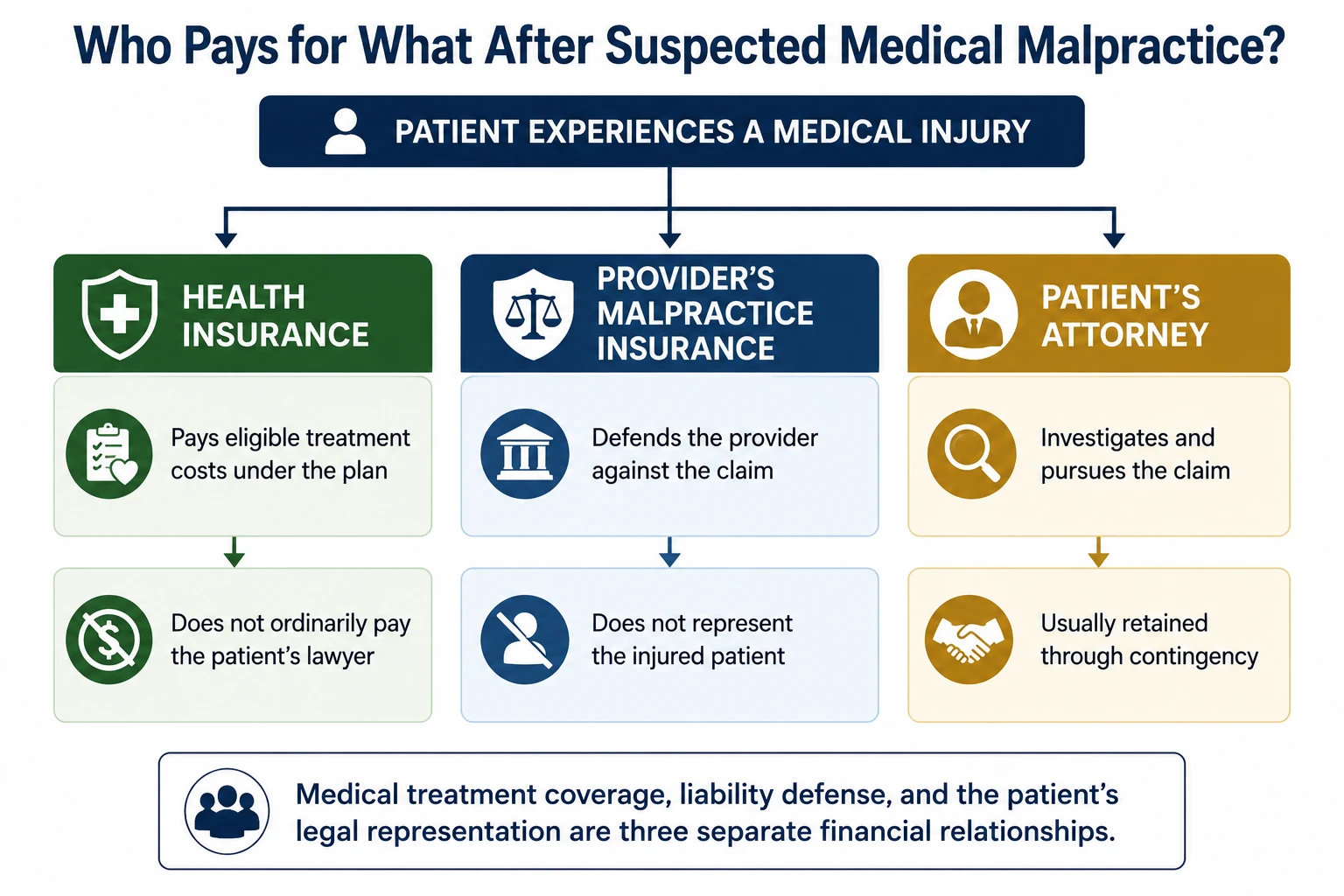
Medical treatment coverage, liability defense, and the patient’s legal representation are three separate financial relationships.
No. A doctor’s, hospital’s, or other provider’s malpractice liability insurer may appoint and pay attorneys to defend the insured provider against the claim. That defense attorney does not represent the injured patient. The patient must separately retain an attorney to investigate and pursue the malpractice claim, typically through a contingency-fee agreement.
Patient’s health insurance
Patient
Helps pay for covered medical treatment
Provider’s malpractice liability insurance
Doctor, hospital, or insured provider
Pays for or provides the provider’s legal defense and covered liability
Contingency-fee agreement
Injured patient and plaintiff’s attorney
Governs payment for the patient’s legal representation
Legal-services benefit or legal insurance
Enrolled member, subject to plan terms
May cover specified legal services; medical malpractice litigation may require separate review
Malpractice recovery
Injured claimant
May provide compensation through settlement, judgment, or verdict if the claim succeeds
The healthcare provider’s insurer does not select or pay the injured patient’s attorney.
A contingency-fee agreement makes the attorney’s compensation dependent on obtaining a monetary recovery for the client. Rather than billing the client an hourly attorney fee, the lawyer receives an agreed fee from the recovery if the claim results in a settlement, judgment, or verdict.
New York law limits contingency fees in medical, dental, and podiatric malpractice matters through a statutory sliding scale under Judiciary Law § 474-a.
New York legal review note: Contingency fees in medical, dental, and podiatric malpractice claims are governed by Judiciary Law § 474-a. The written retainer agreement should explain the fee calculation, litigation expenses, and the client’s potential financial responsibilities.
No. You do not need to use your health insurance or obtain approval from your insurance company before speaking with a medical malpractice attorney.
If you believe you have been harmed by medical negligence, you can contact an attorney directly to discuss your concerns. The consultation allows the attorney to obtain preliminary information, identify relevant deadlines, and determine whether medical-record and expert review may be appropriate. A consultation does not guarantee that the firm will accept the case or that malpractice occurred.
Medical malpractice cases may require expenditures for medical records, qualified medical experts, filing fees, depositions, exhibits, investigators, and other litigation services. These case expenses are separate from attorney fees.
A law firm may advance some or all of these expenses while the matter is being investigated or litigated. The written retainer agreement should explain whether the client is responsible for any expenses if no recovery is obtained, how expenses are deducted if compensation is recovered, and whether the attorney’s fee is calculated before or after particular deductions. Clients should review these provisions before signing the agreement.
The written agreement should identify how the attorney’s fee will be calculated, which expenses the firm may advance, when those expenses will be deducted, whether the client could be responsible for expenses if no recovery is obtained, and how any recovery will be distributed. The client should ask questions about any term that is unclear before signing.
Health insurance may continue paying covered treatment expenses while a malpractice claim is being evaluated or litigated. A malpractice claim does not replace the patient’s existing health coverage or automatically suspend responsibility for medical bills.
If compensation is recovered, a health plan, government benefits program, medical provider, or other entity may assert a reimbursement claim, lien, or repayment right depending on the governing plan documents and applicable law. These issues are separate from the attorney’s contingency fee and can affect the client’s net recovery. An attorney should identify and evaluate potential repayment claims before settlement funds are distributed.
Some people have access to legal-service benefits through an employer, union, membership organization, or separate legal-expense plan. Coverage varies by plan, and complex contingency-fee litigation may be excluded or handled differently from routine legal services. Review the policy or benefit description and ask the plan administrator whether medical malpractice claims are covered. Even if the plan does not cover the case, a patient may still contact a malpractice attorney directly to ask about contingency-fee representation.
Before representation begins, Bottar Law provides a written retainer agreement and explains how the contingency fee is calculated, which case expenses may be advanced, how those expenses are treated if compensation is recovered, and whether the client may be responsible for any expenses if no recovery is obtained. Clients have an opportunity to ask questions before deciding whether to retain the firm.
Our goal is to provide honest guidance so that clients understand the process and can focus on their recovery while we evaluate their legal options.
Ask the attorney to explain the consultation process, contingency-fee calculation, case expenses, and the client’s potential financial responsibilities under the written retainer agreement. You do not need authorization from your health insurer to contact a malpractice attorney. Speaking with a lawyer does not obligate you to file a claim, and the attorney may determine that further investigation is not warranted.
Health insurance generally covers eligible healthcare services, not an attorney retained to pursue a malpractice claim.
The provider’s insurer represents and protects the insured provider, not the injured patient.
Attorney fees and litigation expenses are different. The written retainer should explain how both are handled.
New York medical malpractice contingency fees are governed by a statutory declining schedule rather than a uniform one-third fee.
Responsibility for unrecovered case expenses depends on the written retainer agreement.
Treatment coverage and civil malpractice litigation are separate, subject to the health plan’s terms and applicable law.
The healthcare provider’s liability insurer represents the provider, not the patient.

Michael Bottar is a nationally recognized New York medical malpractice and personal injury attorney and the founder of Bottar Law. Throughout his career, he has dedicated his practice to representing individuals and families affected by medical negligence, catastrophic injuries, wrongful death, and other serious acts of negligence. Michael is committed to helping clients understand their legal rights, navigate the complexities of the legal system, and pursue accountability with compassion, integrity, and unwavering advocacy.
For more than 40 years, Bottar Law has represented individuals and families throughout Syracuse, Central New York, and across New York in complex medical malpractice litigation involving catastrophic injuries and wrongful death. Through educational resources like these FAQs, Michael Bottar and the Bottar Law team strive to provide clear, reliable information to help injured individuals and their families make informed decisions during difficult times. Prior results do not guarantee a similar outcome.
Speak with Bottar Law about how contingency-fee representation and case expenses actually work.