 Call833-268-8277

Understand what actually determines potential case value, and why no formula or prior verdict can predict your case.
Attorney reviewed · New York focused · Updated resource
Value depends on both the provable damages and the strength of the evidence needed to prove them.
There is no standard formula for determining what a New York medical malpractice case is worth. The potential value depends on both the losses caused by the malpractice and the strength of the evidence needed to prove the claim. Important considerations may include whether the provider departed from the accepted standard of medical care, whether that departure caused the injury, the severity and permanence of the harm, past and future financial losses, pain and suffering, comparative fault, available insurance or responsible defendants, and the risks of settlement or trial.
A case's evaluation may change as medical records are obtained, qualified experts provide opinions, depositions are completed, future needs become clearer, and the parties reassess litigation risk. Verdicts and settlements from other cases may provide context, but they do not determine the outcome of a different claim.
Not necessarily. Damages describe the legally recoverable losses caused by the malpractice, such as medical expenses, lost earning capacity, pain and suffering, or future care. Case value is a broader practical evaluation that also considers the probability of proving liability and causation, the quality of the evidence, trial and appeal risks, available defendants or insurance, and the likelihood of collecting a judgment or negotiating a settlement.
A case may involve devastating injuries but remain difficult to prove medically. Another case may have unusually clear liability but more limited damages. Both components must be evaluated together.
Attorneys generally evaluate multiple legal, medical, and practical considerations together rather than relying on any single factor.
Departure from the accepted standard of medical care
Whether qualified evidence supports that the provider's conduct was medically improper
Causation
Whether the departure caused or substantially contributed to the claimed injury
Severity and permanence
Whether the harm was temporary, permanent, progressive, disabling, disfiguring, or fatal
Economic losses
Past and future medical needs, earnings, care, equipment, services, and other supported financial losses
Non-economic harm
Pain, disability, loss of independence, and reduced enjoyment of life
Quality of proof
Medical records, imaging, testimony, communications, expert opinions, and consistency of the evidence
Comparative fault
Whether supported patient conduct may reduce recoverable damages
Responsible parties and practical recovery considerations
Which providers or institutions may be legally responsible and whether practical recovery considerations, including available insurance or other assets, may affect collection or settlement
Venue and trial risk
The court, jury pool, evidentiary disputes, witness credibility, and unpredictability of trial
Stage of the case
Whether the evaluation occurs before expert review, after discovery, during negotiations, or near trial
Post-verdict risk
Possible motions, appellate review, delay, and adjustment of an award
Case evaluation combines provable damages with the probability, cost, and risk of obtaining a recovery.
New York appellate courts may review whether an award materially deviates from reasonable compensation, which is one reason prior cases can offer context without mechanically fixing the value of a new claim.
Evaluation begins with two separate questions: whether the healthcare provider departed from the accepted standard of medical care and whether that departure caused or was a substantial factor in causing injury. A serious medical outcome does not by itself establish either element.
Counsel may review the records, chronology, defendant relationships, damages, and procedural issues, while qualified medical experts evaluate departure and causation. The practical evaluation then considers the probability of proving those issues through admissible evidence, surviving motions, persuading a jury, and defending a favorable result if it is challenged after trial. The objective is not to select a number at the beginning of the case. It is to develop a reasoned range based on the evidence available at that stage and revise it as the record becomes more complete.
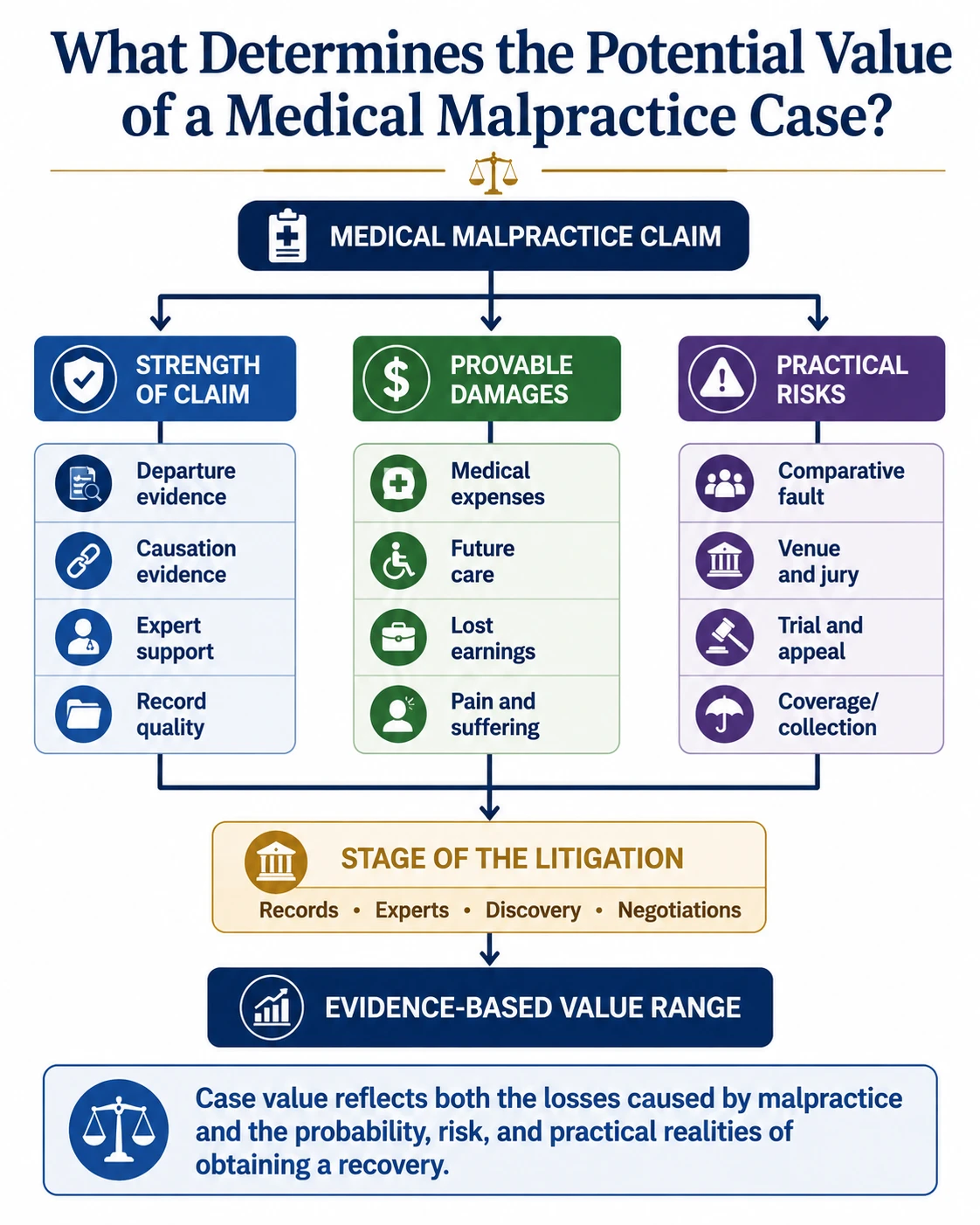
Case value reflects both the losses caused by malpractice and the probability, risk, and practical realities of obtaining a recovery.
Potential value may be affected by the strength of the departure and causation evidence, the severity and duration of the injury, future treatment, lost earning capacity, non-economic harm, comparative fault, witness credibility, expert support, responsible defendants, available insurance or assets, venue, litigation expense, and the risks of trial and appeal.
No factor should be viewed in isolation. Permanent injury may substantially increase damages, but the case may still carry significant risk if causation is disputed. Conversely, strong liability evidence does not automatically create a high-value claim when the additional injury and financial losses are limited.
Severity and permanence can substantially affect the damages analysis because permanent neurological injury, paralysis, loss of organ function, amputation, or another life-altering condition may create long-term medical, financial, and personal losses.
However, the underlying condition must be separated from the additional harm caused by malpractice. The evaluation should identify which future care needs, limitations, and losses probably would not have occurred absent the defendant's departure.
If a medical injury prevents someone from working or reduces their ability to earn income in the future, those financial losses may be included as part of the damages in a medical malpractice claim. This includes wages already lost as well as future lost earning capacity when supported by the evidence.
In many cases, vocational and economic experts may develop evidence-based projections concerning lost wages and diminished earning capacity. Their analysis may consider the person's age, education, employment history, expected career path, disability, work-life expectancy, inflation, and present value.
Pain and suffering cannot be calculated from receipts or a fixed mathematical formula. It is evaluated through evidence concerning the nature, severity, duration, and personal effect of the injury. Medical records, testimony, photographs, functional limitations, treatment history, prognosis, and observations from family members may all be relevant.
Past awards in comparable cases may provide context, particularly because New York appellate courts evaluate whether an award materially deviates from reasonable compensation. Comparable decisions do not create a guaranteed range because injuries, evidence, duration, and individual circumstances differ.
No. A settlement offer reflects what a defendant or insurer is willing to pay at a particular point to resolve the dispute. It may be influenced by the evidence, litigation stage, defense strategy, costs, risk tolerance, policy considerations, and the parties' competing assessments of a possible verdict.
A settlement provides certainty, while trial may produce more, less, or no recovery. A verdict may also be followed by post-trial motions or an appeal. An offer should therefore be evaluated against the supported damages, probability of success, time, expense, collectability, and client's goals rather than treated as an objective declaration of the case's worth.
Early evaluations are necessarily preliminary. Medical treatment may still be ongoing, prognosis may be uncertain, records may be incomplete, and qualified experts may not yet have reviewed the care.
The evaluation may change after additional records or imaging are obtained, experts analyze departure and causation, depositions reveal new facts, future-care needs become clearer, employment losses are documented, or the court resolves important legal issues. Settlement positions may also change as trial approaches and each side reassesses risk.
A responsible attorney should therefore explain the assumptions and uncertainties behind an early evaluation rather than promise a fixed outcome.
The name of the medical error does not determine value. Consider two delayed diagnosis cases. In one, the delay causes a temporary worsening that requires additional treatment but leaves no permanent limitations. In another, the delay allows a disease to progress, eliminates treatment options, prevents employment, and requires lifelong care. The departure may appear similar, but the resulting damages differ substantially.
The reverse may also occur. Two patients may sustain similar injuries, but one case has clear records and strong expert support while the other presents substantial disputes about what happened or whether earlier treatment would have changed the outcome. The injuries may be comparable, but the litigation risk is not.
Case value therefore reflects both the magnitude of the supported losses and the probability of proving them.
Potentially. Under New York's comparative-fault rules, culpable conduct attributed to the claimant generally does not automatically bar recovery, but it may reduce otherwise recoverable damages in proportion to the claimant's assigned share of responsibility.
A defendant must support the allegation and connect the conduct causally to the injury or damages. The possibility of comparative fault may affect settlement and trial evaluation, but blame alone does not establish a reduction.
They can affect practical recovery, although they do not define the patient's medical injuries or legally compensable damages. Counsel may need to identify which physicians, medical groups, hospitals, insurers, or other entities may be responsible and what coverage or assets may be available.
A theoretically large damages claim may present collection issues if viable defendants or recovery sources are limited. Conversely, the existence of insurance does not establish negligence or guarantee payment. Coverage, liability, damages, and collectability are separate issues.
Not usually. A gross recovery is the total settlement or judgment before deductions. The client's net distribution may be affected by attorney fees, litigation expenses, medical or governmental liens, reimbursement claims, court-approved allocations, and other case specific obligations.
Certain collateral-source payments may also affect the treatment of particular economic losses after a verdict under CPLR 4545, subject to the statute's requirements and exceptions. The contingency fee agreement and settlement statement should explain how the final distribution is calculated.
Not necessarily. New York CPLR Article 50-A governs the periodic payment of certain future damages in medical and dental malpractice judgments. Post-trial motions, appellate review, collateral-source issues, liens, and judgment-structure rules may affect when and how a favorable verdict produces an actual client recovery.
This is another reason a headline verdict should not be treated as identical to settlement value or net client compensation.
It is often impossible to accurately evaluate a medical malpractice case immediately after an injury occurs. Patients may still be undergoing treatment, future medical needs may not yet be known, and the long-term effects of the injury may continue to develop over time.
Evaluating a case too early can result in overlooking important damages that become apparent only after the patient's condition has stabilized. A thorough investigation helps ensure that the full impact of the injury is considered before important decisions are made.
Bottar Law may begin by reconstructing the treatment chronology, identifying the potential defendants, and obtaining the records, imaging, communications, and other evidence needed to evaluate departure and causation. Qualified medical experts may review the provider's conduct, the injury caused by the alleged malpractice, prognosis, and future treatment.
Depending on the injuries, vocational experts, life-care planners, or economists may assess work capacity, future care, replacement services, and projected financial losses. Counsel also evaluates comparative fault, evidentiary disputes, venue, trial and appeal risks, insurance or collectability issues, liens, litigation expenses, and the stage of the case.
The result is not a guaranteed figure. It is an evidence-based valuation range that may change as the medical and litigation record develops.
As additional records, expert opinions, and testimony become available, the valuation may be refined to reflect the evolving evidence.
Many people believe there is a formula that determines what every medical malpractice case is worth, or they compare their case to verdicts or settlements they have heard about online or in the news. In reality, every case is different, and compensation depends on the specific facts, the available evidence, and the damages that can be proven.
Another common misconception is that a settlement offer reflects the true value of a claim. Settlement negotiations often involve many factors, and every offer should be carefully evaluated before a decision is made.
Consult a New York medical malpractice attorney who can review the treatment history, obtain relevant records, identify the potential defendants, evaluate filing deadlines, and determine whether qualified expert review is warranted.
An initial evaluation may identify the factors likely to affect the case, but a reliable valuation usually requires more than an intake conversation. The strength of the medical evidence, causation, long-term damages, litigation risk, and practical recovery issues may become clearer only after investigation. No attorney should guarantee a settlement or verdict amount at the beginning of the process.
No responsible attorney can determine the value of a medical malpractice case from a brief conversation alone. A meaningful evaluation requires evidence, expert review, and an understanding of both the medical issues and the litigation risks.
Liability, causation, evidence, prognosis, venue, and individual losses differ.
Bills are only one part of the economic and non-economic damages analysis.
The evidence must still prove departure and causation.
An offer reflects a negotiating position at a particular stage.
Prior cases provide context but do not control a different claim.
Fees, expenses, liens, reimbursement obligations, and other deductions may affect the net distribution.
Meaningful valuation often requires records, expert review, prognosis, and damages evidence.
Case value reflects both the losses caused by malpractice and the probability, risk, and practical realities of obtaining a recovery.

Michael Bottar is a nationally recognized New York medical malpractice and personal injury attorney and the founder of Bottar Law. Throughout his career, he has dedicated his practice to representing individuals and families affected by medical negligence, catastrophic injuries, wrongful death, and other serious acts of negligence. Michael is committed to helping clients understand their legal rights, navigate the complexities of the legal system, and pursue accountability with compassion, integrity, and unwavering advocacy.
For more than 40 years, Bottar Law has represented individuals and families throughout Syracuse, Central New York, and across New York in complex medical malpractice litigation involving catastrophic injuries and wrongful death. Through educational resources like these FAQs, Michael Bottar and the Bottar Law team strive to provide clear, reliable information to help injured individuals and their families make informed decisions during difficult times. Prior results do not guarantee a similar outcome.
Speak with Bottar Law about the evidence and factors that actually drive a meaningful evaluation.