 Call833-268-8277

Understand the categories of economic, non-economic, and related damages that may apply to your case.
Attorney reviewed · New York focused · Updated resource
Every claimed loss must be causally connected to the malpractice and supported by evidence.
Damages in a New York medical malpractice case may include economic losses and non-economic harm caused by the malpractice. Economic damages may include past and future medical expenses, rehabilitation, nursing care, assistive equipment, lost wages, diminished earning capacity, and other necessary out-of-pocket or household-service losses. Non-economic damages may include pain and suffering, disability, loss of independence, reduced enjoyment of life, and emotional distress associated with the malpractice-related injury. A spouse may also have a derivative loss-of-consortium claim in appropriate circumstances. If malpractice caused a death, separate wrongful-death and estate claims may involve different categories of damages. The recoverable amount depends on causation, supporting evidence, the duration and severity of the injury, applicable legal rules, and the facts of the particular case.
Every case is unique, and the damages that may be recovered depend on the nature of the injury, the available evidence, and the long-term impact the negligence has had on the injured person's life. An experienced medical malpractice attorney can help identify and evaluate the damages that may be available in your particular case.
Past economic losses
Medical bills, rehabilitation costs, medication expenses, lost wages, transportation, and other documented out-of-pocket losses
Future economic losses
Future treatment, surgery, therapy, nursing care, assistive equipment, home modifications, and diminished earning capacity
Past non-economic harm
Physical pain, emotional distress associated with the injury, disability, loss of independence, and reduced enjoyment of life
Future non-economic harm
Expected ongoing pain, permanent limitations, disfigurement, and long-term loss of quality of life
Derivative damages
A spouse's potential loss of consortium, services, society, or companionship resulting from the injured person's condition
Wrongful-death damages
Pecuniary losses suffered by eligible beneficiaries, together with qualifying medical, nursing, funeral, and burial expenses
Estate or survival damages
Claims belonging to the estate, potentially including conscious pain and suffering experienced before death
Punitive damages
Rare damages intended to punish exceptionally egregious conduct rather than compensate ordinary malpractice losses
Every category must be connected to the malpractice and supported by appropriate evidence.
Economic damages are measurable financial losses caused by the malpractice. They may include past medical expenses, future healthcare needs, rehabilitation, prescription costs, nursing care, assistive devices, home or vehicle modifications, lost income, diminished earning capacity, replacement services, and other reasonable out-of-pocket expenses.
The patient must ordinarily establish that the expense or loss was caused by the malpractice and is supported by records, testimony, or qualified expert analysis. Future losses should be grounded in a reasonably supported medical and financial projection rather than speculation.
Compensation in a medical malpractice lawsuit is intended to address the losses caused by the negligence. Depending on the circumstances, this may include medical expenses, rehabilitation costs, future healthcare needs, lost income, diminished earning capacity, pain and suffering, and other damages recognized under New York law.
The goal is to evaluate the full impact of the injury so that all recoverable losses are considered before a case is resolved.
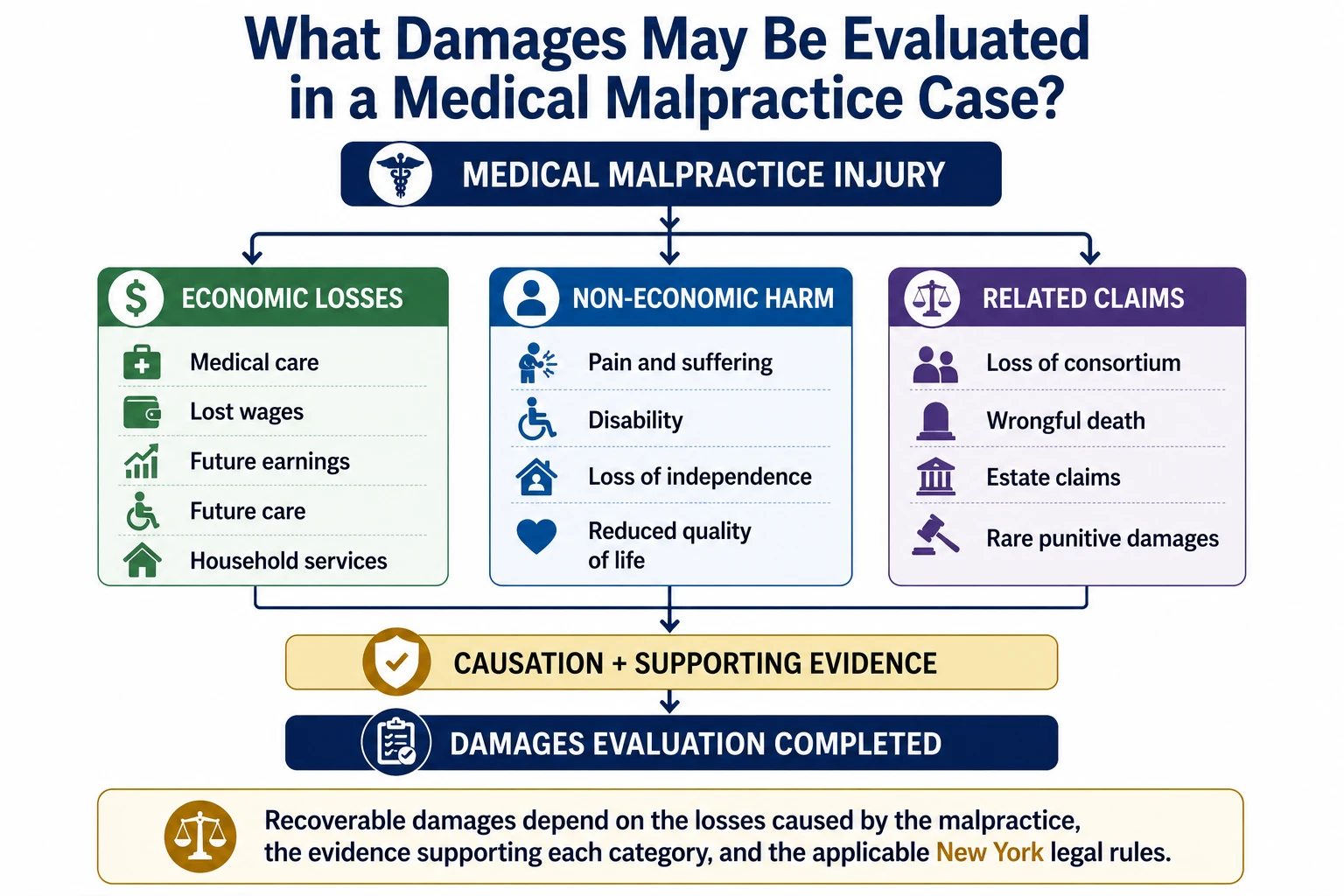
Recoverable damages depend on the losses caused by the malpractice, the evidence supporting each category, and the applicable New York legal rules.
Potentially. When the malpractice-related injury is expected to require ongoing treatment, future medical and rehabilitation expenses may be included in the damages evaluation. These may involve surgery, therapy, medication, nursing or attendant care, diagnostic monitoring, assistive equipment, home modifications, and other medically necessary services.
Qualified medical experts may explain the type, frequency, and expected duration of future care. A life-care planner may organize those needs into a long-term plan, while an economist may evaluate projected costs over time. The claim should distinguish care caused by the malpractice from treatment that would have been required because of an underlying condition regardless of the alleged negligence.
Past lost wages concern income already missed because of the injury. Diminished earning capacity concerns the reduction in the person's ability to earn income in the future, even if the individual later returns to work in a different or limited role.
Evidence may include payroll and tax records, employment history, education, career trajectory, work restrictions, vocational testimony, and economic projections. The analysis should also consider whether the person's underlying medical condition would have affected employment independently of the malpractice.
Non-economic damages may compensate for the human consequences of a malpractice-related injury. Depending on the evidence, those losses may include physical pain, disability, disfigurement, emotional distress associated with the injury, loss of independence, limitations on daily activities, and reduced enjoyment of life.
Past pain and suffering concerns the period from the injury through trial or resolution. Future pain and suffering concerns harm expected to continue afterward. Medical records, testimony from the injured person and family, photographs, treatment history, functional evidence, and expert opinions may all help explain the nature, severity, and duration of these losses.
When medical malpractice causes a death, the personal representative may pursue claims on behalf of the estate and eligible beneficiaries. The available damages depend on the particular cause of action.
A New York wrongful-death claim generally focuses on the pecuniary injuries suffered by the beneficiaries. Depending on the evidence, those losses may include lost financial support, the value of parental guidance or household services, and qualifying medical, nursing, funeral, and burial expenses.
The estate may also have a separate survival claim for injuries the deceased person experienced before death, potentially including conscious pain and suffering, medical expenses, or lost earnings during that period. These categories should not be combined automatically because they compensate different injuries and may be distributed differently.
Potentially. A spouse may assert a derivative claim for losses caused by the injured person's malpractice-related condition. Depending on the circumstances, the claim may involve loss of companionship, affection, services, society, or the marital relationship.
Because the claim is derivative, it generally depends on the viability of the injured spouse's underlying malpractice claim. The nature and extent of the claimed loss must also be supported by the evidence.
Only in exceptional circumstances. Punitive damages are intended to punish and deter conduct rather than compensate the patient for ordinary losses. A routine departure from the accepted standard of medical care is generally not enough.
The evidence would need to support conduct substantially more egregious than ordinary negligence, such as malicious, wanton, reckless, or grossly indifferent behavior. Whether punitive damages may be pleaded or proven depends on the specific facts and governing New York law.
Potentially. Health insurance, disability benefits, workers' compensation, or other collateral sources may affect how certain economic losses are treated. Under CPLR 4545, the court may consider qualifying payments after a verdict when they replace or indemnify particular losses, subject to the statute's requirements and exceptions.
This does not mean that insurance automatically eliminates the claim or every category of damages. Liens, reimbursement rights, premiums paid, future benefits, and the specific source of payment may all require separate analysis.
Not necessarily. New York CPLR Article 50-A contains rules governing the entry and periodic payment of certain future damages in medical and dental malpractice judgments. The application of those rules depends on the verdict, the type and amount of future damages, settlements, and other statutory requirements.
This is primarily a judgment-structure issue rather than a limitation on which losses may be proven. Counsel and financial experts may need to evaluate how a future award would be calculated and paid.
Damages depend on how the injury affects the individual, not simply on the name of the medical error. A temporary injury requiring additional treatment may involve substantial medical expenses and short-term pain but limited future losses. A permanent neurological injury may require lifelong care, prevent employment, and profoundly affect independence and quality of life.
Age, occupation, preexisting health, prognosis, family responsibilities, treatment needs, life expectancy, functional limitations, and the strength of the supporting evidence may all affect the damages analysis. Prior verdicts or settlements may provide context, but they do not determine the value of a different case.
A damages evaluation should account for both losses already sustained and reasonably supported future consequences. Some injuries stabilize quickly, while others involve permanent disability, progressive complications, additional surgery, ongoing care, or long-term effects on employment and independence.
Resolving the case before those issues are sufficiently understood may result in important categories being overlooked. The evaluation should therefore consider medical prognosis, future care, vocational effects, economic losses, non-economic harm, liens or offsets, and the evidence available to prove each category.
Bottar Law may work with qualified medical experts to determine the nature of the injury, prognosis, future treatment, functional limitations, and whether particular care needs were caused by the malpractice.
Depending on the case, life-care planners may organize future medical, rehabilitation, equipment, attendant-care, and accessibility needs. Vocational experts may evaluate the person's ability to work, while economists may analyze lost earnings, diminished earning capacity, inflation, present value, and the projected cost of future care.
The objective is to develop an evidence-based damages analysis that distinguishes past losses from future losses and malpractice-related needs from expenses attributable to the underlying condition.
One common misconception is that compensation is based solely on the amount of a person's medical bills. In reality, medical malpractice damages often include many different types of losses, including future medical care, lost earning capacity, pain and suffering, and the long-term effects the injury has on daily life.
Another misunderstanding is that every case has a predictable value. Because every medical malpractice claim involves different facts and injuries, compensation must always be evaluated on a case-by-case basis.
If you believe you have been harmed by medical negligence but are unsure what damages may be available, a practical next step is to consult a New York medical malpractice attorney who can review the records, evaluate causation, and identify the categories of damages supported by the evidence. An attorney can review your medical records, evaluate the circumstances of your injury, and explain the types of compensation that may be available under New York law.
Even if you are still receiving medical treatment or are uncertain about the long-term impact of your injury, seeking legal guidance early can help protect your rights and provide a clearer understanding of your options.
Preserve existing evidence accurately. Do not alter records or exaggerate limitations.
Recoverable losses may also include earnings, future care, pain and suffering, disability, and other supported harm.
Damages depend on the individual facts, prognosis, evidence, and legal issues.
Future needs must be connected to the malpractice and supported by qualified evidence.
It is evaluated from the nature, severity, duration, and personal impact of the injury.
Current New York wrongful-death law focuses principally on pecuniary injuries and specified expenses.
They require exceptionally egregious conduct beyond ordinary negligence.
Certain collateral-source payments, liens, and reimbursement rights may affect the financial analysis.
Recoverable damages depend on the losses caused by the malpractice, the evidence supporting each category, and the applicable New York legal rules.

Michael Bottar is a nationally recognized New York medical malpractice and personal injury attorney and the founder of Bottar Law. Throughout his career, he has dedicated his practice to representing individuals and families affected by medical negligence, catastrophic injuries, wrongful death, and other serious acts of negligence. Michael is committed to helping clients understand their legal rights, navigate the complexities of the legal system, and pursue accountability with compassion, integrity, and unwavering advocacy.
For more than 40 years, Bottar Law has represented individuals and families throughout Syracuse, Central New York, and across New York in complex medical malpractice litigation involving catastrophic injuries and wrongful death. Through educational resources like these FAQs, Michael Bottar and the Bottar Law team strive to provide clear, reliable information to help injured individuals and their families make informed decisions during difficult times. Prior results do not guarantee a similar outcome.
Speak with Bottar Law about the categories of compensation that may apply to your situation.