 Call833-268-8277

Seven factors that actually matter, from malpractice-specific experience to trial readiness and communication.
Attorney reviewed · New York focused · Updated resource
Firm size, awards, and prior results don’t replace an evaluation of who will actually handle your case.
Look for a New York attorney with substantial medical malpractice experience, access to qualified medical experts, sufficient financial and staffing resources, and the ability to pursue a complex case through trial when necessary. Confirm who will serve as lead counsel, how often that attorney handles malpractice claims, how the case will be investigated, and how fees and expenses are addressed in the written retainer agreement. The attorney should communicate clearly, identify both strengths and uncertainties, and never guarantee a recovery. Firm size, advertising, awards, and prior results should not replace an evaluation of the lawyer and team who will actually handle the case.
Choosing a medical malpractice attorney requires more than comparing advertisements, office size, or prior verdicts. These cases often require extensive medical-record review, qualified expert analysis, substantial litigation expenses, complex discovery, and the ability to present technical medical evidence at trial.
The strongest choice is usually the attorney and case team with relevant malpractice experience, sufficient resources, clearly defined responsibility, transparent communication, and a realistic plan for investigating the particular claim. Trust and personal fit also matter because malpractice litigation may continue for an extended period and involve difficult medical and personal issues.
The attorney who will lead the matter should regularly handle New York medical malpractice claims rather than only occasional general personal injury cases. Relevant experience may include obtaining and analyzing extensive medical records, working with qualified experts in appropriate specialties, taking or defending depositions of healthcare professionals, handling dispositive motions, negotiating complex claims, and preparing malpractice cases for trial.
Ask about experience with claims involving medical issues similar to yours, but do not assume that a prior similar case guarantees the same outcome. The goal is to determine whether the assigned attorney understands the medical, evidentiary, procedural, and strategic demands of the potential claim.
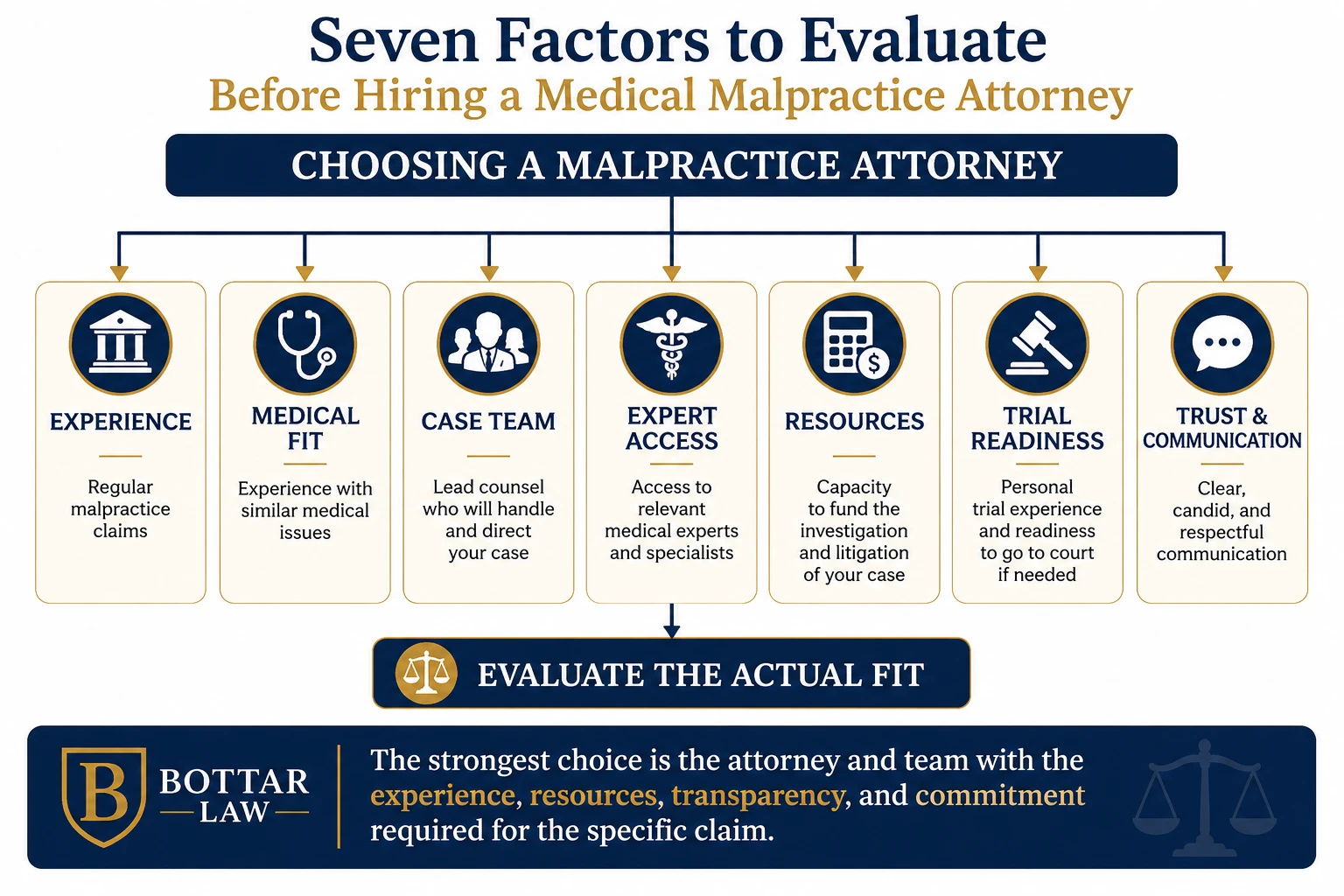
The strongest choice is the attorney and team with the experience, resources, transparency, and commitment required for the specific claim.
Medical malpractice cases differ from many other personal-injury claims because they involve technical medical questions as well as specialized legal and procedural requirements. Evaluating a potential claim may require reviewing thousands of pages of records, reconstructing a treatment timeline, consulting qualified medical experts, and determining whether a healthcare provider departed from the accepted standard of medical care and whether that departure caused or was a substantial factor in causing the patient’s injuries.
These cases may also involve specialized pleading requirements, expert evidence, extensive discovery, depositions of healthcare professionals, complex motions, and substantial litigation expenses. An attorney who regularly handles malpractice litigation is more likely to understand those requirements and plan for them from the beginning.
A prospective client cannot be expected to test an attorney’s medical knowledge directly, but the attorney’s evaluation process can reveal whether the firm approaches the issues carefully. The lawyer should ask detailed questions, identify the providers and treatment periods involved, explain what records are needed, avoid reaching conclusions before appropriate review, and describe how qualified experts will be selected.
Be cautious when an attorney immediately declares that malpractice occurred without reviewing the records or obtaining necessary medical input. A credible lawyer should distinguish between an initial concern and a legally supportable conclusion.
Your first consultation is an opportunity to understand how the attorney evaluates and handles medical malpractice cases. Ask who will lead the matter, how the claim will be investigated, how qualified experts are selected, how communication works, and how fees and expenses are addressed. The consultation should also help you determine whether the attorney answers questions clearly, discusses uncertainty honestly, and appears to be a suitable professional fit.
Who will serve as lead counsel?
Primary responsibility for managing the litigation and advising on strategy, while recognizing that major decisions, such as whether to accept a settlement, remain the client’s
How often does that attorney handle malpractice cases?
Malpractice-specific experience
Have you handled claims involving similar medical issues?
Relevant subject-matter familiarity
How will the claim be investigated?
Records, timeline, experts, and evaluation process
How are qualified experts selected?
Access to appropriate specialty expertise
Can the firm finance the investigation and litigation?
Capacity to advance substantial case expenses
Has the lead attorney handled malpractice trials?
Trial readiness
Who will communicate with me?
Day-to-day contact and update process
Could co-counsel or a referral be involved?
Actual representation structure
How are fees and expenses addressed?
Written financial terms
The firm should explain its communication structure before representation begins. Clients should know who handles routine updates, when the lead attorney becomes directly involved, how urgent issues are escalated, and whether communication occurs through telephone, email, a secure portal, video conference, or another established method.
Accessibility does not require the lead attorney to personally answer every routine question. Associates, paralegals, nurses, or other team members may appropriately assist while lead counsel remains responsible for major strategy and legal advice. What matters is that responsibilities are clear, material developments are communicated, and important decisions are made with the client’s informed participation.
Potential warning signs include limited malpractice-specific experience, guarantees of a settlement or verdict, immediate conclusions before the records are reviewed, unclear answers about who will handle the case, reluctance to explain expert review or litigation expenses, pressure to sign a retainer immediately, and unwillingness to discuss possible weaknesses or deadlines.
Poor communication during the evaluation process may also be relevant. A prospective client should understand the representation structure, fee arrangement, investigation process, and next steps before deciding whether to retain the firm.
Firm size and office location do not determine quality by themselves. A larger or national firm may offer extensive infrastructure, while a local New York firm may provide regional familiarity and convenient access. A solo practitioner or smaller firm may offer direct attorney involvement.
The more important question is whether the assigned attorney and team have the malpractice-specific experience, qualified experts, financial capacity, communication systems, continuity plan, and trial readiness required for the particular claim.
At Bottar Law, a potential medical malpractice case begins with a factual and medical investigation. The legal team obtains and organizes relevant records, develops a detailed treatment timeline, identifies the providers and entities involved, and consults qualified medical experts when appropriate.
The purpose of that review is to evaluate whether a healthcare provider departed from the accepted standard of medical care and whether the departure caused or was a substantial factor in causing the claimed injuries. The findings help determine whether sufficient medical and legal support exists to continue investigating or pursue a lawsuit.
Experience is important, but it is only one part of choosing the right attorney. Integrity, honesty, compassion, preparation, and communication are equally important. You should choose a lawyer who listens carefully, explains the legal process in understandable terms, and treats you with respect throughout the case.
Medical malpractice claims often arise during some of the most difficult moments in a person’s life. Having an attorney who understands that and provides thoughtful guidance can make a meaningful difference throughout the legal process.
Those qualities should be demonstrated through conduct: listening without rushing, explaining uncertainty, answering questions directly, respecting client decisions, providing written fee terms, and avoiding guarantees.
Malpractice-specific experience
Whether the assigned lawyer regularly handles these claims
Similar medical issues
Experience with comparable specialties, procedures, or injuries
Lead attorney and case team
Who performs the work and makes strategic decisions
Expert access
How appropriate specialists are identified and retained
Litigation resources
Capacity to fund records, experts, depositions, and trial preparation
Trial readiness
Personal experience of the lead attorney
Communication and trust
Clear expectations, candid advice, and respectful treatment
Evaluate the attorney who will handle the case, not only the firm’s size, advertising, or overall reputation.
Trial experience matters even when settlement is possible because counsel must be prepared to continue litigating if a fair resolution cannot be reached. Ask whether the attorney who will lead the matter has personally handled malpractice trials, expert examinations, complex motion practice, and settlement negotiations.
Past experience does not guarantee a result, but it can help show whether the lawyer is equipped to pursue the case beyond the initial investigation and negotiation stages.
Prospective clients can review the attorney’s official biography, New York admission status, disciplinary history, malpractice-specific experience, professional publications, and verified profiles. Awards, advertisements, testimonials, and prior results may provide context, but they should not be the sole basis for the decision.
The absence of publicly reported discipline does not by itself establish malpractice experience or suitability for a particular claim.
Ask who will actually lead the case and evaluate that person’s experience, not only the firm’s overall history or marketing. Prior results do not guarantee a similar outcome.
If you are unsure which attorney is right for you, schedule consultations with one or more experienced medical malpractice lawyers. Ask questions about their experience, how they investigate cases, how they communicate with clients, and what you can expect if they agree to represent you.
Choosing an attorney is an important decision, and you should never feel pressured to make it immediately. The right lawyer will take the time to answer your questions, explain your options honestly, and help you determine the best path forward based on the facts of your case.
Not necessarily. Prospective clients may consult more than one attorney when practical and compare their experience, investigation process, staffing, communication, fee terms, and assessment of the potential claim. A consultation does not obligate someone to retain the firm or pursue a lawsuit. However, because legal deadlines may apply, the comparison process should not cause unnecessary delay.
Medical malpractice commonly requires specialized legal experience, extensive medical review, qualified experts, and substantial litigation resources.
Prior results do not establish who will handle your case or predict its outcome.
A credible evaluation generally requires records, a detailed timeline, and qualified medical review.
Verify the capacity and experience of the actual attorney and assigned team.
A qualified team may appropriately divide work while lead counsel remains responsible for strategy.
No attorney can ethically or reliably guarantee a settlement, verdict, or specific recovery.
The strongest choice is the attorney and team with the experience, resources, transparency, and commitment required for the specific claim.

Michael Bottar is a nationally recognized New York medical malpractice and personal injury attorney and the founder of Bottar Law. Throughout his career, he has dedicated his practice to representing individuals and families affected by medical negligence, catastrophic injuries, wrongful death, and other serious acts of negligence. Michael is committed to helping clients understand their legal rights, navigate the complexities of the legal system, and pursue accountability with compassion, integrity, and unwavering advocacy.
For more than 40 years, Bottar Law has represented individuals and families throughout Syracuse, Central New York, and across New York in complex medical malpractice litigation involving catastrophic injuries and wrongful death. Through educational resources like these FAQs, Michael Bottar and the Bottar Law team strive to provide clear, reliable information to help injured individuals and their families make informed decisions during difficult times. Prior results do not guarantee a similar outcome.
Speak with Bottar Law and ask the questions that reveal real fit.