 Call833-268-8277

Understand the practical advantages of local counsel, and why location should be weighed alongside experience and resources.
Attorney reviewed · New York focused · Updated resource
Familiarity with Syracuse courts and hospitals should be evaluated alongside experience, resources, and trial readiness.
Hiring a Syracuse medical malpractice attorney may provide practical advantages when the treatment occurred in Central New York. Local counsel may be familiar with regional healthcare institutions, the courts where a case may be filed, local scheduling and procedural practices, and the logistical needs of clients and witnesses. However, location alone should not determine whom you hire. The attorney should also have substantial medical-malpractice experience, access to qualified experts, sufficient resources to investigate and litigate the claim, and the ability to pursue the case through trial when necessary.
A local Syracuse attorney is not automatically the best choice, and no attorney can guarantee that a case will succeed. However, a lawyer who regularly handles medical malpractice matters in Central New York may bring useful familiarity with regional healthcare systems, local court procedures, travel and scheduling logistics, and the practical issues that arise when clients, witnesses, and records are located in the Syracuse area.
Those local advantages should be evaluated together with malpractice-specific experience, expert access, litigation resources, communication practices, and trial readiness.
The best Syracuse medical malpractice attorney is not simply the nearest lawyer, but the attorney who combines local accessibility with malpractice-specific experience, qualified experts, sufficient resources, and trial readiness.
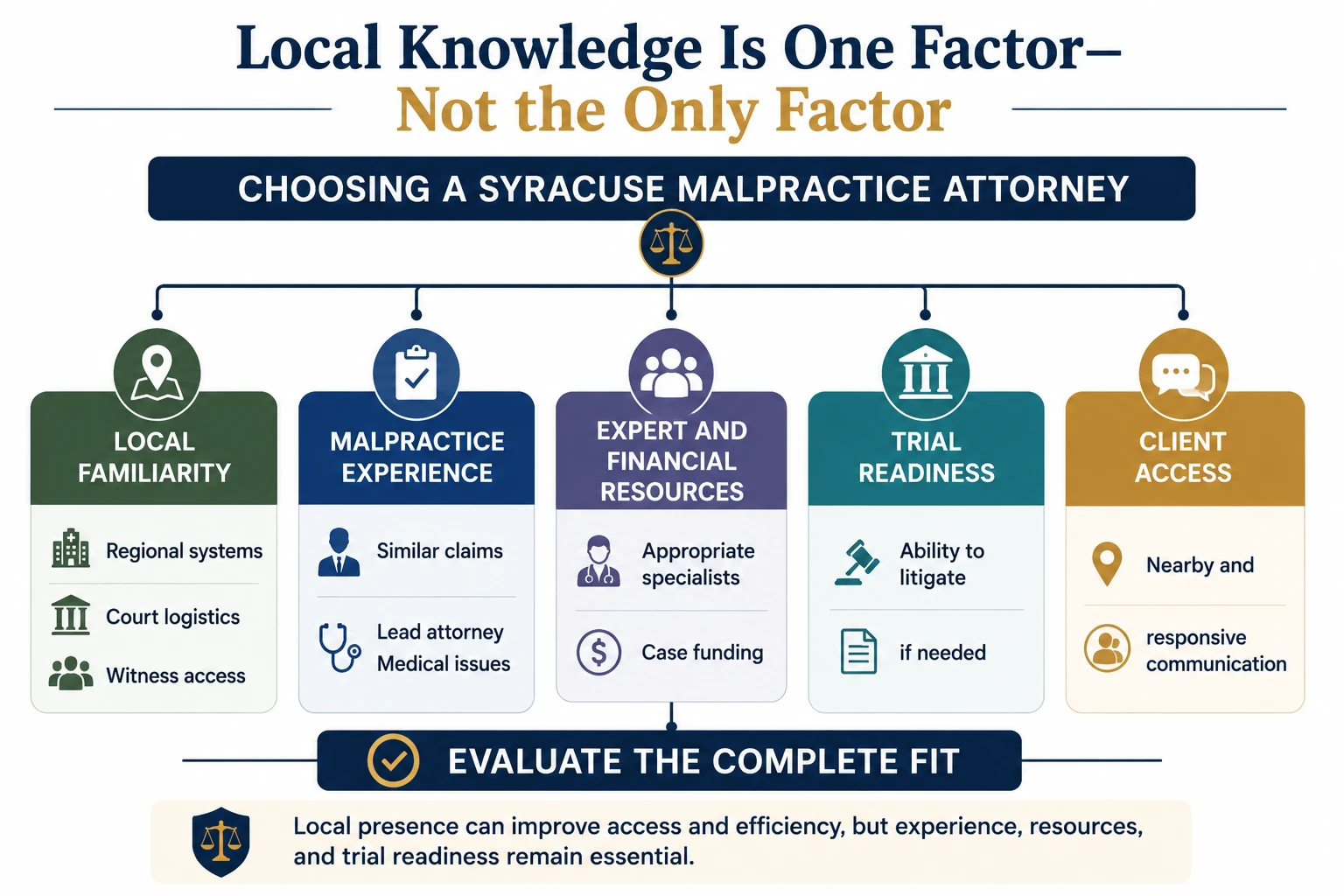
Local presence can improve access and efficiency, but experience, resources, and trial readiness remain essential.
A Syracuse-based medical malpractice attorney may offer practical advantages when the treatment, witnesses, records, and potential defendants are located in Central New York. Local counsel may be familiar with regional hospitals and healthcare systems, the courts in which a claim may proceed, local filing and scheduling practices, and the logistics involved in meeting with clients or preparing witnesses.
Locality does not establish legal ability by itself. A prospective client should still evaluate the experience of the attorney who will handle the case, the firm’s access to qualified medical experts, its capacity to advance litigation expenses, and its readiness to pursue the matter through trial.
No. A person is not generally required to hire an attorney whose office is located in Syracuse. A qualified New York attorney may be able to handle the case regardless of office location. However, local counsel may offer practical advantages involving accessibility, regional healthcare systems, court procedures, witness logistics, and familiarity with Central New York. Location should be considered together with malpractice experience, resources, communication, and trial readiness.
An attorney who has handled claims involving Central New York healthcare institutions may already understand how regional facilities organize records, use electronic health-record platforms, structure departments, and coordinate care among affiliated providers. That familiarity can help the legal team identify which records, policies, personnel, and entities may be relevant to the investigation.
However, every claim must be evaluated independently. Prior experience with a hospital does not establish that malpractice occurred in a new case. The attorney must still obtain the relevant records, consult qualified medical experts, and evaluate whether the healthcare provider departed from the accepted standard of medical care and whether that departure caused injury.
Syracuse hospital policies and procedures
Helps identify policies, procedures, and evidence that may be relevant when evaluating whether a provider departed from the accepted standard of medical care
Local electronic medical record systems
Knows what evidence to look for in the record
Track record of local providers
May recognize recurring medical, procedural, or documentation issues that have arisen in prior cases, while evaluating each new claim independently on its own facts
Local court rules and deadlines
Avoids missed deadlines and procedural dismissals
Judges’ preferences in Central New York
Tailors motions and trial strategy
Local defense lawyer tactics
Anticipates and counters defense moves
Prior verdicts and settlement outcomes
Informs settlement vs trial decisions
Experts willing to travel to Syracuse
Secures qualified testimony for trial
Community reputation
Signals seriousness to insurers and defense counsel
Local jury pool insight
Guides how the case is presented at trial
Medical malpractice cases filed in Onondaga County are governed by New York statutes, the statewide Uniform Civil Rules, court orders, and any applicable rules or practices of the assigned judge. Local experience may help counsel navigate filing systems, conference requirements, motion procedures, scheduling expectations, and communications with the court.
These procedural practices do not ordinarily change the statutory deadline for commencing a malpractice action. However, failing to comply with a court rule, scheduling order, or discovery obligation may cause delay and, depending on the circumstances, could result in sanctions, preclusion, or other adverse consequences. Competent counsel should review the rules and orders applicable to the particular case rather than relying on general familiarity alone.
Attorneys who regularly practice in the region may be familiar with the procedural requirements of local courts, commonly encountered defense firms, and the practical considerations involved in preparing a case for trial in Onondaga County. That experience may improve planning and efficiency, but it does not create preferential treatment or guarantee a particular result.
Experience litigating medical malpractice cases in Central New York may help an attorney evaluate practical issues such as local scheduling, venue, witness availability, trial logistics, and common defense issues that arise in medical malpractice litigation. Publicly reported verdicts and prior case experience may also provide context when evaluating risk.
No prior verdict or settlement determines the value or likely outcome of another case. Settlement decisions should be based on the evidence, expert opinions, legal issues, damages, available sources of recovery, litigation risk, and the client’s informed objectives. The final decision whether to accept a settlement belongs to the client.
Clients should have meaningful access to their legal team, whether meetings occur in person, by telephone, through secure video conferencing, or through another appropriate method. A nearby office can make in-person meetings more convenient, particularly when reviewing extensive records, preparing for testimony, or involving family members.
In-person contact is not required for every stage of a malpractice case. What matters is that the firm provides secure, reliable communication, explains important developments clearly, and remains accessible when significant decisions must be made. Confidential communications with counsel should occur through appropriate channels designed to protect attorney-client privilege and sensitive medical information.
Some Syracuse families value having a legal team nearby, particularly when injuries make travel difficult or when multiple family members participate in meetings. They may also value a firm’s familiarity with New York law, Central New York healthcare institutions, regional logistics, and the local community.
Other clients may prioritize a particular attorney’s experience or resources regardless of office location. The best choice is the attorney who combines relevant malpractice experience, sufficient resources, strong communication, and a representation structure that fits the client’s needs.
For more than four decades, Bottar Law has represented injured individuals and families throughout Syracuse, Central New York, and across the state. The firm meets clients at the historic Fairfield Estate at 7078 East Genesee Street in Fayetteville, serving clients throughout Syracuse and Central New York, and offers communication options designed to accommodate clients whose injuries or circumstances make travel difficult.
The firm’s local presence allows its legal team to remain accessible while bringing the malpractice-specific experience, expert resources, and litigation capacity required for complex cases.
A longstanding community presence may provide useful evidence of stability, accessibility, and professional accountability. Prospective clients can evaluate a firm’s reputation through attorney disciplinary records, verified professional profiles, client feedback, peer recognition, community involvement, and the attorney’s actual experience handling medical malpractice matters.
Reputation should not replace careful evaluation of who will handle the case, how the claim will be investigated, what resources are available, and whether the attorney is prepared to litigate through trial. Prior results and professional recognition do not guarantee a similar outcome.
Representing people in the community where the firm’s attorneys and staff live and work creates a strong sense of responsibility. Medical negligence can affect an injured patient’s health, employment, family, and long-term independence. Helping clients understand their rights and seek accountability through the civil justice system is meaningful work.
In some circumstances, a malpractice claim may also bring attention to disputed practices or contribute to broader institutional review, although no nonmonetary outcome can be guaranteed.
If you believe a Syracuse-area hospital or healthcare provider may have caused a serious injury, you do not need to determine on your own whether malpractice occurred. A medical malpractice attorney can review the timeline, identify relevant providers and records, evaluate filing deadlines, and arrange for qualified medical-expert review when appropriate.
The central questions are whether the provider departed from the accepted standard of medical care and whether that departure caused or was a substantial factor in causing the injury. Because important deadlines may apply, potential claims should be evaluated promptly.
Use this checklist to evaluate any firm before you sign with them:
Local experience may improve procedural familiarity and efficiency, but it does not create preferential treatment or determine the outcome.
Medical malpractice requires specialized experience, expert review, substantial resources, and familiarity with medical and legal causation.
Office location alone does not determine competence. The attorney must be admitted, qualified, properly resourced, and capable of handling the case.
Prior experience with a hospital does not establish negligence in a new case. The records and facts must be independently evaluated by qualified experts.
Clients should evaluate the assigned attorney, experience, resources, communication, trial readiness, and representation structure.
Settlement depends on liability evidence, causation, damages, insurance, litigation risk, and the parties’ decisions, not merely office location.
Local presence can improve access and efficiency, but experience, resources, and trial readiness remain essential.

Michael Bottar is a nationally recognized New York medical malpractice and personal injury attorney and the founder of Bottar Law. Throughout his career, he has dedicated his practice to representing individuals and families affected by medical negligence, catastrophic injuries, wrongful death, and other serious acts of negligence. Michael is committed to helping clients understand their legal rights, navigate the complexities of the legal system, and pursue accountability with compassion, integrity, and unwavering advocacy.
For more than 40 years, Bottar Law has represented individuals and families throughout Syracuse, Central New York, and across New York in complex medical malpractice litigation involving catastrophic injuries and wrongful death. Through educational resources like these FAQs, Michael Bottar and the Bottar Law team strive to provide clear, reliable information to help injured individuals and their families make informed decisions during difficult times. Prior results do not guarantee a similar outcome.
Speak with Bottar Law about what actually matters for your case.