 Call833-268-8277

Learn the qualities that actually matter, from experience and expert access to communication and trial readiness.
Attorney reviewed · New York focused · Updated resource
Evaluate the complete attorney and team who will actually handle your case.
A good New York medical malpractice attorney combines substantial malpractice-specific experience with the ability to understand complex medical evidence, work effectively with qualified experts, finance a demanding investigation, communicate clearly, and prepare the case for trial when necessary. Before commencing most malpractice actions, counsel generally must review the facts with an appropriately qualified physician and execute the certificate required by New York law. The attorney should evaluate both departure from the accepted standard of medical care and causation, discuss uncertainties honestly, explain fees and expenses in writing, and avoid guaranteeing a result. Prior verdicts, awards, firm size, and reputation may provide context, but they should not replace an evaluation of the attorney and team who will actually handle the claim.
A strong medical malpractice attorney regularly handles medical negligence claims and understands the medical, evidentiary, procedural, and financial demands those cases create. Relevant capabilities include reviewing extensive medical records, reconstructing treatment timelines, identifying appropriate medical specialties, consulting qualified experts, conducting depositions, addressing complex motions, evaluating damages, and preparing technical evidence for trial.
Professional qualities also matter. The attorney should communicate clearly, exercise sound judgment, acknowledge uncertainty, treat clients with compassion, and remain prepared to make difficult strategic decisions. No single verdict, award, title, or personality trait establishes that a lawyer is the right choice for a particular claim.
The most important qualities include malpractice-specific experience, medical and legal judgment, access to appropriately qualified experts, sufficient litigation resources, trial readiness, clear communication, integrity, and compassion. A strong attorney should be able to explain how the claim will be investigated, identify the legal and medical questions that require expert analysis, and discuss both favorable and unfavorable evidence.
Professional leadership, teaching, publications, peer recognition, and prior results may provide additional context, but none guarantees competence in a particular case or predicts its outcome. Prospective clients should focus on the qualifications and conduct of the attorney and team who will actually handle the matter.
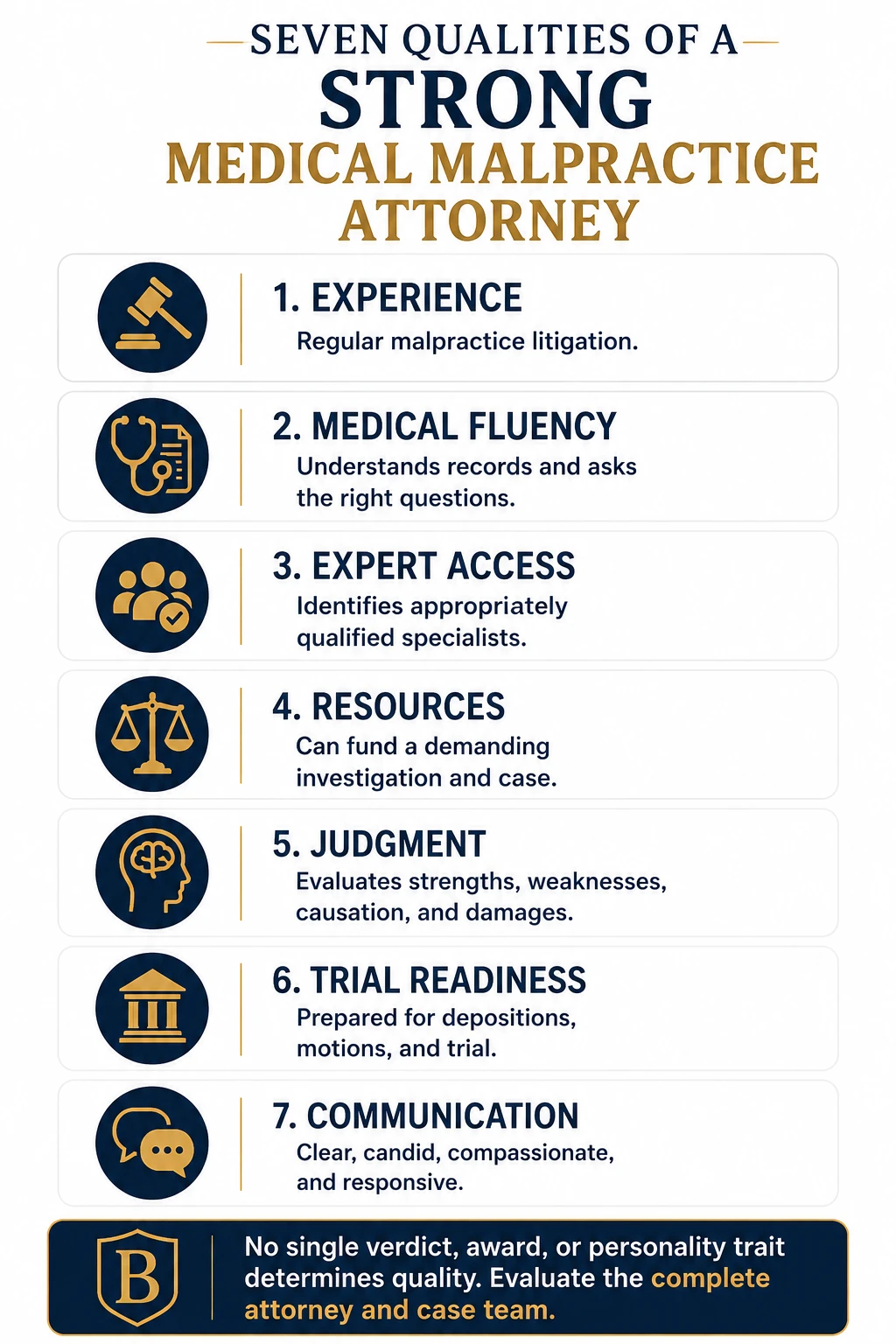
No single verdict, award, or personality trait determines quality. Evaluate the complete attorney and case team.
Medical malpractice claims present different medical, evidentiary, insurance, and procedural issues from many other personal injury matters. Liability commonly depends on qualified expert analysis of the accepted standard of medical care and whether an alleged departure caused or was a substantial factor in causing injury. The case may involve extensive medical records, multiple specialties, complex causation disputes, specialized pleading requirements, lengthy discovery, and substantial litigation expenses.
The attorney should understand how professional liability insurance, expert disclosure, healthcare-provider testimony, credentialing evidence, institutional records, and trial preparation may affect the claim. General personal injury experience can be valuable, but it does not automatically establish the malpractice-specific experience required for a complex medical negligence case.
Some professional-liability policies may give the insured healthcare provider rights concerning settlement, while others may provide the insurer with greater settlement authority. The applicable policy language and circumstances should be reviewed rather than assumed.
A prospective client cannot be expected to test an attorney’s medical knowledge directly. Instead, evaluate how the lawyer approaches the medical questions. The attorney should ask detailed questions, identify the relevant providers and treatment periods, explain which records are needed, distinguish preliminary concerns from supported conclusions, and describe how appropriately qualified experts will be selected.
After sufficient investigation, the attorney should be able to explain the medical theory in understandable language and identify the relationship among the alleged departure, causation, injury, and damages. A lawyer should understand the medicine well enough to work effectively with experts, but should not attempt to replace qualified medical judgment.
Qualified medical experts are central to most New York medical malpractice claims. Before commencing most medical malpractice actions, the plaintiff’s attorney generally reviews the facts, consults an appropriately qualified physician to determine whether there is a reasonable basis for the action, and executes the certificate of merit required by CPLR 3012-a, subject to the limited statutory exceptions.
During the case, experts may help counsel interpret records, evaluate the accepted standard of medical care, analyze causation and prognosis, identify additional evidence, prepare for depositions, address dispositive motions, and present technical issues at trial. Expert review must remain objective. A qualified expert may conclude that the evidence supports the claim, that additional information is needed, or that the available evidence does not establish malpractice.
A good attorney should provide candid advice, consistent communication, careful preparation, and clearly defined responsibility throughout the case. Clients should understand who serves as lead counsel, which team members handle routine work, how material developments will be communicated, and when strategic decisions require the client’s informed input.
The attorney should explain delays, discuss weaknesses as well as strengths, prepare the client for testimony and major case stages, and avoid creating false expectations. Persistence matters, but it should be guided by evidence, expert analysis, professional judgment, and the client’s informed objectives.
Communication is essential because medical malpractice matters often involve extended periods of record collection, expert review, discovery, motion practice, and court scheduling. Some stages may progress quickly, while others may take substantial time depending on the facts, parties, venue, and complexity of the medical issues.
Before retention, the firm should explain who provides routine updates, how urgent questions are escalated, when the lead attorney becomes directly involved, and how significant decisions will be discussed. Clients should also keep counsel informed of changes in treatment, health, employment, or other circumstances that may affect the claim or damages.
The biggest fear injured patients carry is choosing the wrong attorney and losing time they cannot get back. These signs make that decision easier.
Attorney guarantees a settlement, verdict, or specific recovery
Serious warning sign because no outcome can be guaranteed
Attorney concludes malpractice occurred before reviewing sufficient records
The evaluation may be premature
Firm cannot explain how qualified experts are identified
Weak or unclear investigation process
Responsibility for lead counsel is unclear
Uncertainty about who controls strategy and client advice
Fee and expense terms are not explained in writing
Insufficient financial transparency
Attorney explains the medicine and legal theory clearly after adequate review
Strong communication and issue comprehension
Firm discusses both strengths and potential weaknesses
Candid, evidence-based evaluation
Attorney has relevant malpractice litigation and trial experience
Greater preparation for complex procedural and evidentiary issues
Communication responsibilities and update procedures are defined
More predictable client service
Firm has sufficient resources to obtain records, retain experts, and prepare the claim
Capacity to pursue a resource-intensive matter
Integrity, preparation, sound judgment, compassion, confidence, humility, patience, and clear communication can all strengthen the attorney-client relationship. Those qualities should be demonstrated through conduct: listening carefully, explaining uncertainty, responding candidly, respecting the client’s decisions, meeting deadlines, preparing thoroughly, and avoiding promises about the outcome.
Personal compatibility matters because malpractice litigation can involve sensitive medical information, difficult testimony, and important decisions over an extended period.
A strong malpractice attorney combines relevant experience with disciplined case evaluation, appropriately qualified experts, sufficient resources, careful preparation, and the ability to explain complex issues clearly. The attorney should recognize both strong and weak evidence, develop a litigation strategy that fits the particular claim, and remain prepared to proceed to trial when appropriate.
Prior results and case volume may provide context, but they do not prove competence in every medical specialty or predict the outcome of a new claim. The attorney’s judgment, conduct, transparency, and handling of the specific case remain more important.
Use this checklist while you research and interview a potential attorney:
Schedule a consultation with an attorney who regularly handles New York medical malpractice claims. Be prepared to discuss the treatment, injury, providers, timeline, and records already available. Ask how the matter would be investigated, who would lead the case, how qualified experts are selected, and how fees and expenses are handled.
If another firm declined the claim, ask whether the attorney can explain the reason. A prior rejection does not always determine how another firm will evaluate the matter, but it also does not establish that the claim has merit. Because filing deadlines may apply, additional consultations should not cause unnecessary delay.
Prior results provide context but do not identify who will handle the case or predict its outcome.
Medical malpractice commonly requires specialized medical, evidentiary, procedural, and expert-related experience.
Responsible evaluation generally requires medical records, a treatment timeline, and appropriately qualified medical consultation.
Sound judgment includes objectively evaluating whether the evidence, causation, damages, deadlines, and resources support proceeding.
Expert consultation generally follows sufficient factual and record review.
No ethical or credible attorney can guarantee a settlement, verdict, or specific amount.
No single verdict, award, or personality trait determines quality.

Michael Bottar is a nationally recognized New York medical malpractice and personal injury attorney and the founder of Bottar Law. Throughout his career, he has dedicated his practice to representing individuals and families affected by medical negligence, catastrophic injuries, wrongful death, and other serious acts of negligence. Michael is committed to helping clients understand their legal rights, navigate the complexities of the legal system, and pursue accountability with compassion, integrity, and unwavering advocacy.
For more than 40 years, Bottar Law has represented individuals and families throughout Syracuse, Central New York, and across New York in complex medical malpractice litigation involving catastrophic injuries and wrongful death. Through educational resources like these FAQs, Michael Bottar and the Bottar Law team strive to provide clear, reliable information to help injured individuals and their families make informed decisions during difficult times. Prior results do not guarantee a similar outcome.
Speak with Bottar Law and ask the questions that actually matter.