 Call833-268-8277

The questions that help you evaluate experience, investigation process, communication, and fees before you hire an attorney.
Attorney reviewed · New York focused · Updated resource
You’re evaluating the attorney just as much as they’re evaluating your case.
Choosing the right medical malpractice lawyer begins with asking the right questions. You should ask about the attorney’s experience handling medical malpractice cases, how the firm investigates potential claims, whether it works with qualified medical experts, how often you can expect communication, who will handle your case, what the process looks like, and how fees and costs are paid. The answers will help you determine whether the attorney has the experience, resources, and approach that fit your needs.
After suffering a serious medical injury, it is normal to feel overwhelmed. Most people have never hired a medical malpractice lawyer before, and they are unsure what separates one attorney from another. At the same time, they may be coping with ongoing medical treatment, lost income, and uncertainty about the future. Knowing what questions to ask can help you make an informed decision during an already difficult time.
Medical malpractice is one of the most complex areas of civil litigation. Successfully pursuing a claim requires more than knowing the law. It requires understanding medicine, working with highly qualified medical experts, navigating New York’s procedural requirements, and presenting complicated medical issues in a way judges and juries can understand. Not every personal injury attorney has the experience or resources necessary to handle these cases.
Your initial consultation is an opportunity to learn how an attorney approaches medical malpractice litigation and whether you feel comfortable placing your trust in that firm. Beyond discussing the facts of your potential case, you should understand how the investigation will proceed, who will be working on your case, how often you will receive updates, and what you can realistically expect throughout the process.
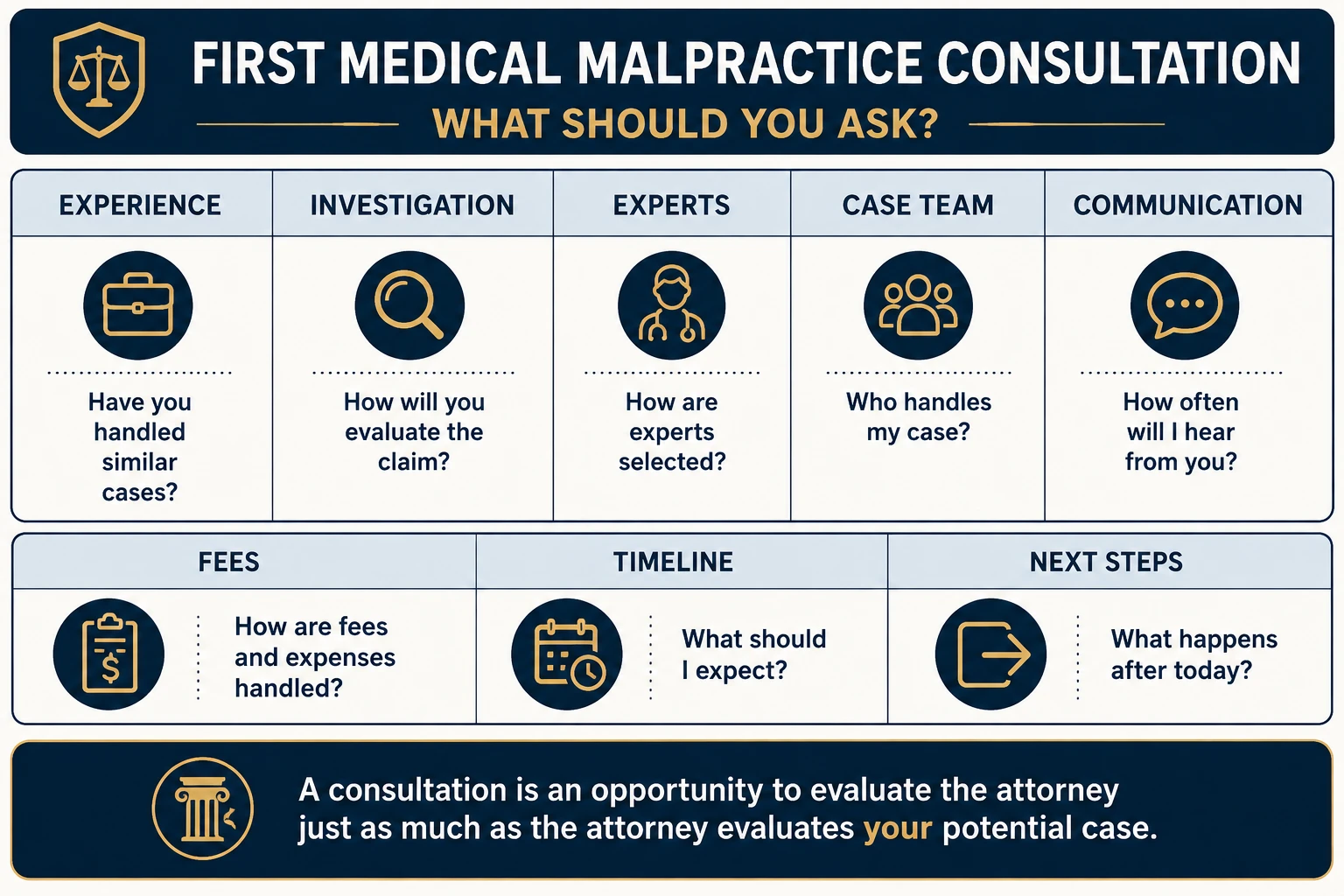
A consultation is an opportunity to evaluate the attorney just as much as the attorney evaluates your potential case.
Medical malpractice is unlike any other area of personal injury law. It requires a thorough understanding of both medicine and the legal standards that govern healthcare providers. An attorney handling these cases should have extensive experience investigating medical records, working with qualified medical experts, taking depositions of physicians and nurses, and presenting complex medical evidence in a way that judges and juries can understand.
Just as importantly, the lawyer should have experience taking malpractice cases through trial. While many claims resolve through settlement, insurance companies know which law firms are prepared to try a case if necessary. That experience often shapes how a case is evaluated from the very beginning.
Medical malpractice also involves unique procedural requirements that do not exist in most other personal injury cases. When asking about experience, the goal is not simply to learn how many cases the attorney has handled. It is to understand whether the lawyer regularly evaluates complex medical issues, works with qualified experts, prepares malpractice cases for trial when appropriate, and has experience with claims involving medical circumstances similar to yours. Throughout the litigation, expert testimony is ordinarily required to establish that the healthcare provider departed from the accepted standard of medical care and that the departure caused or was a substantial factor in causing the patient’s injuries.
Experience matters because every decision, from identifying the appropriate medical experts to determining which records require closer review, can influence the outcome of a case. An attorney who regularly handles medical malpractice claims is more likely to recognize issues that may otherwise be overlooked.
Not every personal injury lawyer regularly handles medical malpractice cases. Some firms primarily focus on automobile accidents, construction accidents, or other injury claims and accept only an occasional malpractice matter.
There is nothing inherently wrong with having a broad practice, but medical malpractice litigation is exceptionally demanding. These cases involve thousands of pages of medical records, complicated scientific issues, extensive expert testimony, and aggressive defense lawyers retained by medical malpractice insurance companies.
When meeting with an attorney, ask how much of the firm’s practice is devoted to medical malpractice and how often they litigate these cases. A lawyer who regularly represents injured patients is more likely to stay current on developments in medicine, changes in New York law, and the strategies used by healthcare providers and their insurers.
At Bottar Law, representing patients harmed by preventable medical errors has been a central part of the firm’s practice for more than four decades. That focused experience allows the legal team to identify important issues quickly, explain complicated medical concepts clearly, and guide clients through a process that often feels overwhelming.
Ask whether the attorney who meets with you will also serve as lead counsel if the case is accepted, or whether responsibility may later be transferred to another lawyer within the firm.
Your first meeting should leave you feeling informed, not pressured. The consultation is an opportunity for you to evaluate the attorney just as much as the attorney is evaluating your case. Some helpful questions include:
Have you handled cases involving injuries similar to mine?
Relevant experience
Who will handle my case day to day?
Case ownership
Who is lead counsel?
Primary responsibility for managing the litigation and advising on strategy, while recognizing that major decisions, such as whether to accept a settlement, remain the client’s
How will you determine whether malpractice occurred?
Investigation process
What records will you need?
Evidence gathering
How are qualified experts selected?
Expert evaluation
What happens if experts disagree?
Objective assessment
How often should I expect updates?
Communication
How are fees and expenses handled?
Financial clarity
What happens after today’s consultation?
Next steps
Pay attention not only to the answers, but also to how they are delivered. Does the attorney take time to explain the process? Are your questions welcomed? Do you feel listened to?
A medical malpractice claim may take several years to resolve. Choosing an attorney is about more than credentials, it is about finding someone you trust to guide you through one of the most difficult experiences of your life.
A medical malpractice lawyer does not need to be a physician, but they do need to understand how medicine works.
An experienced attorney should also explain where legal judgment ends and qualified medical expertise begins. A lawyer should understand the medical issues well enough to ask the right questions and identify the appropriate experts, rather than attempting to replace medical expertise.
One sign of experience is the ability to explain complicated medical issues in plain English. If an attorney cannot clearly explain why a healthcare provider may have violated the standard of care, it will be difficult to present that case to an insurance company, judge, or jury.
At Bottar Law, every case begins with careful review of the available medical information. The firm’s legal team works closely with physicians and other healthcare professionals to understand what happened, why it happened, and whether the healthcare provider departed from the accepted standard of medical care. That collaborative approach allows clients to receive straightforward answers based on medicine, not speculation.
A thorough investigation is the foundation of every successful medical malpractice case. Before hiring an attorney, ask how the firm approaches that investigation. For example, you may want to ask:
The answers can tell you a great deal about how the firm prepares cases.
Medical experts are not hired simply to support a lawsuit. Their role is to determine whether healthcare providers departed from the accepted standard of medical care and whether any failures caused injury. An experienced law firm understands that objective evaluation benefits everyone involved. Qualified experts may also conclude that the accepted standard of medical care was not violated. A credible attorney should explain that expert review is intended to objectively evaluate the claim rather than confirm assumptions.
At Bottar Law, the firm advances the costs associated with obtaining medical records and consulting with qualified experts. Clients are not expected to finance the investigation while they are recovering from a serious injury.
Communication is one of the most important parts of the attorney-client relationship.
Medical malpractice cases often take time because they involve extensive investigation, expert review, discovery, depositions, and motion practice. During that process, there may be times when little appears to be happening from the client’s perspective. Good communication helps eliminate uncertainty.
Ask your attorney how updates are provided, who you should contact with questions, and how quickly you can expect a response.
At Bottar Law, the legal team believes clients should understand not only what is happening, but why it is happening. The firm makes every effort to explain developments in plain language so clients can make informed decisions throughout the case.
Understanding how communication works can reduce uncertainty during a case that may involve lengthy periods of investigation, discovery, expert review, and court scheduling. Clear expectations often help clients feel more informed throughout the process.
Every client deserves honest advice, even when the answers are difficult to hear.
Be cautious if an attorney guarantees a particular outcome, promises a specific dollar amount, or claims your case is certain to succeed before reviewing the medical records. Medical malpractice cases are simply too complex for anyone to make those promises responsibly. Other warning signs may include:
A good attorney will explain both the strengths and the challenges of your case. They should be willing to tell you when additional investigation is needed before offering an opinion.
Trust is built through honesty, not promises.
Once you retain a medical malpractice attorney, the relationship shifts from an initial case evaluation to a structured legal and factual investigation. While every case is different, an experienced attorney should explain what happens next and keep you informed throughout the process.
The legal team will typically begin by obtaining and organizing the relevant medical records, developing a detailed timeline of the patient’s care, identifying the healthcare providers and facilities involved, and determining what additional information may be needed. When appropriate, qualified medical experts may be consulted to evaluate whether the care departed from the accepted standard of medical care and whether that departure caused or contributed to the patient’s injuries.
Throughout the representation, you should know who will be responsible for handling your case, how communication will occur, and when you can expect updates. Although there may be periods when little appears to be happening while records are collected or experts complete their review, your attorney should explain the purpose of each stage of the investigation and promptly communicate significant developments.
As the case progresses, your attorney should also discuss important strategic decisions, including whether additional records are needed, whether expert review supports moving forward, whether settlement discussions are appropriate, and, if necessary, how the case will be prepared for litigation or trial. Good communication includes explaining both opportunities and challenges as the case develops, rather than making promises about the outcome.
Many people delay speaking with an attorney because they worry about cost or assume they cannot afford legal representation.
During your consultation, ask how attorney’s fees are calculated, whether litigation expenses are advanced by the firm, and how those expenses are handled if there is no financial recovery.
You should also ask about the anticipated timeline. While every case is different, your attorney should explain the major stages of the process, including investigation, filing the lawsuit, discovery, depositions, expert review, settlement discussions, and, if necessary, trial.
Understanding the process in advance often makes it feel less intimidating.
At Bottar Law, clients are encouraged to ask questions throughout the representation. The goal is not simply to pursue compensation, but to help clients understand the process so they can make informed decisions every step of the way.
If you are unsure where to begin, start with the simplest question: “Can you help me understand what happened?”
That single question opens the conversation where it belongs, not with legal strategy, but with your experience.
A good medical malpractice lawyer should listen carefully, gather the necessary information, explain what the investigation involves, and tell you honestly whether additional review is needed before any conclusions can be reached.
You do not need to know whether malpractice occurred before contacting an attorney. You do not need to understand the medicine or the law. Your job is simply to tell your story.
If a preventable medical error caused serious harm, an experienced attorney can investigate the facts, consult qualified medical experts, explain your legal options, and help you decide what comes next.
That question invites the attorney to explain the investigation process rather than immediately offering conclusions about whether malpractice occurred.
If available, bring any medical records already in your possession, discharge instructions, prescription information, imaging reports, pathology reports, correspondence with healthcare providers, insurance information, photographs, and a written timeline of important events. If you do not have these materials, do not delay scheduling a consultation because an attorney can often obtain relevant records after appropriate authorizations are signed.
When practical, meeting with more than one attorney may help you compare experience, communication style, investigation methods, staffing, fee arrangements, and overall fit. However, because legal deadlines may apply, comparing firms should not unnecessarily delay seeking legal advice.
Attorneys routinely obtain records after proper authorizations are signed.
Determining whether malpractice occurred is part of the investigation.
A responsible opinion usually requires records and, when appropriate, expert review.
A consultation is an opportunity to evaluate whether the attorney is the right fit.
Many experienced medical malpractice firms work on a contingency-fee basis.
It is equally an opportunity for the prospective client to evaluate the lawyer.
A consultation is an opportunity to evaluate the attorney just as much as the attorney evaluates your potential case.

Michael Bottar is a nationally recognized New York medical malpractice and personal injury attorney and the founder of Bottar Law. Throughout his career, he has dedicated his practice to representing individuals and families affected by medical negligence, catastrophic injuries, wrongful death, and other serious acts of negligence. Michael is committed to helping clients understand their legal rights, navigate the complexities of the legal system, and pursue accountability with compassion, integrity, and unwavering advocacy.
For more than 40 years, Bottar Law has represented individuals and families throughout Syracuse, Central New York, and across New York in complex medical malpractice litigation involving catastrophic injuries and wrongful death. Through educational resources like these FAQs, Michael Bottar and the Bottar Law team strive to provide clear, reliable information to help injured individuals and their families make informed decisions during difficult times. Prior results do not guarantee a similar outcome.
Speak with Bottar Law and come with the questions that matter most.