 Call833-268-8277

Understand how New York’s comparative-fault rule actually works, and why blame alone isn’t enough to defeat a claim.
Attorney reviewed
New York focused
Updated resource
New York’s comparative-fault rule may reduce damages, but it rarely eliminates them entirely.
Being blamed for your medical condition does not automatically prevent you from pursuing a New York medical malpractice claim. Under New York’s comparative-fault rule, patient conduct that contributed to the injury may reduce recoverable damages in proportion to the patient’s share of responsibility, but it generally does not bar recovery entirely. The defendant must identify and prove the allegedly culpable conduct. The investigation should distinguish between conduct that merely created the medical condition requiring treatment and conduct that actually caused or worsened the injury resulting from the alleged malpractice. Counsel and qualified medical experts evaluate the records, instructions, communications, treatment timeline, departure from the accepted standard of medical care, and causation.
A provider or insurer may point to delayed treatment, missed appointments, medication use, incomplete medical history, lifestyle factors, or failure to follow instructions. Those allegations must be evaluated in context. The relevant question is not simply whether the patient could have acted differently. It is whether the alleged conduct was unreasonable under the circumstances and whether it caused or contributed to the specific injury or damages at issue.
The allegation alone does not automatically defeat the claim. The provider or insurer may contend that the patient delayed seeking care, did not follow instructions, missed appointments, failed to disclose relevant information, or otherwise contributed to the outcome. Each contention must be supported by evidence and connected causally to the claimed injury.
The investigation should separately evaluate the provider’s conduct. A patient’s actions do not excuse a healthcare provider’s departure from the accepted standard of medical care. Depending on the facts, both the provider’s departure and the patient’s conduct may be considered when responsibility and damages are evaluated.
Yes. New York follows comparative fault rather than a rule that automatically bars recovery whenever a patient shares some responsibility. If the patient’s culpable conduct is established, the recoverable damages may be reduced by the percentage of responsibility assigned to the patient.
For example, if total damages were determined to be $1 million and the patient were found 20 percent responsible, the recoverable amount could be reduced by that percentage, subject to the other legal and factual issues in the case. This is only an illustration; actual fault and damages must be determined from the evidence.
Under CPLR 1411, culpable conduct by the patient generally does not bar recovery. Instead, damages otherwise recoverable may be reduced in proportion to the patient’s assigned share of fault. Under CPLR 1412, the party asserting comparative fault must plead and prove that defense.
A defendant, therefore, must do more than suggest that the patient made imperfect choices. The evidence must support the relevant conduct and a causal connection between that conduct and the injury or damages for which compensation is sought.
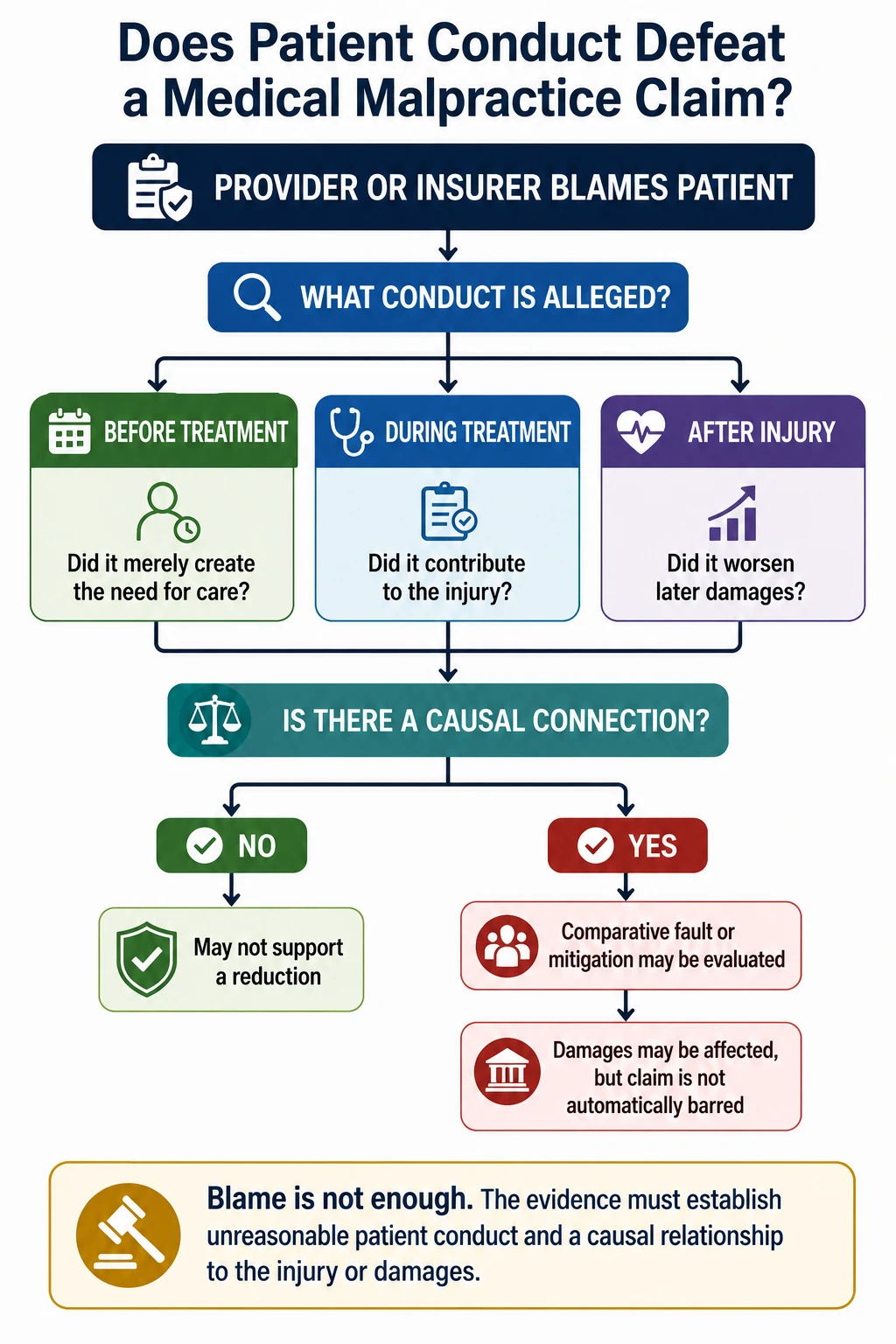
Blame is not enough. The evidence must establish unreasonable patient conduct and a causal relationship to the injury or damages.
Not automatically. Conduct that merely created the condition for which the patient sought medical treatment is different from conduct that contributed to the harm caused by the alleged malpractice. For example, a patient’s prior health choices or delay before entering treatment may explain why care was needed, but they do not necessarily reduce recovery for a provider’s later failure to diagnose or treat appropriately.
New York appellate authority has recognized that a comparative-negligence instruction should not be given when the patient’s alleged negligence preceded the malpractice and did not otherwise contribute to the harm resulting from that malpractice. The specific timing and causal relationship must be evaluated carefully.
Healthcare providers may argue that a patient delayed seeking treatment, did not follow discharge instructions, missed follow-up appointments, failed to take prescribed medications, or did not fully disclose important medical information.
While these issues may become part of the discussion, they do not automatically excuse negligent medical care. A thorough investigation is necessary to determine whether the healthcare provider fulfilled their own responsibilities under the accepted standard of care.
Delayed seeking treatment
What symptoms existed, what did the patient reasonably understand, and did the delay cause the injury attributed to malpractice?
Missed appointment
Was the appointment medically important, was its importance communicated, why was it missed, and did the absence change the outcome?
Medication not taken as directed
Were instructions clear, were side effects or access barriers reported, and did nonuse cause or worsen the claimed harm?
Incomplete medical history
What information was omitted, was the patient asked clearly, was it material to treatment, and did the omission affect the outcome?
Failure to follow discharge instructions
Were instructions understandable and feasible, were warning signs explained, and did the alleged noncompliance contribute to additional injury?
Lifestyle or preexisting condition
Did the condition merely create the need for treatment, or did the patient’s conduct independently contribute to the malpractice-related injury?
Failure to obtain follow-up care
Did the provider arrange and communicate follow-up appropriately, and what harm remained preventable at that stage?
An allegation about patient conduct matters only when the evidence supports both the conduct and its causal relationship to the claimed injury or damages.
Comparative fault generally concerns conduct that contributed to causing the injury. Failure to mitigate concerns conduct after an injury that allegedly allowed the harm or damages to become worse.
For example, a defendant may argue that a patient contributed to an initial injury by disregarding clearly communicated treatment instructions, or separately argue that the patient failed to limit later damages by unreasonably refusing recommended care. The timing, reasonableness, medical evidence, and causal effect of the conduct must be evaluated.
Yes. A complete review may show that the patient repeatedly reported symptoms, followed the instructions that were actually provided, requested additional evaluation, or lacked information needed to appreciate the urgency of the condition. The records may also reveal delayed testing, uncommunicated results, incomplete follow-up instructions, or failures to respond to documented concerns.
Conversely, the evidence may support some portion of the provider’s argument. A credible investigation should evaluate both possibilities rather than assuming either that the patient caused the outcome or that the patient’s conduct was irrelevant.
Medical records provide contemporaneous evidence concerning symptoms, test results, instructions, provider observations, treatment decisions, appointments, communications, and follow-up. They may not capture every conversation or event, so portal messages, pharmacy records, photographs, personal notes, witness accounts, telephone records, and later treatment records may also be relevant.
Qualified medical experts evaluate whether the provider departed from the accepted standard of medical care and whether that departure caused injury. Experts may also assess whether alleged patient conduct medically affected the outcome. Counsel then evaluates the complete record and the applicable legal rules, including comparative fault and damages.
Many medical malpractice cases involve situations where patients or family members reported symptoms, expressed concerns, or requested additional evaluation, but those concerns were not fully addressed. If important warning signs were ignored or appropriate follow-up care was not provided, those facts may be relevant when evaluating whether the provider departed from the accepted standard of medical care and whether that departure caused or was a substantial factor in causing the patient’s injuries.
The best way to determine whether those concerns affected the outcome is through a careful review of the medical records and expert analysis. Relevant evidence may include triage notes, portal messages, telephone logs, repeated appointments, symptom descriptions, requests for testing, and instructions given in response.
After a serious medical event, many people wonder whether they should have acted sooner, asked different questions, or insisted on additional testing. Those feelings are understandable, especially when the outcome has been life changing.
Patients often place tremendous trust in their healthcare providers and rely on their training and judgment. If something goes wrong, it is natural to question yourself. A careful legal and medical investigation can help determine whether the injury resulted from unavoidable circumstances or from preventable medical negligence.
The legal evaluation should separate understandable hindsight from conduct that was actually unreasonable and causally related to the injury. Patients are not expected to diagnose themselves or independently know when specialized testing or treatment is required.
Bottar Law may reconstruct the treatment chronology, review the instructions actually provided, examine appointments and follow-up efforts, identify symptoms reported by the patient, and compare the patient’s conduct with the provider’s documented responsibilities. The investigation may include medical records, portal messages, prescription records, telephone logs, discharge materials, witness information, and subsequent treatment.
Qualified medical experts may evaluate whether the provider departed from the accepted standard of medical care, whether the alleged patient conduct medically affected the outcome, and what portion of the injury remained preventable. Counsel then analyzes whether a comparative-fault or mitigation argument is supported and how it may affect the potential claim.
The objective is not to assume that either side is entirely responsible, but to determine what the medical evidence and applicable law support.
Do not assume that the allegation ends your legal rights. Preserve the records and communications already available, including discharge instructions, portal messages, prescription information, appointment records, and notes concerning symptoms or conversations. Do not alter or delete potentially relevant information.
Consult a New York medical malpractice attorney without unnecessary delay. Counsel can evaluate the provider’s care, the patient-conduct allegation, causation, comparative fault, damages, and applicable filing deadlines. An initial consultation does not require you to decide whether a lawsuit should be filed.
Under comparative fault, proven patient conduct generally reduces damages proportionally rather than automatically barring recovery.
A provider may still be responsible if negligent medical care worsened the patient’s condition or caused additional injury, even when the patient had a preexisting medical condition.
The importance of the appointment, instructions, reason for the absence, and causal effect must be evaluated.
Patients rely on healthcare professionals to evaluate symptoms and recommend appropriate testing and treatment.
Records are important but may be incomplete; other communications and evidence may also matter.
Investigation and expert review are used to evaluate the allegation.
Blame is not enough. The evidence must establish unreasonable patient conduct and a causal relationship to the injury.

Michael Bottar is a nationally recognized New York medical malpractice and personal injury attorney and the founder of Bottar Law. Throughout his career, he has dedicated his practice to representing individuals and families affected by medical negligence, catastrophic injuries, wrongful death, and other serious acts of negligence. Michael is committed to helping clients understand their legal rights, navigate the complexities of the legal system, and pursue accountability with compassion, integrity, and unwavering advocacy.
For more than 40 years, Bottar Law has represented individuals and families throughout Syracuse, Central New York, and across New York in complex medical malpractice litigation involving catastrophic injuries and wrongful death. Through educational resources like these FAQs, Michael Bottar and the Bottar Law team strive to provide clear, reliable information to help injured individuals and their families make informed decisions during difficult times. Prior results do not guarantee a similar outcome.
Speak with Bottar Law about whether the allegation actually holds up.