 Call833-268-8277

Understand when emotional harm may be recoverable in a New York medical-malpractice case, and how the rules differ for patients and family members.
Attorney reviewed · New York focused · Updated resource
The legal basis depends on whose emotional harm is involved and whether a physical injury also occurred.
Yes, emotional distress may be recoverable in a New York medical-malpractice case, but the legal basis depends on whose emotional harm is involved and whether the patient also suffered a physical injury. A patient may generally seek damages for emotional suffering that accompanies a malpractice-related physical injury. Claims based only on emotional harm, or claims brought by relatives who witnessed harm to someone else, are more limited and require additional legal conditions. Emotional distress alone does not automatically create a malpractice claim.
Medical negligence can affect far more than a patient’s physical health. It may cause fear, depression, anxiety, trauma, loss of confidence, sleep disturbance, and lasting changes in daily life. Whether those effects are legally compensable depends on the relationship between the emotional harm, the medical negligence, and any physical injury.
New York law treats emotional harm differently depending on whether it is suffered directly by the patient, accompanies a physical injury, arises without physical injury, or is claimed by a family member. An attorney must evaluate the specific legal category rather than assuming all emotional distress is recoverable in the same way.
Yes. When medical negligence causes a physical injury, the injured patient may generally seek compensation for the emotional suffering associated with that injury as part of pain-and-suffering damages. Depending on the circumstances, that emotional suffering may include anxiety, depression, psychological trauma, fear, sleep disturbance, embarrassment, and loss of enjoyment of life.
A claim based solely on emotional harm, without a related physical injury, is more legally complex. Whether such a claim is legally recognized depends on the specific facts and applicable legal principles. The claimant must establish the required legal elements, including an applicable duty, a breach of that duty, causation, and reliable evidence demonstrating that the emotional injury has caused significant emotional harm.
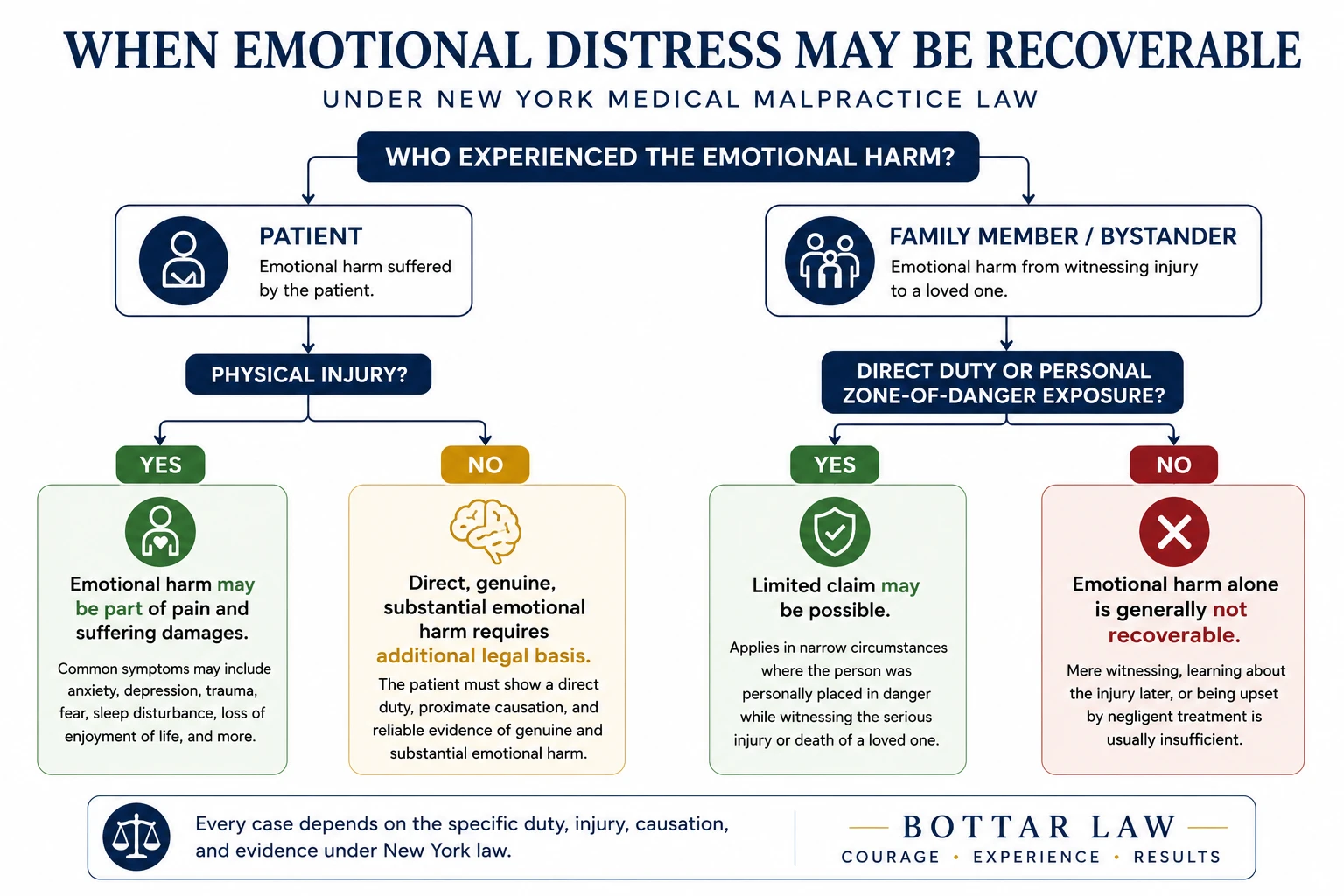
Every case depends on the specific duty, injury, causation, and evidence under New York law.
Emotional harm becomes legally significant when the evidence establishes that it was caused by medical negligence and is more than ordinary disappointment, worry, or temporary emotional upset. When emotional distress is part of a medical malpractice claim, it is evaluated in light of the underlying negligence, the resulting injuries, and the evidence supporting its impact on the patient’s life.
Relevant considerations may include:
No single factor determines whether emotional harm is legally significant. Each case depends on its specific facts and the available evidence.
Sometimes, but such claims are limited under New York law.
In certain circumstances, New York law may recognize claims involving direct emotional harm even without a related physical injury. Whether such a claim is legally viable depends on the particular duty owed to the claimant, whether that duty was breached, whether the emotional injury was a direct and foreseeable result of the breach, and whether reliable evidence demonstrates that the emotional harm is genuine and substantial.
At the same time, New York courts have rejected certain claims seeking recovery for purely emotional harm where there was no qualifying physical injury or other independent legal basis for recovery.
Because the viability of a claim based solely on emotional distress depends heavily on the specific facts, the legal duty involved, and the applicable law, it should be evaluated by an experienced medical malpractice attorney rather than treated as an automatic extension of every malpractice claim.
When emotional distress is part of a legally viable medical malpractice claim, the evidence is evaluated to understand the nature, extent, and impact of the patient’s emotional suffering. This evaluation is separate from the legal question of whether the healthcare provider is responsible for the injury in the first place.
The following types of evidence may help document emotional harm:
Medical records
Physical injury, treatment course, symptoms, and prognosis
Mental health records
Diagnosis, counseling or therapy, medication, and the progression of psychological symptoms
Testimony from the patient
The effects of the injury on daily life, including fear, sleep disturbance, psychological trauma, and changes in functioning
Family or caregiver testimony
Observable changes in behavior, personality, relationships, and daily activities
Employment or school records
Missed time, reduced performance, accommodations, or an inability to carry out normal responsibilities
Expert opinion
Causation, psychological diagnosis, expected duration of symptoms, and potential future emotional or psychological effects
This evidence may help document the nature and severity of emotional harm, but it does not, by itself, establish that the healthcare provider is legally responsible for it. Liability depends on whether the required legal elements of a medical malpractice claim are established under New York law.
A patient may be able to recover damages for anxiety, psychological trauma, depression, fear, and other forms of emotional suffering when those injuries are legally connected to medical malpractice. When emotional suffering accompanies a physical injury caused by medical negligence, it is commonly evaluated as part of pain-and-suffering damages.
Grief experienced after the injury or death of a family member is treated differently under New York law. New York generally does not permit a family member to recover emotional-distress damages solely because medical negligence harmed someone else. Instead, wrongful-death claims generally focus on pecuniary losses, subject to the law in effect when the claim is evaluated.
Because the legal rules governing emotional-distress damages vary depending on who suffered the injury and the nature of the claim, an experienced medical malpractice attorney can evaluate how New York law applies to the specific facts of a case.
Claims brought by family members are generally more limited than claims brought by the injured patient. In New York, a family member typically must have an independent legal basis for seeking emotional-distress damages, such as a duty owed directly to that individual or, in limited circumstances, a qualifying claim under the state’s zone-of-danger rule.
Under the zone-of-danger rule, a person who was personally threatened with bodily harm may, in limited circumstances, recover for emotional distress arising from witnessing the serious injury or death of an immediate family member. Merely learning about the injury afterward, or observing negligent medical care without being personally endangered, is generally not enough to support such a claim.
Because these claims are highly fact-specific, an experienced medical malpractice attorney can evaluate whether New York law recognizes an independent basis for recovery under the particular circumstances.
Emotional harm may become a significant component of a medical malpractice claim when it is legally connected to the underlying negligence and supported by the available evidence. Examples may include:
These examples are provided for illustrative purposes only. Whether emotional damages are recoverable depends on the specific facts of the case, the available medical evidence, and the applicable legal basis for recovery under New York law.
It is not uncommon for patients to experience significant emotional distress before the full consequences of a medical error are understood. Learning that a serious mistake may have occurred, undergoing additional testing, facing uncertainty about a diagnosis, or anticipating further treatment can all be emotionally overwhelming.
The timing of emotional symptoms may be relevant, but the evidence must establish that the emotional distress was caused by the actionable medical negligence rather than solely by the underlying illness, the uncertainty that commonly accompanies medical treatment, or another unrelated condition.
When emotional distress is legally connected to medical malpractice, it may become an important part of understanding the overall impact of the injury. Determining that connection requires a careful review of the medical records, the patient’s clinical course, and the available medical and other evidence.
Medical records, mental health records, counseling records, therapy notes, and expert opinions may all help document the nature and extent of emotional harm following medical negligence. Together with testimony from the injured individual and other witnesses, they can provide a more complete understanding of how the emotional injury has affected the person’s life.
Depending on the circumstances, this evidence may help establish:
Qualified medical and mental health experts may also offer opinions regarding diagnosis, causation, prognosis, and the relationship between the patient’s emotional condition and the alleged medical negligence, when appropriate.
The absence of formal counseling or therapy does not necessarily mean that emotional harm did not occur. However, professional evaluation and treatment may provide more objective documentation of the nature, severity, and progression of emotional symptoms.
People respond to serious medical errors in different ways. The emotional effects vary depending on the individual’s experience, the nature of the injury, the available support system, and many other factors. Emotional responses may develop immediately or emerge over time.
Depending on the circumstances, a patient may experience:
Experiencing one or more of these emotional effects does not, by itself, establish a medical malpractice claim or determine whether emotional-distress damages are recoverable. Each case depends on the specific facts, the available medical evidence, and the applicable legal principles under New York law.
At Bottar Law, we understand that discussing emotional trauma can be difficult. We take the time to listen carefully, answer questions honestly, and provide a supportive environment where clients can share their experiences at their own pace. Our goal is to help clients feel informed, respected, and supported while we work to understand the full impact that medical negligence has had on their lives.
When appropriate, Bottar Law may also work with qualified medical and mental health professionals to better understand the nature and extent of a client’s emotional injuries. Their opinions may help evaluate issues such as causation, the severity of emotional harm, prognosis, and the relationship between the emotional injury and the underlying medical condition or alleged medical negligence.
Every case is different. Whether expert opinions are needed depends on the specific facts, the available medical evidence, and the legal issues presented.
If you believe medical negligence caused serious emotional or physical harm, it is important to speak with an experienced New York medical malpractice attorney promptly. Early legal guidance can help you understand your rights, evaluate the available evidence, and identify any applicable legal deadlines.
If possible, preserve copies of records already in your possession that may be relevant to your situation, including:
Continue obtaining appropriate medical or mental health care based on your individual clinical needs. An experienced attorney can evaluate whether the emotional harm is part of a physical-injury medical malpractice claim, may support a separate legal theory under New York law, or is not independently recoverable based on the specific facts of the case.
Speaking with an attorney does not obligate you to file a lawsuit. It can help you better understand your legal options and make informed decisions about how to move forward.
Emotional distress alone does not establish medical malpractice. The claimant must prove the required legal elements, including an applicable duty, a departure from the accepted standard of care, causation, and legally recoverable damages.
Emotional suffering commonly accompanies a physical injury caused by medical negligence and may be recoverable as part of pain-and-suffering damages. In limited circumstances, New York law may also recognize certain direct emotional-harm claims without a related physical injury. Those claims are more limited and depend on the specific facts and applicable legal principles.
New York generally restricts claims for emotional distress brought by family members unless there is an independent legal basis for recovery, such as a duty owed directly to the claimant or another recognized legal doctrine that applies under the specific facts.
Therapy records, counseling records, and other mental health evidence may document emotional symptoms, diagnosis, and treatment. However, they do not by themselves establish that the healthcare provider legally caused the emotional harm. Causation and liability must still be established based on the evidence.
New York wrongful-death damages have traditionally focused on pecuniary losses rather than grief or sorrow alone, subject to the law in effect when the claim is evaluated.
The emotional injury must be genuine, substantial, and legally connected to the provider’s conduct.

Michael Bottar is a nationally recognized New York medical malpractice and personal injury attorney and the founder of Bottar Law. Throughout his career, he has dedicated his practice to representing individuals and families affected by medical negligence, catastrophic injuries, wrongful death, and other serious acts of negligence. Michael is committed to helping clients understand their legal rights, navigate the complexities of the legal system, and pursue accountability with compassion, integrity, and unwavering advocacy.
For more than 40 years, Bottar Law has represented individuals and families throughout Syracuse, Central New York, and across New York in complex medical malpractice litigation involving catastrophic injuries and wrongful death. Through educational resources like these FAQs, Michael Bottar and the Bottar Law team strive to provide clear, reliable information to help injured individuals and their families make informed decisions during difficult times. Prior results do not guarantee a similar outcome.
Speak with Bottar Law about whether your emotional injuries may be part of a legal claim under New York law.