 Call833-268-8277

Understand why New York does not cap malpractice damages, and what actually drives the value of a claim.
Attorney reviewed
New York focused
Updated resource
Value depends on the evidence proving injury severity, permanence, and personal circumstances.
New York does not cap damages in medical malpractice cases, so there is no fixed dollar limit on recovery. Instead, value depends on the severity and permanence of the injury, age, employment, family circumstances, and future medical needs. A major permanent injury is generally valued higher than a temporary one. The tradeoff is that the injured person must prove every element of damages, and a jury verdict can still be reduced on appeal if a court finds it materially deviates from reasonable compensation.
If you’ve read about damage caps in other states and worry the same limits apply here, or wonder whether there’s a ceiling on what your case is actually worth, that uncertainty is understandable. Knowing how New York actually values a claim can replace that worry with a clearer picture.
Some states have caps on damages. Damage caps limit what an injured person can recover for pain and suffering and economic harm. New York does not have caps on damages in medical malpractice cases.
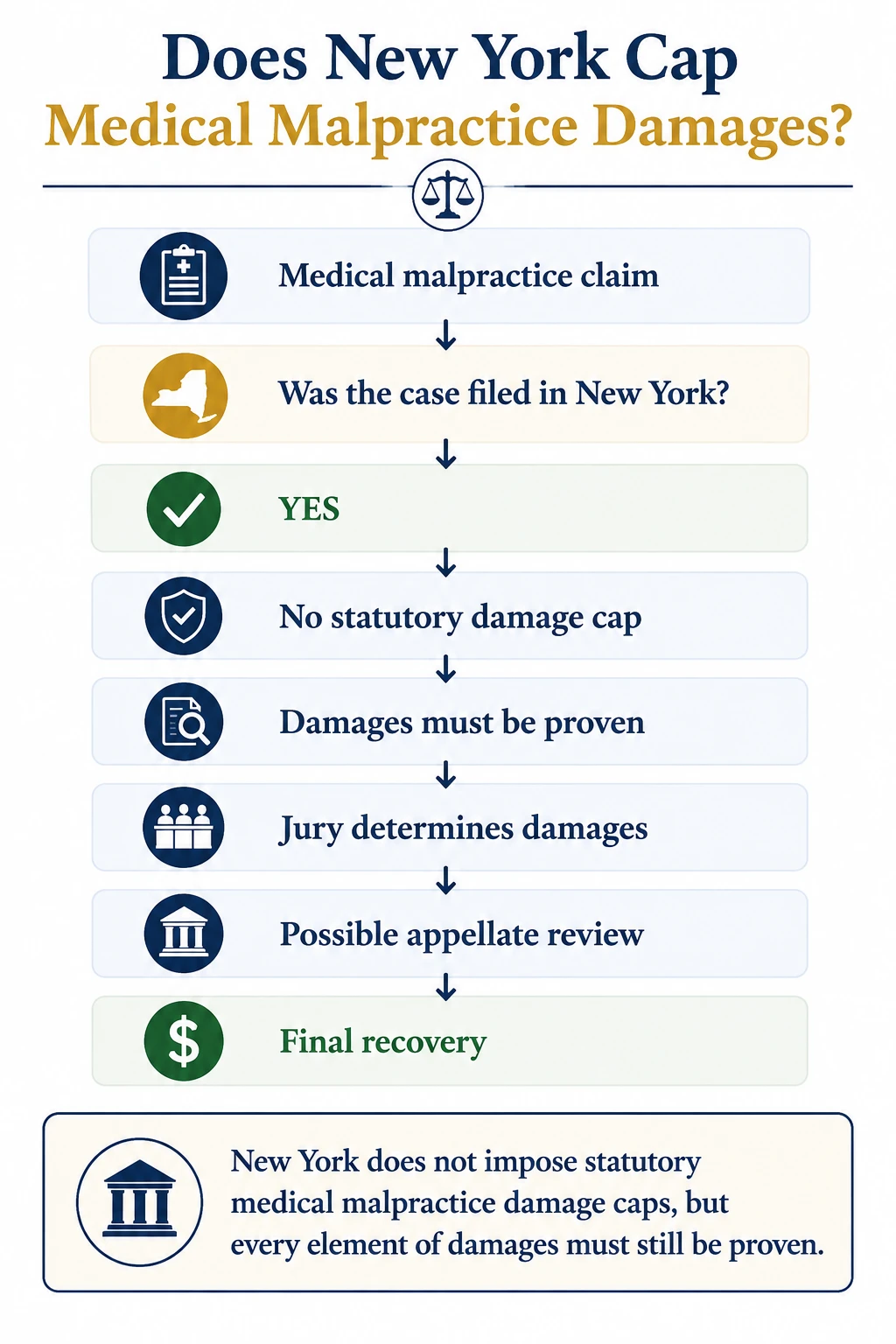
New York does not impose statutory medical malpractice damage caps, but every element of damages must still be proven.
Many people research medical malpractice online and encounter articles discussing damage caps in states such as California, Texas, or Florida. Because search results often combine information from multiple states, it is easy to assume those rules apply everywhere. New York follows its own laws and does not impose statutory caps on damages in medical malpractice cases.
New York does not cap damages in medical malpractice cases. While there is no cap on damages, the injured plaintiff bears the burden of proving all elements of damages by a preponderance of the evidence.
The absence of a damage cap does not mean that jury verdicts are unlimited or based on speculation. In every medical malpractice case, the injured person must prove the nature and extent of the claimed damages through competent evidence.
Evidence regarding the patient’s injuries, pain and suffering, medical expenses, lost income, future medical needs, and other legally recoverable damages helps the jury determine appropriate compensation. The plaintiff bears the burden of proving those damages by a preponderance of the evidence.
Even after a jury returns a verdict, New York law provides for appellate review. If an appellate court concludes that a damages award materially deviates from what would be reasonable compensation, it may reduce or otherwise modify the award in accordance with applicable law. As a result, the absence of a statutory damage cap does not mean there are no legal safeguards governing damage awards.
No. Damage caps and settlement negotiations are different concepts.
A settlement is a voluntary agreement reached between the parties to resolve a claim without asking a judge or jury to decide the outcome. The amount of a settlement is determined through negotiation and reflects the parties’ evaluation of the evidence, the claimed damages, the risks of litigation, and other case-specific considerations.
Because New York does not impose statutory medical malpractice damage caps, settlement amounts are not limited by a statutory maximum. Instead, each settlement depends on the unique facts of the case and the agreement reached by the parties.
Yes. Laws can change over time through legislation or court decisions.
At present, New York does not impose statutory damage caps on medical malpractice claims. While future legislative changes are always possible, any such changes would depend on action by the New York Legislature and, when applicable, interpretation by the courts.
Anyone pursuing a medical malpractice claim should rely on the law in effect at the time their case is being evaluated rather than assumptions based on proposed legislation or the laws of other states. Because laws can change over time, individuals should rely on current New York law rather than older articles or information describing proposed legislation.
New York law applies to New York medical malpractice cases. Damage caps in other states are not relevant to New York damage analysis or case valuation.
Yes. States that have medical malpractice damage caps do not all use the same approach.
Some states place limits on non-economic damages, such as pain and suffering. Others limit punitive damages, while some impose broader limitations that may affect different categories of damages. The amount of any cap, the claims to which it applies, and the exceptions recognized by law vary significantly from state to state. Those laws do not govern medical malpractice claims arising in New York. When evaluating a New York case, it is important to rely on New York law rather than information describing damage caps in other jurisdictions.
No statutory malpractice damage cap
Some states limit certain damages
Damages proved through evidence
Recovery may be limited by statute
Jury evaluates damages
Statutory damage limits may affect the amount ultimately recoverable
Appellate review still applies
Statutory caps may also apply
While New York does not impose statutory damage caps, every claim must still be supported by evidence establishing the nature and extent of the damages being sought.
The damages sought in a New York medical malpractice case depend on the specific facts of the case and the injuries that can be proven. Broadly speaking, they generally fall into two categories:
Economic damages compensate for measurable financial losses and may include:
Non-economic damages compensate for the personal effects of the injury and may include:
Depending on the circumstances, damages may also include losses such as lost parental guidance, lost household services, lost employment benefits, or other legally recoverable damages recognized under New York law. Every case is unique, and the available damages depend on the evidence and the specific facts presented.
The biggest fear for someone comparing notes online is assuming a cap applies here when it does not, or assuming there’s a formula when there isn’t one. Here is what actually drives value.
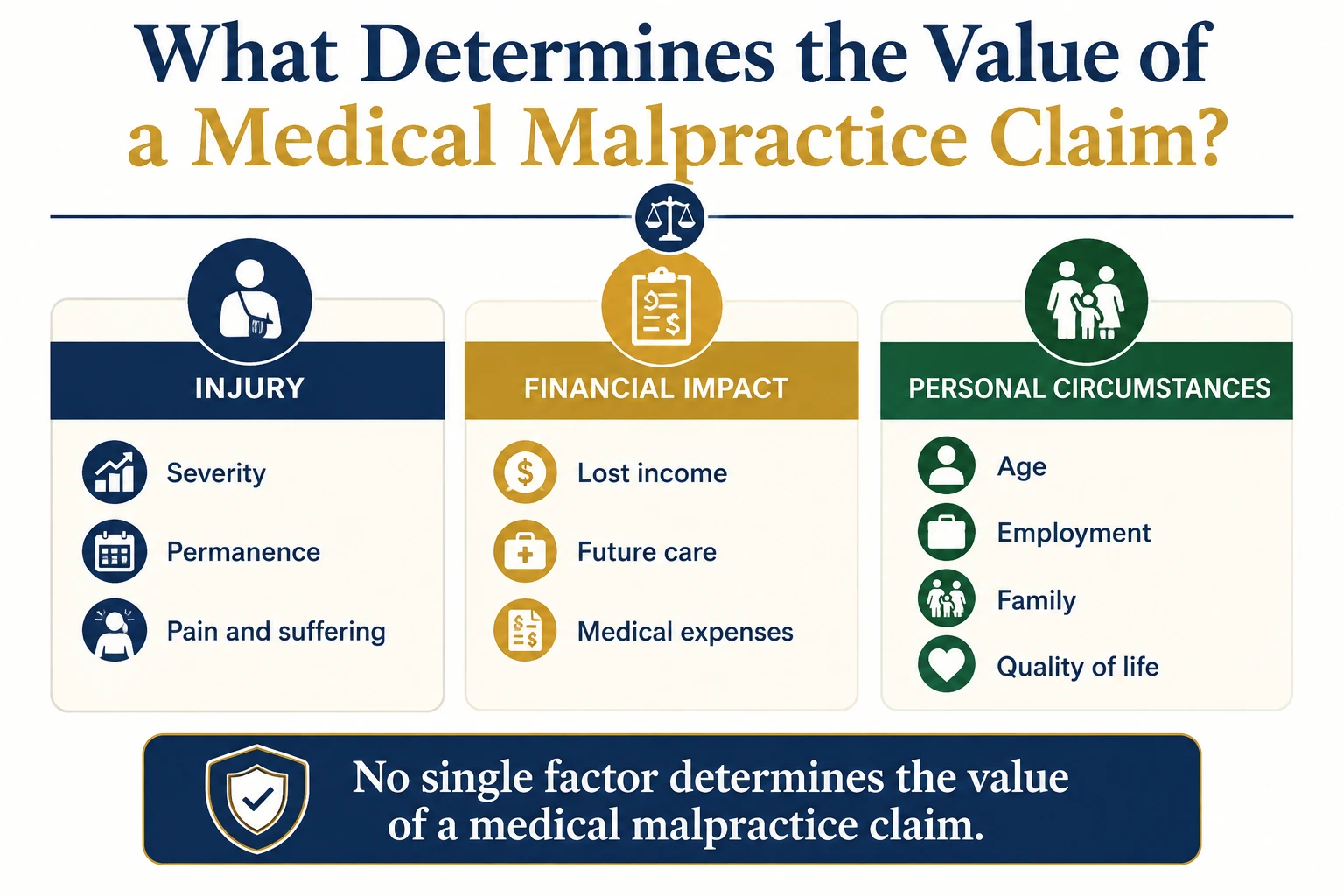
No single factor determines the value of a medical malpractice claim.
Damage caps
New York has none for medical malpractice. Figures from other states do not apply here.
Major permanent injury
Generally valued higher than a major temporary injury.
Major temporary injury
Generally valued higher than a minor permanent injury.
Minor permanent injury
Generally valued higher than a minor temporary injury.
Age, marital and employment status, children
All factor into the overall value of a claim beyond medical bills alone.
Appellate review
A jury verdict can still be reduced if a court finds it materially deviates from reasonable compensation.
When valuing a claim, a major permanent injury usually has more value than a major temporary injury, a major temporary injury usually has more value than a minor permanent injury, and a minor permanent injury usually has more value than a minor temporary injury. As every person is unique, damages must be valued on a case-by-case basis.
Overall value in a medical malpractice case is driven by the age of the injured patient, his or her marital status, his or her employment status, whether the injured patient has children, whether the injured patient has experienced pain and suffering, and whether the injured patient needs future medical care.
There is no fixed limit on a recovery for medical malpractice in New York. However, a jury verdict can be appealed to a court that can reduce the verdict if the appellate judges believe the verdict materially deviates from reasonable compensation.
Use this checklist to think through how your case may be valued:
Since New York does not use a fixed formula or a damage cap, the biggest fear is relying on outside information that simply does not apply here. Here is what actually goes into understanding a case’s value:
You do not need a formula to understand what your case may be worth. The next step is a conversation with an attorney who can walk through these factors with your specific situation.
New York has no statutory malpractice damage cap.
Every element of damages must still be proven.
Many additional factors influence value.
Every case is evaluated individually.
Appellate courts may reduce awards that materially deviate from reasonable compensation.
New York does not impose statutory damage caps, but every claim must still be supported by evidence.

Michael Bottar is a nationally recognized New York medical malpractice and personal injury attorney and the founder of Bottar Law. Throughout his career, he has dedicated his practice to representing individuals and families affected by medical negligence, catastrophic injuries, wrongful death, and other serious acts of negligence. Michael is committed to helping clients understand their legal rights, navigate the complexities of the legal system, and pursue accountability with compassion, integrity, and unwavering advocacy.
For more than 40 years, Bottar Law has represented individuals and families throughout Syracuse, Central New York, and across New York in complex medical malpractice litigation involving catastrophic injuries and wrongful death. Through educational resources like these FAQs, Michael Bottar and the Bottar Law team strive to provide clear, reliable information to help injured individuals and their families make informed decisions during difficult times. Prior results do not guarantee a similar outcome.
Speak with Bottar Law about the factors that actually drive value in a New York malpractice claim.