 Call833-268-8277

Understand how permanent medical injuries are evaluated, which damages may be recoverable, and how experts document long-term medical, functional, vocational, and financial consequences.
Attorney reviewed · New York focused · Updated resource
The evidence must connect a departure from accepted medical care to the lasting harm.
Yes. If a healthcare provider departed from the accepted standard of care or was a substantial factor in a permanent injury, the injured patient may be able to pursue compensation under New York law. Every case is different, but legally recoverable damages may include medical expenses, lost income or reduced earning capacity, future care needs, pain and suffering, and other supported losses. An experienced medical malpractice attorney can evaluate the medical evidence and explain the legal options that may be available.
Permanent medical injuries may affect a person’s health, independence, ability to work, family responsibilities, and need for future care. Evaluating a potential claim therefore requires more than identifying the diagnosis. Attorneys and qualified experts must assess how the injury occurred, whether it is expected to remain permanent, and how it may affect the injured person over time.
Permanent injuries caused by medical negligence may support a medical malpractice claim when a healthcare provider departed from the accepted standard of care and that departure caused or was a substantial factor in causing the patient’s permanent injury. Every case depends on its own facts and the available medical evidence.
To pursue a medical malpractice claim, it is generally not enough to show that a permanent injury occurred. Qualified medical evidence must support both that the healthcare provider departed from the accepted standard of care and that the departure caused or was a substantial factor in causing the patient’s lasting condition. An experienced medical malpractice attorney can work with qualified medical experts to evaluate whether these legal requirements may be satisfied under New York law.
Medical malpractice can result in many different types of permanent injuries when a healthcare provider’s departure from the accepted standard of care causes lasting harm. Every case is unique, and the nature and severity of the injury depend on the specific medical circumstances.
Examples of permanent injuries that may result from medical malpractice include:
Whether a particular injury supports a medical malpractice claim depends not only on the severity of the injury, but also on whether qualified medical evidence establishes that a healthcare provider departed from the accepted standard of care and that the departure caused or was a substantial factor in causing the patient’s permanent injury.
Determining whether a permanent injury was caused by medical negligence requires a careful review of the patient’s medical history, the treatment that was provided, and the medical condition that followed. Attorneys and qualified medical experts compare the patient’s condition before the alleged malpractice with the course of treatment and the outcome that ultimately occurred.
As part of that review, they generally evaluate:
After reviewing the available medical records and other evidence, qualified medical experts evaluate whether the healthcare provider’s departure from the accepted standard of care caused or was a substantial factor in causing the patient’s permanent injury. This analysis helps determine whether the legal requirements for a medical malpractice claim may be satisfied under New York law.
When a medical error results in a permanent injury, an injured patient may be entitled to seek compensation for future medical care and other long-term needs that are reasonably expected to result from the injury. Future damages generally must be supported by evidence showing that the anticipated treatment, services, or assistance will likely be necessary because of the permanent injury.
Depending on the circumstances, future needs may include:
Medical treatment
Surgery, specialist care, therapy, medication, and ongoing medical monitoring
Personal assistance
Home health aides, skilled nursing, and attendant care
Medical equipment
Wheelchairs, prosthetics, communication devices, mobility aids, and other assistive technology
Home and transportation
Accessibility modifications, adaptive equipment, and modified vehicles
Rehabilitation
Physical, occupational, speech, or cognitive therapy
Long-term planning
Life care planning and other services used to evaluate future medical and personal care needs
To evaluate these future losses, attorneys often work with qualified medical experts, life care planners, economists, and other specialists who assess the nature of the permanent injury and estimate the cost of future care over the patient’s expected lifetime. Their opinions help ensure that future care needs are supported by reliable medical and economic evidence rather than speculation.
Under New York law, damages in a medical malpractice case may include categories such as medical expenses, impairment of earning ability, and pain and suffering. In some cases, future damages may also be subject to specific statutory rules governing how those damages are awarded or paid.
A permanent injury can affect far more than a person’s physical health. It may change the individual’s mobility, independence, ability to work, relationships, daily routines, and ability to participate in activities they previously valued. These losses are evaluated through evidence showing how the injury has affected the person’s life both now and in the future.
Depending on the circumstances, that evidence may include:
Together, this evidence helps demonstrate the full impact of a permanent injury when evaluating damages in a medical malpractice case. Depending on the facts, damages may include both economic losses, such as medical expenses and lost earning ability, and non-economic losses, such as pain and suffering and the loss of enjoyment of life, as permitted under New York law.
Medical malpractice can result in permanent injuries in many different healthcare settings. Examples include delayed diagnosis of cancer, surgical errors, birth injuries, medication errors, failure to diagnose or promptly treat infections or strokes, anesthesia errors, and delayed treatment of other serious medical conditions.
Whether a permanent injury supports a medical malpractice claim depends on the specific facts of the case. The key question is not simply whether a serious injury occurred, but whether qualified medical evidence establishes that a healthcare provider departed from the accepted standard of care and that the departure caused or was a substantial factor in causing the patient’s permanent injury.
An experienced medical malpractice attorney can work with qualified medical experts to evaluate the medical records, determine whether the accepted standard of care was met, and assess whether the legal requirements for a claim may be satisfied under New York law.
Permanent injury cases may involve input from several different types of experts, each providing opinions within their area of expertise. Depending on the facts of the case, these experts may assist in evaluating both the medical consequences of the injury and its long-term financial impact.
Not every medical malpractice case requires every type of expert. The experts involved depend on the nature of the injury, the issues in dispute, and the evidence needed to evaluate the patient’s long-term medical, personal, and financial needs.
Medical specialist
Evaluates how the injury occurred, whether the healthcare provider departed from the accepted standard of care, whether that departure caused or was a substantial factor in causing the injury, and the patient’s prognosis.
Rehabilitation specialist
Assesses the patient’s functional limitations, rehabilitation needs, and anticipated therapy requirements.
Life care planner
Develops a comprehensive plan outlining the patient’s anticipated long-term medical care, equipment, support services, and related needs.
Vocational expert
Evaluates how the permanent injury affects the patient’s ability to work, earn income, or perform occupational duties.
Economist
Calculates the projected financial impact of the injury, including future medical costs and other economic losses supported by the evidence.
Learning that a medical injury may be permanent can be overwhelming. Many people worry not only about their current health, but also about how the injury will affect their future, their independence, and their family’s well-being. They often have questions such as:
These concerns are common and often arise long before families know whether they have a legal claim. Understanding the full long-term impact of a permanent injury is an important part of evaluating both medical needs and legal options. Attorneys may work with qualified medical experts, life care planners, vocational experts, and other professionals to better understand how the injury may affect a person’s future, helping individuals and families make informed decisions based on reliable medical and financial information.
At Bottar Law, we believe it is important to understand the full impact of a permanent injury before making significant legal decisions. Every case begins with a careful review of the available medical records, the patient’s medical history, current condition, and the circumstances surrounding the alleged medical negligence.
As part of that evaluation, our team works to understand the person’s present limitations, expected prognosis, anticipated medical treatment, ability to work, need for assistance at home, and the ways the injury has affected daily life and future independence. This comprehensive review helps ensure that both the immediate and long-term consequences of the injury are carefully considered.
When appropriate, Bottar Law consults with qualified medical specialists, life care planners, vocational experts, economists, and other professionals to better understand the medical, functional, and financial impact of a permanent injury. This information helps clients make informed decisions about settlement discussions or litigation based on a thorough evaluation of the available evidence and their long-term needs.
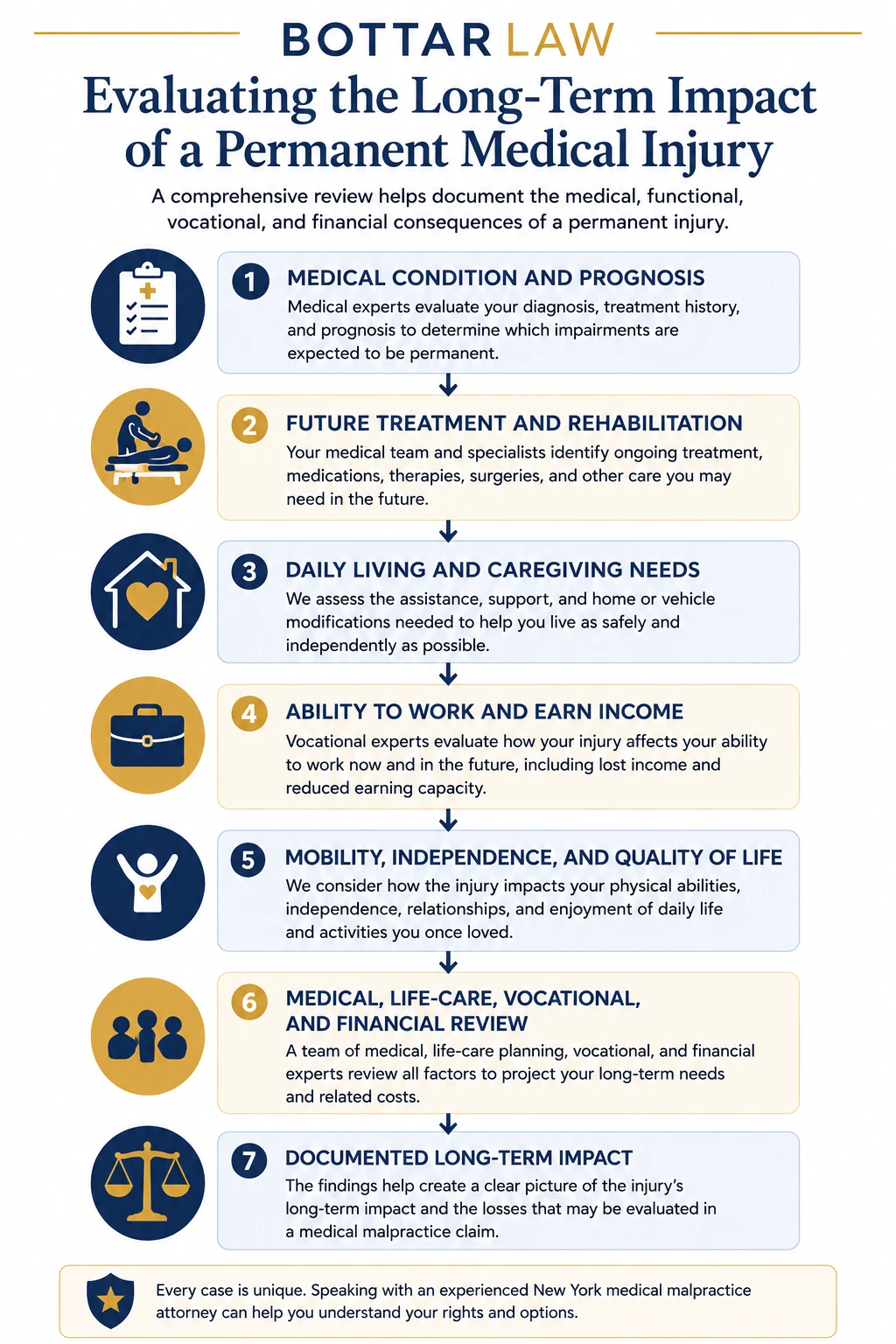
Evaluating the long-term medical, functional, vocational, and financial impact of a permanent injury.
Determining whether an injury is permanent requires a careful medical evaluation based on the patient’s diagnosis, treatment history, recovery, and expected prognosis. In many cases, medical experts review the available evidence to determine whether the patient’s condition is likely to improve with additional treatment or whether lasting impairments are expected to remain.
Depending on the circumstances, medical experts may evaluate:
In some cases, the full extent of a permanent injury cannot be determined immediately. Medical experts may recommend allowing additional time for treatment or recovery before offering an opinion about permanency. When appropriate, a treating physician, an independent specialist, or another qualified medical expert may provide an opinion regarding which impairments are expected to continue and how they may affect the patient’s future health, daily activities, ability to work, and long-term care needs.
Establishing that an injury is permanent does not, by itself, establish medical malpractice. Qualified medical evidence must also support that a healthcare provider departed from the accepted standard of care and that the departure caused or was a substantial factor in causing the permanent injury.
If you believe a medical error caused a permanent injury, it is important to speak with an experienced medical malpractice attorney as soon as possible. A lawyer can obtain the necessary medical records, arrange for an independent expert review, explain the applicable legal deadlines, and determine whether you may have a medical malpractice claim. Seeking legal guidance early can help preserve important evidence and provide clarity about your options.
A permanent or life-changing injury does not, by itself, establish medical malpractice. The evidence generally must show that a healthcare provider departed from the accepted standard of care and that the departure caused or was a substantial factor in causing the patient’s permanent injury.
Depending on the facts of the case, a medical malpractice claim may also seek compensation for reasonably anticipated future medical treatment, rehabilitation, long-term care, impairment of earning ability, pain and suffering, and other losses supported by the evidence.
It is often beneficial to seek legal advice promptly. Early legal review can help preserve important evidence, identify applicable deadlines, and begin the process of obtaining medical records and expert review. The patient’s long-term prognosis and future care needs can continue to be evaluated as the investigation progresses.
A person may have a permanent impairment even if they are able to work, live independently, or continue some of their previous activities. Whether a claim exists depends on the nature of the injury, the available medical evidence, and whether the legal requirements for medical malpractice can be established.
A medical opinion regarding permanency is an important part of evaluating a claim, but it does not determine the outcome of a case. The value of a medical malpractice claim depends on many factors, including whether liability can be established, whether the provider’s conduct caused or was a substantial factor in causing the injury, the nature and extent of the damages, and the specific facts and evidence in the case.
A complete evaluation should account for the injury’s long-term medical, personal, vocational, and financial impact.

Michael Bottar is a nationally recognized New York medical malpractice and personal injury attorney and the founder of Bottar Law. Throughout his career, he has dedicated his practice to representing individuals and families affected by medical negligence, catastrophic injuries, wrongful death, and other serious acts of negligence. Michael is committed to helping clients understand their legal rights, navigate the complexities of the legal system, and pursue accountability with compassion, integrity, and unwavering advocacy.
For more than 40 years, Bottar Law has represented individuals and families throughout Syracuse, Central New York, and across New York in complex medical malpractice litigation involving catastrophic injuries and wrongful death. Through educational resources like these FAQs, Michael Bottar and the Bottar Law team strive to provide clear, reliable information to help injured individuals and their families make informed decisions during difficult times. Prior results do not guarantee a similar outcome.
Speak with Bottar Law about the medical evidence, long-term needs, damages, legal deadlines, and options that may apply under New York law.